( Last updated 2024/11/10 - The estate of Paul Marmet
)
About the Author
Paul Marmet, Ph. D. (1932-2005)
From 1990 to 1999, Paul Marmet was assistant professor in the
physics department of the University of Ottawa. He was a
senior researcher at the Herzberg Institute of Astrophysics of the
National Research Council of Canada, in Ottawa, from 1983 to
1990. From 1967 to 1982, he was director of the laboratory for
Atomic and Molecular Physics at Laval University in Québec
City.
A past president of the Canadian Association of Physicists
(1981-1982), he also served as a member of the executive committee
of the Atomic Energy Control Board of Canada from 1979 to
1984. Marmet was elected Fellow of the Royal Society of Canada
in 1973 and was made an Officer of the Order of Canada in
1981. The Order of Canada is the highest decoration bestowed
by the Canadian government.
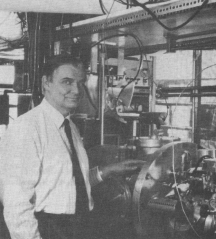
The
Author's Electron Beam Device. Paul Marmet (Who's Who)
is shown here at the Herzberg Institute of Astrophysics in Ottawa
with the electron spectrometer he pioneered. The spectrometer
developed during his Ph. D. thesis (1960) produces a very low-energy
monoenergetic electron beam (0 to 100eV) in vacuum which is used to
study the internal structure of atoms and molecules. This
spectroscopic technique uses a beam of monoenergetic electrons
instead of photons used by most spectroscopists. As in other
electron beam devices, the free electrons are produced by heating a
filament in high vacuum. Just after emission, electrons in
such a beam vary in their individual energies by 1eV or more.
In Marmet's spectrometer, the spread of electron energies is reduced
to 10mV so that the results of the interaction provide information
with a resolution improved by a factor of 100. Also, an
electrodynamic quadrupole mass spectrometer with hyperbolic
electrodes is used instead of a magnetic analyser, since the
sensitive electron source requires a magnetic-field free
environment. The ion current is measured counting individual
ions.
In the ion source, the electron beam is crossed with a
collimated beam of atoms or molecules directed at right angle.
The number of ions produced in the resulting interactions is
measured as a function of the electron energy, and provides the
information about the electron configuration in the atoms and
molecules. The energy of the electron beam gives the absolute
energy of the quantum state.
The advantages of using an electron beam instead of photons
are multiples. Since photons do not carry electric charges,
they cannot produce directly negative ions. The absence of an
electric charge in photons is responsible for the fact that most of
the negative ions have not been studied extensively. The
energy of excited negative ion states is a very undeveloped field in
physics. These negative ions are however very important in the
experiments in plasma physics.
Using this electron beam, this instrument measures multiple
electronic states of negative ions of hydrogen, helium, nitrogen,
oxygen, all the halogens and also numerous diatomic molecules like
carbon monoxide, methane, and many others. Even doubly or
triply excited states of negative ions can be measured and
identified. For example, using that electron beam, this
instrument was used to discover and measure negative helium ions
with all three electrons in an excited state [i.e. He-(2s22p)].
These short-lived quantum states cannot be measured using photon
spectroscopy. It was also interesting to measure different
quantum states (and their half-life) of negative diatomic argon
molecules and all other inert gases, which remain stable long enough
to be measured in the mass-spectrometer. Using that
monoenergetic electron beam, several hundred states have been
discovered in numerous atoms and molecules. Finally, using the
filtering power of the mass spectrometer, several free radicals have
been studied. Marmet
and
his
mentor,
Larkin Kerwin, described their pioneer work on this electron
source in Citation Classics (Nov. 23, 1987). More than 100
scientific papers of spectroscopic data and
interpretations have been published on this subject.
Furthermore, about 200 other papers have been presented in numerous
international and national meetings.
Between 1978 and 1998, the author also published several
other papers related to the fundamental principles in physics.
Several of these papers are presented on this web site.
In
1997-99,
physicists
of
the
establishment
showed
fierce disagreement with the fact that Marmet’s research implied
that the fundamental principles of physics were being
questioned. [...] Physics is not only a science, it is a
doctrine. Therefore, there are heretics.
Paul Marmet
Obituary
Paul Marmet, Ph. D. (1932-2005)
May
2005
On May 20th 2005, Paul Marmet passed away in
Ottawa after complications due to bone marrow cancer. Dr.
Marmet was a retired assistant professor at the Physics Department
of the University of Ottawa. He was formerly a Senior
Researcher at the Herzberg Institute of Astrophysics of the
National Research Council of Canada in Ottawa. From 1967 to
1982, he co-founded and directed the laboratory for Atomic and
Molecular Physics where he was full professor at l'Université
Laval in Québec City. In 1967, he spent his sabbatical in
the department of chemistry at l'Université de Liège in
Belgium. In 1961, Dr. Marmet spent a year at the CSIRO
Melbourne, Australia to work on negative ions. He developed
an electron selector which played a major role in high resolution
electron beam spectroscopy.
A past president of the Canadian Association of Physicists
(1981-2), he also served as a member of the executive committee of
the Atomic Energy Control Board of Canada. Dr. Marmet has
been elected Fellow of the Royal Society of Canada and was made an
Officer of the Order of Canada. He was awarded the Herzberg
prize, the Rutherford prize, the Parizeau medal and a Service
Award from the Royal Astronomical Society of Canada. He is
the author of over a hundred journal papers, four books and 200
presentations at scientific meetings.
At l'Université Laval, he worked with his mentor Larkin
Kerwin on studies of the interaction of low-energy electrons at
surfaces. This enabled him to develop a high resolution
electron selector - 10 meV resolution with beam energy ranging
from 0.5 eV to 100 eV. Multiple electronic states of
negative ions were measured: hydrogen, helium, nitrogen, oxygen,
all the halogens and numerous molecules. Even doubly or
triply excited states of negative ions were measured and
identified. Several hundred states which are not accessible
via optical transitions have been discovered in numerous atoms and
molecules. Finally, using the filtering power of a mass
spectrometer he developped, several free radicals were
studied. His electron selector was widely used in electron
scattering studies which led to several discoveries such as
enhanced vibrational excitation in nitrogen and the first Feshbach
resonance in helium. The experimental system he developed
was able to detect negative ions in the ionization efficiency
curve. His design remains among the most popular in use
today.
His interest in astronomy led him to study the numerous
anomalies observed by astronomers, especially the inconsistent
redshifts reported in the works of H. Arp. To explain these
anomalies, Dr. Marmet suggested that an energy loss mechanism
resulting from dipole emission could leave the same signature on
spectral absorption lines as the Doppler redshift. The
dipole is created by momentum transfer of a photon in its
interaction with a single molecule in a low density gas.
Observations of massive quantities of molecular hydrogen by the
European Space Agency's Infrared Space Observatory confirms there
is enough interstellar gas to support his hypothesis that the
cosmological redshift is not entirely of Doppler origin. The
mechanism still waits for a detailed quantum mechanical
development and experimental verification in the laboratory.
He also proposed other models to explain non-intuitive quantum
mechanical phenomena and relativity. He is said to be a
strong critic and a mighty rebel in physics. He leaves many
incomplete ideas and many colleagues still wishing to discuss with
him.
He will be missed as a good experimentalist and also as my father.
Louis Marmet
Institute for National Measurement Standards
National Research Council, Ottawa
Canada
Canadian Who's Who
2001 Edition
MARMET, Paul, O.C., D.Sc.; physicien, éducateur; né Lévis,
Qué. 20 mai 1932; f. Albert et Corinne (Filteau) M. (décédés); e.
Univ. Laval B.Sc. 1956, D.Sc. 1960; CSIRO Melbourne, Australia
Postdoctoral 1960-61; ép. Jacqueline f. Albert Côté (dé.) 6 Juin
1959; enfants: Louis, Marie, Nicolas, Frédéric; Prof Adjoint, Dept.
Physique Université d'Ottawa 1991-99; enseignement en Physique,
Coll. Univ. Laval 1958-60; Asst. de recherche CSIRO, Melbourne,
Australia 1960-61; prof. auxiliaire, Univ. Laval 1961, prof. agrégé
1966, prof. chercheur 1974-77, prof. titulaire 1970-84; Agent de
recherche senior, Institut Herzberg d'astrophysique, Conseil
National de recherches 1984-91; Dir. du Lab. de Physique Atomique et
Moléculaire 1967-82; année sabbatique au service de Chimie,
Université de Liège, Belgique 1967; mem. co-fondateur du Centre de
recherche sur les atomes et les Molécules (CRAM), bureau de
direction 1967-69; mem. du Comité de subventions du Gouvernement du
Qué. 1975; Comité des Subventions-Physique du C.N.R.C. 1971-74,
représentant Canadien, Union Internationale de Physique pure et
appliquée 1976-79; Comité d'Organisation des IPEAC Paris 1977 et
Tokyo 1979 (Organisateur du IV Congrès International de la Physique
des Collisions Atomiques et Ioniques, Qué. 1965); Officier de
l'Ordre du Canada, 1981; Médaille Herzberg de l'Assn. Canadienne des
Physiciens 1971; Prix Rutherford de la Société Royale du Can. 1960;
Médaille Pariseau (ACFAS) 1976; Service Award Soc. Royale
d'Astronomiedu Can.; Prix Concours Scientifique de la Prov. de Qué.
1962; Bourse Post-doctorale du CNRC Melbourne 1960, 3 bourses
graduées 1957-59; co-auteur High Resolution Electron Beams
and their Applications 1969; Auteur A New Non-Doppler
Redshift 1981; Absurdities in Modern Physics: A
Solution 1993; Einstein's Theory of Relativity versus
Classical Mechanics 1997; articles nombreux; mem, Conseil
de Dir., Commn. de Contrôle de l'Énergie Atomique du Can. 1979-84;
mem. Société Royale du Canada; Assn. Canadienne des Physiciens Vice
Prés. 1979-81, Prés. 1981-82; Am. Phys. Soc.; Soc. Royale
d'Astronomie du Canada;
Canadian Who's Who
10 St. Mary Street, Suite 700,
Toronto, Ontario
Canada, M4Y 2W8
List of Papers Published
by Paul Marmet
"Perfectionnement
d'un
sélecteur d'électrons et étude de quelques ions
moléculaires" P. Marmet. Ph.D. Thesis, Université
Laval (1960)
"An Improved Electrostatic
Electron Selector" P. Marmet and Larkin Kerwin. Can. J. Phys. 38, 787 (1960)
"Experimentally Measured
Vibrational Levels in H2+" P. Marmet and L. Kerwin. Can. J. Phys. 38, 972 (1960)
"Recent Appearance
Potential Using an Electrostatic Electron Selector" Larkin Kerwin and P. Marmet. Can.
J. Phys. 31, 12 (1960)
"The Identification of
Vibrational Levels in H2" L. Kerwin, P. Marmet
and E.M. Clarke. Can J. Phys. 39,
1240 (1961)
"A Mass Spectrometer for
Ionization Efficiency Studies using an Electron Velocity
Selector" P. Marmet and J.D.
Morrison. J. Chem. Phys. 35,
746 (1961)
"Secondary Reactions in the
Ion Chamber of a Mass Spectrometer" P. Marmet and J.D.
Morrison. J. Chem. Phys. 36, 1238
(1962)
"Neutralization of Fringing
Fields in the Ion Source of a Mass Spectrometer" P. Marmet, J.D.
Morrison and D.L. Swingler. Rev.
Sci. Instr. 33, 239 (1962)
"Recent Work with the
Electrostatic Electron Selector" L.
Kerwin, P. Marmet and E.M. Clarke. Advances
in Mass Spectrometry, Volume 2
Pergamon Press, Oxford (1962)
"Opération
d'un filtre de masse quadrupolaire en condition optimum" P. Marmet et P.
Marchand. Can.
J. Phys. 42, 1914 (1964)
"Effet des
charges d'espace électronique sur les courbes de
probabilité d'ionisation des gaz" P.
Marmet. Can. J. Phys. 42, 2102
(1964)
"Near 100% Efficiency Ion
Detector for use with Quadrupole Mass Filter" P. Marchand,
C. Paquet and P. Marmet. Rev. Sci. Inst. 37, 1702 (1966)
"Simple System for
Photoelectron Spectrum Determination" P.
Marmet, P. Natalis and A.
Dumont. Rev. Sci. Inst. 39, 683
(1968)
"New Type of Monovelocity
Electron Source" Paul Marmet. Rev. Sci. Inst. 39, 1932
(1968)
"Threshold Behavior of the
Cross Section for Ionization of He and Ar by Monoenergetic
Electrons" P. Marchand, C. Paquet and P. Marmet. Phys. Rev. 180 123 (1969)
"High Resolution Electron
Beams and their Applications" L.
Kerwin, P. Marmet and J.D. Carette. Case
studies in Atomic Collisions Physics, Edited
by
E. W. McDaniel and M. R. C. Mc Dowell, North Holland Pub.
Company (1969)
"Quadrupole Mass Analyzers"
P. Marmet. J. Vac. Sci. Technol. 8, 262 (1971)
"Formation de O- de NO par impact électronique" C. Paquet, P.
Marchand and P. Marmet. Can. J. Phys. 49, 2013(1971)
"Natural Line Shapes
Resolved in the Ionization Yield of He below
the n=2 Threshold" J.J.
Quémener, C. Paquet and P. Marmet. Phys. Rev. A4, 494 (1971)
"Electron-Impact Excitation
of 3s3p nl States of Ar" E.
Bolduc, J.J. Quémener and P. Marmet. Can.
J. Phys. 49, 3095 (1971)
"Energy Analyzer for
Charged Particles" P.
Marmet. Canadian Patent Office
No: 905567 July 18, 1972
"Autoionizing and Negative
Ion States of Xe and Kr below the P
Limits" P. Marmet, E. Bolduc and
J.J. Quémener. J. Chem. Phys.
56, 3463 (1972)
"Autoionizing 2s 2p 3s3l
States of Ne and Related Ne Resonances"
E.
Bolduc, J.J. Quémener and P. Marmet. J.
Chem. Phys. 57, 1957 (1072)
"Autoionizing
levels of N2 converging to the AΠu and BΣu limits"
R.
Carbonneau and P. Marmet. Int. J. Mass Spectrom. Ion Phys.
10, 143 (1972)
"New Large Aperture Energy
Analyzer" P. Marmet. Rev. Sci. Instr, 44, 67 (1973)
"Properties of a New
Non-Differentiating Treatment of Experimental Data" R.
Carbonneau, E. Bolduc and P. Marmet. Can. J. Phys. 51, 505
(1973)
"Negative and Neutral
Autoionizing States Detected in the Electroionization
Curves in CO" R.
Carbonneau and P. Marmet. Can. J. Phys. 51, 2202 (1973)
"Theoretical and
Experimental Line Profiles of Autoionizing States as
Reflected in their Electroionization Curve" E. Bolduc and P. Marmet. Can. J. Phys. 51, 2108 (1973)
"Electroionization Spectrum
of O2" R.
Carbonneau and P. Marmet.
Phys. Rev. A9, 1898 (1974)
"Optimizing Ion Injection
Phase in Quadrupole Mass Filters" D.
Lefaivre and P. Marmet. Rev. Sci. Inst. 45, 1134 (1974)
"The Electroionization
Spectrum of Nitric Oxide" R. Carbonneau and P. Marmet.
Can. J. Phys. 52, 1885(1974)
"Ionization dissociative de
N2"
H. Wankenne, E.
Bolduc
and P. Marmet. Can. J. Phys.
53, 770 (1975)
"Relative Cross Section in
Electroionization" P.
Marmet. J. Chem. Phys. 63, 249
(1975)
"Electron Excitation of Ar
Between 26 and 34 eV" D. Lefaivre
and P. Marmet. Int. J. Mass
Spectrom. and Ion Phys. 18, 153 (1975)
"Resonance in the Total
Electron Impact Excitation Cross Section of Metastable
States of Helium Near 60 eV" E. Bolduc and P.
Marmet. J. Phys. B8, 1241 (1975)
"Excitation de
l'argon par impact électronique entre 43 et 60 eV" P.
Marmet, E. Bolduc and J.J. Quémener. Can. J. Phys. 53, 2438 (1975)
"Atomic Structure in Kr
between 22 and 32 eV" M.
Valin and P. Marmet. J. Phys. B8, 2953 (1975)
"Comparison of Techniques
for Extracting Signals from Strong Background" H. Arsenault and
P. Marmet. Rev. Sci. Inst. 48,
512 (1977)
"On the Subject of
Displaced Thresholds" P.
Marchand, P. Veillette and P. Marmet. J.
Chem. Phys. 67, 2908 (1977)
"Ionization and
Dissociative Ionization of CO by
Electron
Impact" N. Bussières and P. Marmet, Can.
J. Phys. 55, 1899 (1977)
"Formation du
néon métastable entre 42 et 46 eV" D. Huard, P.
Marmet and E. Bolduc. Can. J.
Phys. 56, 82 (1978)
"On the Heat of formation
of CS" M.-J. Hubin-Franskin, D. Huard and P. Marmet. Int. J. Mass Spectrom. and Ion
Phys. 27, 263 (1978)
"New Digital Filter for the
Analysis of Experimental Data" P.
Marmet. Rev. Sci. Instr. 50, 79
(1979)
"Electroionization of D2O
and H2O and Study of Fragments Hand
OH" D.
Lefaivre and P. Marmet. Can. J. Phys. 56, 1549 (1978)
"Excited States of CH4 and CD4 between 18
and 22 eV" P. Marmet and L.
Binette. J. Phys. B:
Atom. Molec. Phys. 11, 3707 (1978)
"Excitation and Ionization
of OCS and CS by Electron
Impact" M.-J. Hubin-Franskin, P.
Marmet and D. Huard. Int. J. Mass Spectrom. Ion Phys. 33, 311
(1980)
"Ionization Energies of Xe2+and Xe3+" R. Dutil
and P. Marmet. Int. J. Mass Spectrom. and Ion Phys. 35, 371(1980)
"Political Action and the
ACP" <<Actions politiques et l'ACP>> P.
Marmet, President, Canadian
Association of Physicists, Physics
in
Canada, Vol. 37 No: 5, P. 99-102, Septembre 1981. In the
same issue, page 103, Profile of the President: Paul
Marmet
"A New Non-Doppler
Redshift" P. Marmet. Book:
Physics Dept. Laval University, Québec June 1981 (64pages)
"Simple and Efficient
Mono-Energetic Electron Source" M.
Proulx, P. Marmet and R.
Dutil. Rev. Sci. Inst. 53, 778
(1982)
"A Frequency Swept
Quadrupole Mass Filter" P.
Marmet and M. Proulx. Int. J. Mass Spectrom. and Ion Phys.42, 3(1982)
"Electroionization of
NH and ND near
Threshold" M. Proulx and P.
Marmet. Int. J. Mass Spectrom.
and Ion Phys.50, 129 (1983)
"Ionization and Appearance
Potentials of CH by electron
impact" P. Plessis, P. Marmet and R. Dutil, J.
Phys. B 16, 1283 (1983)
"Impact
électronique sur les halogénures d'hydrogène: Double
ionisation, fragmentation et molécules de van der
Waals" H.K. Nasrallah, P.
Marmet and R. Dutil. Int. J. Mass Spectrom. and Ion Phys. (1983)
"Excited States of HCl and
DCl and their Negative Ions between 12.5 and 28 eV" H.K. Nasrallah and P.Marmet. J. Phys. B18,
2075-2086
(1985)
"Spectroscopie
d'électroionisation de HBr et DBr entre 11 et 25 eV" P. Marmet et H.K. Nasrallah. Can. J. Phys. 63, 1015-1021 (1985)
"Electroionization Study of
Acetylene and Fragment Ions" P.
Plessis and P.Marmet. Int. J. Mass Spectrom. and Ion Processes
70, 23-44 (1986)
"Electroionization Study of
Ethylene: Ionization and Appearance Energies, ion-pair
Formations and Negative Ions" P. Plessis, P. Marmet Can.
J. Phys. 65, 165-172 (1987)
"A New Technique to Measure
the total Electron Scattering Cross Section: Application
to Helium" P. Marmet, P. Plessis and R. Dutil. Int. J.
Mass Spectrometry and Ion Processes 75, 265-273 (1987)
"Electroionization Study of
Ethane: Ionization and Appearance Energies, Ion-Pair
Formations and Negative Ions" P. Plessis, P. Marmet Can.
J. Chem. 65, 1424-1432 (1987)
"Electroionization Study of
Ethane: Structures in the Ionization and Appearance
Curves" P. Plessis, P. Marmet.
Can. J. Chem. 65, 2004-2008 (1987)
"Excited States of K and K+with the 3p configuration"
P. Marmet, M. Proulx, Physics of Electronic Collisions ed.
J. Geddes, H. B. Gilbody, A. E. Kingston, C. L. Latimer,
P184 (1987)
"An Improved Electrostatic
Electron Selector" P. Marmet and L. Kerwin Citation
Classics, a) Engineering, Technology and Applied Sciences
18, 20 (1987), b) Physical, Chemical and Earth Sciences
18, 20 (1987)
"Electroionization Study of
Ethylene: Structures in the Ionization and Appearance
Curves" P. Plessis, P.
Marmet Can. J. Phys. 65, 803-807 (1987)
"Electroionization
des alcalins: Mise au point d'un nouvel appareil de
mesure" M. Proulx, P. Marmet Can. J.
Phys. 66, 103 (1988)
"A New Non-Doppler
Redshift" P. Marmet Phys. Essays 1, 24-32 (1988)
"Excited
States
of HI and DI and their Negative Ions between 10 and 20 eV"
P. Marmet, H. K. Nasrallah. Can. J. Phys. 66, 564-569
(1988)
"Resonance in the Electron
Impact Ionization Spectrum of Na"
P. Marmet and M. Proulx, Book:
"Resonance Ionization Spectroscopy 1988" P. 89-93 (1988).
Edited by T B Lucatorto and J E Parks" Institute
of Physics, Bristol and Philadelphia
"Almanach
Graphique 1989" Publié par le Centre de Québec de la
Société Royale d'astronomie du
Canada, 4 pages (Dessiné à l'institut Herzberg tout comme
en 1986, 1987 et 1988)
"The 3 K Microwave
Background and the Olbers' Paradox" P.
Marmet, Science, 240, 705 (1988)
"Redshift of Spectral Lines
in the Sun's Chromosphere" P. Marmet. IEEE
Transactions on Plasma Science: Space and Cosmic Plasma,
17 238-243 (1989)
"Cosmic Matter and the
Non-Expanding Universe" P. Marmet and Grote Reber, IEEE
Transactions on Plasma Science, 17, 264-269 (1989)
"Non-Doppler Redshift of
Some Galactic Objects" P. Marmet.
IEEE Transaction on Plasma Science, Feb. 1990, Vol. 18 No
1, Pages 56-60, Special issue on Plasma Cosmology "IEEE
Workshop on Plasma Cosmology" La Jolla Calif. (Feb. 1989)
"New Structure in the
Electron Ionization Efficiency Curve of Helium above the
2s2pD negative Ion Resonance" R.
Gosselin and P. Marmet Proceedings of the Sixteen
International Conference on the Physics of Electronic and
Atomic Collisions, page 206 1989. Edited by A. Dalgarno,
R. S. Freud, M. S. Lubell, and T. B. Lucatorto. New York
(July 26-Aug. 1, 1989)
"Excited Sates of Xe and Xe+ Above the PIonization
Limit" P. Marmet. Proceedings of
the Sixteen International Conference on the Physics of
Electronic and Atomic Collisions, page 244, 1989. Edited
by A. Dalgarno, R. S. Freud, M. S. Lubell, and T. B.
Lucatorto. New York (July 26 - Aug.
1, 1989)
"The Deceptive Illusion of
The Big Bang Cosmology" P. Marmet. La Physique au Canada,
Vol. 46. No. 5 (Sept. 1990)
"Big Bang Cosmology Meet an
Astronomical Death" P. Marmet. 21st
Century Science and Technology, 3, No: 252-59,
(1990)
"Electron-atom interaction
mechanism: Xenon states between the P(1/2) and P(3/2) limits" P. Marmet, M. Proulx. Journal of Physics B:At. Mol. Opt. Phys 23, 549-560
(1990)
"Observation of 2p states in the Electron Ionization
Efficiency Curve of Helium between 58 and 59 eV"
R. N. Gosselin and P. Marmet. Phys. Rev. A. Vol.
41 p 1335-9, (1990)
"Relativity and the
Formation of Black Holes" P.
Marmet. Apeiron, No:7
Page 8-10, Summer (1990)
"L'illusion
séduisante de la cosmologie du Big Bang" P.
Marmet. Publié dans
"Fusion", édité à Paris, Volume No:
34, Page 33-41 (Octobre-Novembre 1990)
"A
New Mechanism to Explain Observations Incompatible with
the Big Bang" P. Marmet.
Apeiron, Ed. R.
Keys, 4405 St-Dominique Montréal, pages 45-54,
Winter-Spring 1991 No: 9-10, (1991)
"Post
Collision Interaction and The Threshold of Electronically
Excited Auto-ionizing States" P. Marmet, Volume: "The
Electron 1990 Workshop" Editor: A.Weingartshofer and D.
Hestenes. Kluwer Academic Publishers Spuiboulevard 50
P.O.Box 173300 AA Dordrecht, The
Netherlands (1990)
"La
physique
de
la
lumière
fatiguée
et
le
décalage non-cosmologique" Paul Marmet. Bulletin of the
Polish Academy of Sciences, No: 1, Vol. 39, p. 185-192. Présenté par le professeur Stefan
Wegrzyn, Membre de l'académie des sciences de Pologne,
Gliwice, ul. Konarskiego 11 m 3 Pologne (1991)
"Lettre à
l'éditeur" P. Marmet. “Physics in Canada”,"Physics in Canada" Vol. 47 No. 4
juillet, p. 112 (1991)
"Lettre
à
l'éditeur"
P. Marmet, Journal 21st Century, Science and
Technology. Answer
to Dr. Kenneth J. Epstein,
Summer (1991)
"The Cosmological Constant
and the Redshift of Quasars" P.
Marmet. Special Issue of "IEEE
Transactions on Plasma Science Vol: 20, No: 6, pages 1-7 (Dec
1992)
"Absurdities in Modern
Physics: A Solution" P.
Marmet. ISBN 0-921272-15-4. 144
pages, Hard coverEdited: c/o R.
Yergeau," Les Éditions du Nordir", Simard Hall 165 Waller
St. Ottawa, Ontario K1N 6N5
"Quantum
Mechanics
and Its Paradox: A Realistic Solution to Mermin's EPR
Apparatus". P. Marmet, Physics
Essays Vol. 6 No: 3 (1993)
"On the Interpretation of
the Heisenberg's Uncertainty Relationship" P.
Marmet. Physics Essays, Volume
7 No: 3 Page 340-345 (1994)
"Stellar Aberration and
Einstein's Relativity" P. Marmet. Physics Essays, p. 96. Vol 9, No 1 (1996)
"An Alternative
Interpretation of the 3K Radiation"
P. Marmet, AAAS
Meeting Pacific Division San Francisco, Calif. (19-23 June 1994)
"The Origin of the 3 K
Radiation" P. Marmet. Apeiron, Vol.
2 No: 1 P. 1-4 (January 1995)
"Incompatibility between
Einstein's Relativity and Lorentz Equation" P. Marmet. The
Present Status of the Quantum Theory of Light, Kluwer
Academic Publishers P.O.Box 173300
AA Dordrecht, The Netherlands,
pp. 383-395 (1996)
"A Realistic Description of
Length Contraction" P. Marmet.
Meeting of the American Association for the Advancement of
Science AAAS, Flagstaff, AZ (June
2-6 1996)
"The Physical Reality of
Length Contraction" P. Marmet. Physical Interpretations of
Relativity Theory, British Society for the Philosophy of
Science, London, p. 231 (September
1996)
"Length
Contraction
without Relativity" P. Marmet. Proceedings of the IV
International Conference on Space, Time and Gravitation,
Re: Dr. M. Varin 65-9-1 Pulkovskoye Rd. 196140
St-Petersburg, Russia
"Einstein's Theory of
Relativity versus classical Mechanics" P. Marmet. Book, Ed. Newton Physics Books, 200
pages (1997)
"Transformation of Internal
Energy of Matter Between Frames" P.
Marmet. Proceedings of "Physical Interpretations of
Relativity Theory, by the "British Society for the
Philosophy of Science" London, Page
218-223 (September 1998)
"The Advance of the
Perihelion of Mercury using Classical Mechanics" P. Marmet. Proceedings of "Physical
Interpretations of Relativity Theory", by the "British
Society for the Philosophy of Science" London,
Page 2203-217 (September 1998)
"Relativistic Deflection of
Light Using Radio Signals and Visible Light" P. Marmet et
C. Couture. Physics
Essays, Physics Essays, Volume
12 No: 1 (March 1999)
“Classical Description of
the Advance of the Perihelion of Mercury” P. Marmet, Physics Essays, Vol 12, No 3,
p. 468-487 (1999)
“Einstein’s
Mercury
Problem Solved in Galileo’s Coordinates” P.Marmet.
Galileo Back in Italy, Per il
ritorno della razionality nella Scienza moderna. Istituto
di Chimica “G.Ciamician” Via Selmi 2- Bologna, Italy,
Societa Editrice Andromeda, Book of papers, p. 335-351 (Maggio
1999)
“Discovery of H2
in Space Explains Dark Matter and Redshift” P.
Marmet, 21st
Century, Science and Technology, Vol. 13 No: 1 p. 5-7
(2000)
“The GPS and the Constant
Velocity of Light” P. Marmet. Acta Scientiarum, Universidade Estadual
de Maringà, Brazil, ISSN
1415-6814, Vol 22, No: 5, p. 1969-1279 (December 2000)
 The
Author's Electron Beam Device.
The
Author's Electron Beam Device.