Fundamental Nature
of Relativistic Mass and Magnetic Fields.
Paul Marmet
(
Last updated 2018-12-15 - The estate of Paul Marmet )
Eine deutsche Übersetzung dieses
Artikels finden Sie hier.
Taken from an invited paper in: 
International IFNA-ANS Journal "Problems of Nonlinear Analysis in
Engineering Systems"
No.3 (19), Vol.9, 2003
Kazan University, Kazan city, Russia.
Note added on 2018-12-15: It is also recommended that the
reader compares this paper with "The Feynman Lectures on Physics"
(Ref. 7 below), where a correct, but somewhat dated, discussion
and calculation of the electromagnetic momentum of the electron is
presented. It seems that at the time this paper was written
(2003) the author was unaware that the "electric-mass" also
increases with velocity, as discussed by Feynman.
Thus, this paper suffers from many inaccuracies:
- The "magnetic-mass" (Eq. 17) and the "electric-mass" (Ref.
7) add up to a total mass that is larger than the measured mass.
- The "electric-mass" is inconsistently ignored in
Section 6, but discussed in Section 12.
- A transverse structure such as magnetic vortices
(Section 8) is inconsistent with the de Broglie wavelength
(Section 10) which is a longitudinal wavelength.
- The de Broglie wavelength involves the phase, not the charge or
the magnetic density.
Abstract.
Relativity theory gives a
relationship predicting the increase of mass of relativistic moving
particles, but no physical model has been given to describe the
fundamental physical mechanism responsible for the formation of that
additional mass. We show here that this additional kinetic
mass is explained by a well-known mechanism involving
electromagnetic energy. This is demonstrated taking into
account the magnetic field generated by a moving electric charge,
calculated using the Biot-Savart equation. We show that the
mass of the energy of the induced magnetic field of a moving
electron is always identical to the relativistic mass Mo(g-1) deduced in Einstein’s relativity.
Therefore the relativistic parameter g
can be calculated using electromagnetic theory. Also, we explain
that in order to satisfy the equations of electromagnetic theory and
the principle of energy and momentum conservation, toroidal vortices
must be formed in the electric field of an accelerated
electron. Those vortices are also simultaneously compatible
with the magnetic field of the Lorentz force and the well-known de
Broglie wave equation. This leads to a physical description of the
internal structure of the electron in motion, which is at the same
time compatible with the Coulomb field, the de Broglie wavelength
equation, mass-energy conservation and with the magnetic field
predicted by electromagnetic theory. That realistic
description is in complete agreement with all physical data and
conventional logic. The paper concludes with an application,
which is a first classical model of the photon, fully compatible
with physical reality, without the conflicting dualistic
wave-particle hypothesis.
1 -
Fundamental Mechanism.
Let me first express my
high regard to the scientific achievement of late Professor Ilya
Prigogine, in honor of which this special issue is dedicated.
It is well known
theoretically and observed experimentally, that when a constant
electric current is flowing in a wire, there is a magnetic field
surrounding this wire. The emission of bremsstrahlung
electromagnetic radiation, during the time interval while the
electrons are accelerated from zero to the final velocity, is
irrelevant in this section. We consider only the free moving
electrons at constant velocity after the initial acceleration
period. The magnetic field intensity distribution around a
wire carrying a constant electric current is calculated using the
Biot-Savart’s law. This law requires, that a constant electric
current must generate a stable magnetic field around the wire. That
stable magnetic field, due to the electron current, is illustrated
on Figure 1.
---
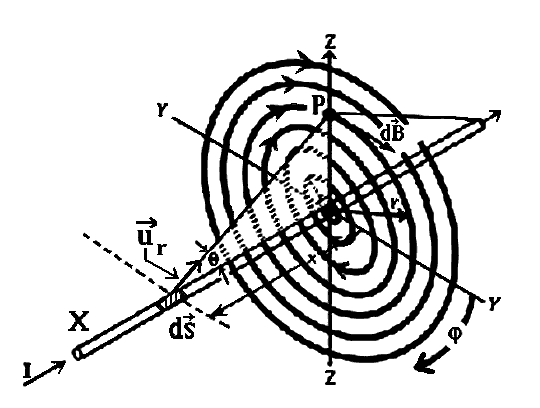 Figure 1
On figure 1, the constant electron
current
Figure 1
On figure 1, the constant electron
current  flows along the X-axis. This electron current
generates an element of magnetic field
flows along the X-axis. This electron current
generates an element of magnetic field  (at
location P) perpendicular to both, the electron current in
(at
location P) perpendicular to both, the electron current in  and also the elementary vector
  joining the element to P. The magnetic lines of force
surrounding the axis of the electron current in the plane Y-0-Z, are
represented by heavy circles. Also , passing at P, where the magnetic field is
calculated, makes an angle q, with
respect to the element on the X-axis.
Angle j is the angle around the X-axis.
---
In the Biot-Savart’s law,
the magnetic field is always perpendicular to the
X-axis. The Biot-Savart (1) law is given by
the relationship:
joining the element to P. The magnetic lines of force
surrounding the axis of the electron current in the plane Y-0-Z, are
represented by heavy circles. Also , passing at P, where the magnetic field is
calculated, makes an angle q, with
respect to the element on the X-axis.
Angle j is the angle around the X-axis.
---
In the Biot-Savart’s law,
the magnetic field is always perpendicular to the
X-axis. The Biot-Savart (1) law is given by
the relationship:
 1
Equation 1 gives the
component of the magnetic field (at P), at a distance r from
the X-axis. This magnetic field component is perpendicular to
both, the element and the elementary
vector . Therefore the intensity of the
magnetic field in P, given by the Biot-Savart equation (eq. 1), is
proportional to Sinq, because it takes
into account only the component of the magnetic field perpendicular
to the element of current .
1
Equation 1 gives the
component of the magnetic field (at P), at a distance r from
the X-axis. This magnetic field component is perpendicular to
both, the element and the elementary
vector . Therefore the intensity of the
magnetic field in P, given by the Biot-Savart equation (eq. 1), is
proportional to Sinq, because it takes
into account only the component of the magnetic field perpendicular
to the element of current .
After the initial
transient, when the flow of electron current is stabilized in the
wire, no more energy is directly required to maintain that induced
magnetic field. That can be verified in the case of an
electron current inside a conductor, since it is well known that the
current (and therefore the magnetic field) remains naturally
constant in time, if the electric resistivity of the conductor is
zero, as in the case of a superconductor. In the case of a
conductor with a non-zero electrical resistivity, the energy
required to maintain the current, is totally used to heat up the
wire. However, if the electron current is formed by a free
electron beam, traveling in vacuum, it is even more obvious that the
current of free electrons maintains a constant velocity inside the
electron beam, due to momentum conservation. Since the
Biot-Savart equation 1 is most suitable to calculate the magnetic
field, with any electron current, we can consider either a current
generated by the flow of free electrons in vacuum (as for the
electron beam drifting inside a cathode ray tube), or the constant
electron current inside a wire.
2 -
Magnetic Field Produced by Single Moving Electrons.
Using the Biot-Savart
law, let us now calculate the magnetic field when we have an extremely small current. We
consider the special case of a magnetic field produced by an
electron current formed by one single electron, moving at velocity
v. Therefore, the long linear distribution of electric charges in
the Biot-Savart equation must be substituted for one concentrated
electric charge existing at one point.
We know that the electric
current I, is defined as defined as a number of individual
electrical charges (e-) passing through a point per
second. Since the electric charge is quantized, in the case of a
single electron it is impossible to calculate an infinitesimal
variation of charge of one single electron. Electrons cannot
produce a continuous flow of electric charge. This is
particularly obvious when the number of electrons is close to
unity. In one unit of electron current, (one ampere) we have N(1 amp)@6.25 x
1018
electrons. The electron current I, is defined as the passage
of a charge Q coulombs of electric charge per second. We have:
 2
Since the electron charge
is quantized, the manifestation of one new individual electron
corresponds to the appearance of a new charge dQ. Therefore
dQ=d(Ne-). The electron velocity v is defined as the
distance dx traveled by the electric charge along the x-axis per
second. In the Biot-Savart equation, since the electron
current I, is constant during one calculation, its velocity is also
constant (v=constant). We can write:
2
Since the electron charge
is quantized, the manifestation of one new individual electron
corresponds to the appearance of a new charge dQ. Therefore
dQ=d(Ne-). The electron velocity v is defined as the
distance dx traveled by the electric charge along the x-axis per
second. In the Biot-Savart equation, since the electron
current I, is constant during one calculation, its velocity is also
constant (v=constant). We can write:
 3
Equations 2 and 3 give:
3
Equations 2 and 3 give:
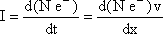 4
4
The scalar form of the
Biot-Savart equation is:
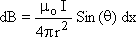 5
Substituting equation 4
in 5 gives:
5
Substituting equation 4
in 5 gives:
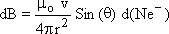 6
Equation 6 shows that
when we introduce a new linearly distributed electric charge d(Ne-),
a
new magnetic field dB appears at distance r in the direction q with respect to the unitary vector . We have seen above that without the
integration of the electric charges along the x-axis, the
Biot-Savart equation, gives the increase of magnetic field dB
produced at a distance r, due to the velocity of an elementary
electric charge dQ distributed along length ds. Since we
calculate the magnetic field generated by one single (isotropic)
electric charge, the linear distribution of charges used in
Biot-Savart equation no longer exists. Therefore equation 6
must be modified to take that into account that change of geometry
of the electron source.
6
Equation 6 shows that
when we introduce a new linearly distributed electric charge d(Ne-),
a
new magnetic field dB appears at distance r in the direction q with respect to the unitary vector . We have seen above that without the
integration of the electric charges along the x-axis, the
Biot-Savart equation, gives the increase of magnetic field dB
produced at a distance r, due to the velocity of an elementary
electric charge dQ distributed along length ds. Since we
calculate the magnetic field generated by one single (isotropic)
electric charge, the linear distribution of charges used in
Biot-Savart equation no longer exists. Therefore equation 6
must be modified to take that into account that change of geometry
of the electron source.
Quantization of Charges - Equation 6 gives the component of
the magnetic field B in direction q,
produced by one electric charge composed of N electrons distributed
along the vector. In Maxwell’s time, it was unknown
that the electric charges were quantized. Since the electric
charge is quantized in individual electrons, the fundamental
assumption of a continuous distribution of charges along assumed a century ago is incorrect. However, since
there are about 1019 electrons in one unit of electron
current, there is generally no appreciable difference, whether we
consider that large number of individual charges or a continuous
flow of charges. Yet, in equation 6, we wish to consider a
number of electrons as small as N=1. Equation 6 must be
re-considered in order to look for that necessary adjustment, due to
the disappearance of the linear distribution of electric charges
given by vector as a consequence of the
quantization of the electron charge.
It is interesting
to note that H. Poincaré (2) in 1906, was the first to
recognize that another force, called the “Poincaré stress” has to be
present to prevent the electric charge of an electron from flying
apart due to the Coulomb repulsion.
Since we now
consider the magnetic field produced by one single quantized
electron, additional transformations are also required. For
example, the Biot-Savart equation defines the magnetic field in a direction with respect to the element . In the Biot-Savart equation, the electron
charge distribution is not isotropic. From the explanations
above, in the Biot-Savart equation, we have seen that the Sin (q) function (Eq. 6) determines the direction
of the calculated magnetic field with respect to
the continuous charge distribution. However, when we have a
single electron, it becomes impossible to define the direction of a
no-longer-existent continuous distribution of electric charges.
Since the axis of distribution of the electric charges no longer
exists, we have to find the new geometry. Since we now
have an isotropic electric field around an individual electron, let
us assume that the magnetic field generated is also isotropic. Eq. 6
becomes:
 7
7
Here, dBi is
the magnetic field calculated considering quantized electric
charges, but also the fact that the axis of distribution of the
electric field no longer exists. Equation 7 gives the total
magnetic field dB for an isotropic geometry around a single free
moving electron when the moving electric charges generating that
field are also isotropic.
We can easily visualize
qualitatively that the magnetic field produced by a row of electric
charges is, as calculated by the Biot-Savart equation, not
isotropic, because the magnetic field generated backward by the
particles in the first part of the row of charged particles cancels
out the magnetic field generated forward by the ones in the last
part of that row of electric charges. Of course, that cannot
exist for a single electron. It is not surprising that the
passage from a geometry of linearly distributed electron charges (in
an electron current) to the geometry of a point source (single
moving electron) produces a similar change of geometry in the
resulting magnetic field. We will see below that the
hypothesis above is valid because the isotropic distribution of the
magnetic field around single electrons is compatible with equation
1, (which is applicable to a smooth linear distribution of
electrons).
Experimentally, due to
its smallness, it has never been possible to measure the faint
magnetic field induced around one single moving electron.
Nevertheless, the validity of that relationship is verified
indirectly by the correctness of the Biot-Savart equation. We
remember that the Biot-Savart equation was planned only to calculate
the component of the magnetic field appearing in a specific
direction, in the case of a large number of electrons distributed
linearly. It was not destined to calculate the total magnetic
field around one single isolated electron. The existence of
quantized electron charge in an electron was still unknown in
Maxwell’s time. Only the effect produced by a continuous flow
of electric charges could be considered then. Consequently,
this calculation here, which involves independent electrons, is more
fundamental than the Biot-Savart equation, since the fundamental
corpuscular nature of the electric charge, which is more realistic
in physics, is now taken into account.
3 -
Induced Magnetic Energy around a Single Moving Electron.
We have seen that
equation 7 gives the amplitude and the distribution of the total
induced magnetic “field” around individual moving electrons.
Corrections have been made in order to take into account that we
have now point like electric charges so that the electric charge of
the electron is no longer distributed along a line. Also the
electric field around one electron is isotropic and is not
distributed along a line as in the Biot-Savart problem.
These new considerations
are such that the Biot-Savart equation is still valid when the
electric charge is distributed as a continuous flow. From that
induced magnetic field, let us calculate now, the magnetic “energy”
around one single (N=1) electron. The density of
magnetic energy um which is defined as the magnetic
energy Um per unit volume V, is given by the relationship
(3):
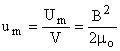 8
Since the magnetic field
d(Bi) around a single electron calculated in equation 7
is the only magnetic field of interest in the rest of this paper, we
simplify the notation below substituting the magnetic field dBi
in equation 7 by the plain symbol B. Around one single
electron (N=1), from Eqs. 7 and 8 we calculate the magnetic energy
dUm inside a volume dV. This gives:
8
Since the magnetic field
d(Bi) around a single electron calculated in equation 7
is the only magnetic field of interest in the rest of this paper, we
simplify the notation below substituting the magnetic field dBi
in equation 7 by the plain symbol B. Around one single
electron (N=1), from Eqs. 7 and 8 we calculate the magnetic energy
dUm inside a volume dV. This gives:
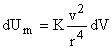 10
with
10
with
 11
Equation 10 gives the
magnetic energy dU in volume dV around one electron.
11
Equation 10 gives the
magnetic energy dU in volume dV around one electron.
4
- Total Mass of Magnetic Energy in One Single Moving Electron.
Equation 10 gives the
total energy of the induced magnetic field around one moving
electron in volume dV. Let us calculate the total mass M of
that magnetic field surrounding the moving electron, using the
Biot-Savart’s equation. We know that the constant of
proportionality between energy and mass is c2 (in the
relationship E=mc2). Since equation 10 gives the
energy per unit volume dV, it must be divided by c2 in
order to get the mass of the magnetic field. We have:
 12
Let us calculate the
total magnetic energy (and mass) in all that infinite volume around
a single electron. Since the integration of equation 12
contains a singularity, we must find the appropriate integration
limits of magnetic mass. In electromagnetic theory, the
magnetic field around a moving electron (Eq. 7) extends up to
infinity. Therefore, the total mass of the magnetic field
surrounding the electron must be integrated, in all three
dimensional space, up to infinity. We have seen above, that
the distribution of magnetic energy is compatible with an isotropic
distribution, since the electron has a spherical geometry. In order
to integrate the total mass of the magnetic field of the moving
electron, we use the integral of the volume of a sphere, on which we
apply the variable radial density calculated in equation 12.
12
Let us calculate the
total magnetic energy (and mass) in all that infinite volume around
a single electron. Since the integration of equation 12
contains a singularity, we must find the appropriate integration
limits of magnetic mass. In electromagnetic theory, the
magnetic field around a moving electron (Eq. 7) extends up to
infinity. Therefore, the total mass of the magnetic field
surrounding the electron must be integrated, in all three
dimensional space, up to infinity. We have seen above, that
the distribution of magnetic energy is compatible with an isotropic
distribution, since the electron has a spherical geometry. In order
to integrate the total mass of the magnetic field of the moving
electron, we use the integral of the volume of a sphere, on which we
apply the variable radial density calculated in equation 12.
On figure 2, we see that
the differential surface element of the surface of a sphere, at a
distance r, is equal to a thin square, having sides respectively
equal to r dq along meridians,
multiplied by the element of longitude j
of the circle 2prSin(q).
 ---
---
Figure
2
Figure 2 illustrates the parameters used in equation 13.
---
The total volume of an
ordinary sphere is given by the double integral:
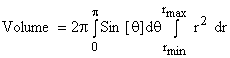 13
In equation 13, the
volume of a sphere between radius zero and radius rmax
is, as expected: V=4pr3/3.
In the case of magnetic energy, which extends to infinity, the upper
integration limit of the radii in equation 13 is infinity. We
must then take into account that the density of the magnetic mass is
variable and decreases as 1/r4, as given in equation
12. In order to calculate the total mass of electromagnetic
energy, inside a volume given by equation 13, we have to integrate
the mass density distribution in equation 12, with the volume in
equation 13. This double integral is integrated in the
following way:
13
In equation 13, the
volume of a sphere between radius zero and radius rmax
is, as expected: V=4pr3/3.
In the case of magnetic energy, which extends to infinity, the upper
integration limit of the radii in equation 13 is infinity. We
must then take into account that the density of the magnetic mass is
variable and decreases as 1/r4, as given in equation
12. In order to calculate the total mass of electromagnetic
energy, inside a volume given by equation 13, we have to integrate
the mass density distribution in equation 12, with the volume in
equation 13. This double integral is integrated in the
following way:
 14
Equation 14 can be
written:
14
Equation 14 can be
written:
 15
The total mass of the
magnetic energy in equation 15 remains finite even if the upper
limit of integration is infinity. However, we notice that
equation 15 gives an infinite mass (magnetic energy) at r = 0.
We know that an infinite mass is not physically realistic. There is
obviously a physical constraint, which must now be taken into
account.
15
The total mass of the
magnetic energy in equation 15 remains finite even if the upper
limit of integration is infinity. However, we notice that
equation 15 gives an infinite mass (magnetic energy) at r = 0.
We know that an infinite mass is not physically realistic. There is
obviously a physical constraint, which must now be taken into
account.
Magnetic fields are well
measured experimentally at any large distances, but such a
measurement is no longer possible directly at an infinitesimal
distance, very near the center of the electron. At r = 0,
equation 15 shows that it would require an infinite amount of energy
to generate magnetic fields right down to the center of the
electron. Therefore, the total electron energy of 511 keV,
gives the information of how close to the geometrical center, the
field can exist. As a result, a hollow structure of electric
and magnetic fields of the electron is absolutely necessary, due to
the finite energy of the electron (511 keV). More explanation
is given below in section 7. There is a minimum radius
expected due to the fact that the electron energy is finite (511
keV), which is called the classical electron radius (re)
(3). There cannot exist any electromagnetic
energy within the classical electron radius (re), because
the velocity of that empty part of the electron (hollow cavity)
cannot induce a magnetic field as calculated by the Biot-Savart
equation.
Let us integrate the
magnetic energy from the well-known (hollow) classical electron
radius re up to infinity, where an electric field can
exist. From equation 15, we have:
 16
After integration, this
gives:
16
After integration, this
gives:
 17
Equation 17 gives the
total mass of the magnetic field in a single electron, moving at
velocity v.
17
Equation 17 gives the
total mass of the magnetic field in a single electron, moving at
velocity v.
5 -
The “Relativistic Increase of Mass”.
We wish to compare the
magnetic mass of a moving electron given in equation 17, with the
kinetic mass (which is the increase of the so-called “relativistic
mass”) of the same electron. When we apply the principle of
mass-energy conservation, we have found (4), that the
mass of a moving particle in motion Mv is given by the
same relationship as in Einstein’s relativity. The mass of a
moving particle is given by the relationship
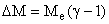
 18
Where g is:
18
Where g is:
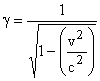 19
From equation 18, the
increase of mass due to velocity, is:
19
From equation 18, the
increase of mass due to velocity, is:
 20
In mathematics, we can
show that a series expansion of equation 19 gives:
20
In mathematics, we can
show that a series expansion of equation 19 gives:
 21
Equations 18, 19, 20 and
21 give:
21
Equations 18, 19, 20 and
21 give:
 22
In equation 21, the
second order term (v/c)4 is extremely small when v is
much smaller than the speed of light. The (v/c)4
and others higher order terms, are negligible with respect with the
first term. It can be shown that these higher order
terms are due to the energy required to accelerate the increase of
mass due to the previous order term (v/c)2. For the
moment, let us neglect the (v/c)4 and higher order
terms.
22
In equation 21, the
second order term (v/c)4 is extremely small when v is
much smaller than the speed of light. The (v/c)4
and others higher order terms, are negligible with respect with the
first term. It can be shown that these higher order
terms are due to the energy required to accelerate the increase of
mass due to the previous order term (v/c)2. For the
moment, let us neglect the (v/c)4 and higher order
terms.
6 -
The Magnetic Mass Versus the Relativistic Mass.
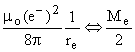
Let us compare the
increase of magnetic mass calculated above in equation 17, with the
increase of electron mass, using relativity theory as given in
equation 22. In fact, we are testing whether the relativistic
mass is the same thing as the magnetic mass. Equations 17 and
22 give:
 23
We notice in equation 23
that both phenomena (magnetic energy and relativistic energy)
produce an increase of mass, which is proportional to (v/c)2.
This means that the magnetic energy around individual electrons
increases as the square of the electron velocity, just as the
increase of relativistic mass. To be totally identical, it
remains that we need then to compare “only” the constant of
proportionality between these two phenomena. Simplifying
equation 23 gives:
23
We notice in equation 23
that both phenomena (magnetic energy and relativistic energy)
produce an increase of mass, which is proportional to (v/c)2.
This means that the magnetic energy around individual electrons
increases as the square of the electron velocity, just as the
increase of relativistic mass. To be totally identical, it
remains that we need then to compare “only” the constant of
proportionality between these two phenomena. Simplifying
equation 23 gives:
 24
One quick way to verify
the equality in equation 24 is to use numerical values. The
best accuracy known data are: The permittivity of space is
24
One quick way to verify
the equality in equation 24 is to use numerical values. The
best accuracy known data are: The permittivity of space is  . The electron charge is:
  . Finally the classical radius of the
electron, given in tables is:
. Finally the classical radius of the
electron, given in tables is:  Let us substitute these constants and the electron mass, which is Me=
9.109534 x 10⁻³¹ Kg. This gives:
Let us substitute these constants and the electron mass, which is Me=
9.109534 x 10⁻³¹ Kg. This gives:
 25
Equation 25 shows that
the magnetic mass of the moving electron is, within experimental
accuracy, identical to the increase of relativistic mass for any
velocity of the particle. Such a striking agreement cannot be
a coincidence. We conclude that the two quantities in equation
23 are physically identical. Those two quantities are
identical at any velocity of the electron as explained above.
In both cases, there is an identical increase of mass with respect
to the electron mass at rest.
25
Equation 25 shows that
the magnetic mass of the moving electron is, within experimental
accuracy, identical to the increase of relativistic mass for any
velocity of the particle. Such a striking agreement cannot be
a coincidence. We conclude that the two quantities in equation
23 are physically identical. Those two quantities are
identical at any velocity of the electron as explained above.
In both cases, there is an identical increase of mass with respect
to the electron mass at rest.
Therefore
the
increase
of
the
so-called
relativistic
mass
is
in
fact nothing more that the mass of the magnetic field
generated due to the electron velocity.
In fact, the real
fundamental nature of the kinetic mass, which increases with
velocity, is nothing else than the magnetic energy, as given by the
Biot-Savart equation. From equations 17 and 23, we can
conclude that for an electron, the physical nature of the parameter
g in relativity is:
 26
The so-called
“relativistic increase of mass” is only due to the induced magnetic
field as calculated by the Biot-Savart equation.
26
The so-called
“relativistic increase of mass” is only due to the induced magnetic
field as calculated by the Biot-Savart equation.
7 -
Physical Meaning of the Classical Electron Radius.
Let us examine a natural
interpretation to the Classical Electron Radius. Following the
above calculation (re in eq. 17), we see that the
“Classical Electron Radius” can be described, as the size of a
central cavity with radius re, in which there is no
field, because this would require an amount of energy (and mass)
which is not compatible with the electron mass. An infinite
amount of energy is required if we assume that there is a field at
the center of the electron, inside that cavity. This is
physically unrealistic and therefore impossible. The fact that
there is always only 511 keV of energy available in an electron is a
natural physical constraint, which prevents any electrical field
inside that classical radius.
It has been shown that
electrons at rest are pure electromagnetic fields (3).
Since the electron is pure electromagnetic energy, the total
electromagnetic field surrounding the electron has an energy equal
to
U=mec2=511 keV. Using that relationship
(3), the entire energy of an electron is:
 27
Then the electric field
can be accumulated by integration, bringing together these
infinitesimal electromagnetic elements forming the electron.
We find that the size of the cavity decreases when the charge gets
larger. Due to Coulomb repulsion of electric charges, energy
is required to bring together the elements of electric field forming
an electron. Since we know that the total energy of a single
electron is 511 keV, the total energy required to compress all the
electromagnetic field toward a concentrated packet (which is the
electron) is limited to the total energy available to an
electron. It has been calculated that when the total energy of
the fields, reaches the electron energy of 511 keV, the electric
charge of the electron is then complete, so that no further electric
field can be accumulated in the inner region of the electron.
Therefore, the charge distribution forming an electron has the shape
of a hollow sphere, having a radius ro(e-),
called “classical radius of the electron” (3).
Outside the “classical radius of the electron”, the electric field
(of an electron at rest) decreases smoothly (as 1/r2) to
zero at an infinite distance, as observed experimentally. The fact
that the electromagnetic field is absent inside the classical radius
is demonstrated in the high-energy electron scattering experiments
(much above 511 keV), which show that the electrical potential of
the electron does not reach an infinite limit (at r=0), but remains
below 511 keV. The interaction between particles is due to the
interaction between the fields located at the exterior of the
classical radius. That way, there is no need of existence of a
paranormal action-at-a-distance hypothesis. At a distance, it
is the exterior parts of the particles, which are always
reciprocally interacting.
27
Then the electric field
can be accumulated by integration, bringing together these
infinitesimal electromagnetic elements forming the electron.
We find that the size of the cavity decreases when the charge gets
larger. Due to Coulomb repulsion of electric charges, energy
is required to bring together the elements of electric field forming
an electron. Since we know that the total energy of a single
electron is 511 keV, the total energy required to compress all the
electromagnetic field toward a concentrated packet (which is the
electron) is limited to the total energy available to an
electron. It has been calculated that when the total energy of
the fields, reaches the electron energy of 511 keV, the electric
charge of the electron is then complete, so that no further electric
field can be accumulated in the inner region of the electron.
Therefore, the charge distribution forming an electron has the shape
of a hollow sphere, having a radius ro(e-),
called “classical radius of the electron” (3).
Outside the “classical radius of the electron”, the electric field
(of an electron at rest) decreases smoothly (as 1/r2) to
zero at an infinite distance, as observed experimentally. The fact
that the electromagnetic field is absent inside the classical radius
is demonstrated in the high-energy electron scattering experiments
(much above 511 keV), which show that the electrical potential of
the electron does not reach an infinite limit (at r=0), but remains
below 511 keV. The interaction between particles is due to the
interaction between the fields located at the exterior of the
classical radius. That way, there is no need of existence of a
paranormal action-at-a-distance hypothesis. At a distance, it
is the exterior parts of the particles, which are always
reciprocally interacting.
One must logically
conclude that the electron is made of fields surrounding a hollow
core. The entire electron field is exterior to that
radius. When we simulate the formation of an electron from a
gradual integration of an electromagnetic field (3), we
notice that the intensity of electric field outside the central
cavity must always remains constant, independently of the total
electromagnetic mass accumulated in the particle. This
explains the fact the electric charge always appears with a constant
amplitude for all particles (electrons or protons). It is the
size (radius) of the empty cavity, which decreases when new electric
fields are integrated. In agreement with physical data,
outside the central cavity, the electric field around the electron
is identical (in amplitude) to the electrical field around the
proton.
We normally have
the impression that the amount of integrated electrical charge in
the electron is identical to the amount of electric charge in the
proton. However, it is just the external part of the electrical
field (larger that the classical electron radius), which has the
same amplitude. The proton possesses a much larger
amount of charge (mostly responsible for the larger proton mass)
located in the gap between the classical electron radius and the
classical proton radius. The addition of some extra electric
charge to the electron, at a location inside the classical electron
radius, to form a proton (or anti proton) does not change the
amplitude of the remote electric fields around the newly formed
particle.
Consequently, we must
realize that the physical concept of “charge” must be
reconsidered. It must not be confused with the remote electric
field, which is always the same around any electric charge. We
usually claim that the electric charge of the proton is equal to the
electric charge of the electron, just because the field distribution
is identical at r>re. We have seen that when more
electromagnetic field energy is integrated inside the proton, within
the classical electron radius re, there is no change of
remote electric field around the particle. Furthermore, we
must understand that the electric field around a charge particle is
not due to the “action-at-a-distance” around an electric charge
located at one point. An “action-at-a-distance“ implies an
interaction between two physical elements located at different
locations. That is non-sense. Logically, the interaction
between two elements can take place only, if they are located at the
same place, at the same time. The electric field, which is
located around a charged particle, possesses its own existence at
the location where it is measured. It is not some magic
“action-at-a-distance”. An interaction between
“particles” can take place only when the field of an interacting
particle has reached the inside of the interacted particle. It
is always a field-to-field interaction at any distance. Such a
mechanism solves the “action-at-a-distance" paradox.
In Jackson (3),
when the mass of the field is equal to the observed mass of the
particle to the extent of the charge distribution, we find that the
minimum radius is the classical electron radius ro(e-),
where:
 28
The description above
shows that the entire mass of the electron “at rest” is a
distribution of electromagnetic field, surrounding a hollow core.
28
The description above
shows that the entire mass of the electron “at rest” is a
distribution of electromagnetic field, surrounding a hollow core.
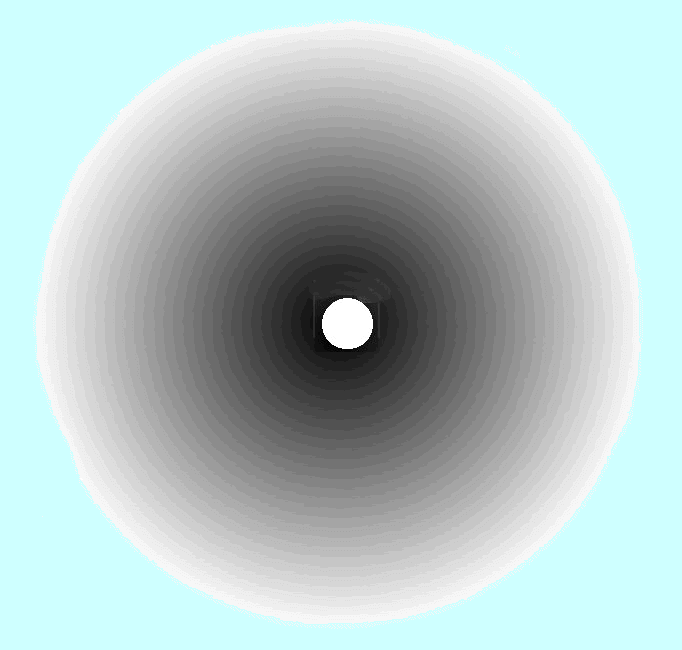
This is illustrated on
figure 3.
 As explained above in section 6, we can add that the
relativistic mass-increase, due to the mass of the magnetic field,
is in agreement with the Biot-Savart equation. We must also
conclude that there exists no massive nucleus at r=0 inside the
electron.
---
As explained above in section 6, we can add that the
relativistic mass-increase, due to the mass of the magnetic field,
is in agreement with the Biot-Savart equation. We must also
conclude that there exists no massive nucleus at r=0 inside the
electron.
---
Figure 3.
Figure 3 illustrates the cross
section of an electron at rest, representing the electric field
density by a dark area. The electric field of an electron at
rest is isotropic (in 3-D) around its hollow core and extends to
infinity.
---
Let us compare the above
model, which is deduced from experimental observations and
mass-energy conservation, with some previous theoretical electron
models. There have been many theoretical attempts to discover
the internal structure of electrons. For example, Poincaré(2)
was the first to recognize that another force, (called the Poincaré
stress) has to be present to prevent the electron from flying apart
due to the Coulomb interaction. The same problem has been
studied by M. Abraham (5). Of course, in
principle, the magnetic component of the field might produce
stability, but we still do not know exactly how.
More recently, different
electron models have been suggested (6-12). All these
mathematical models suggest that the electron is formed with
electromagnetic fields. However, none of these models can give
a coherent description of the force capable of holding together the
electric charge (the Poincaré stress). The field forming a
hollow electric sphere is formed with a self-repulsion electric
field, but the fundamental origin of that Poincaré stress(2)
is still missing. Even in the most recent paper by J. G.
Williamson, and M. B. van der Mark(11) , they attempt to
give the electron charge distribution in the nucleus. The
toroidal geometry proposed for an electron at rest does not lead to
the accurately observed isotropic decrease of electric field around
an electron. Furthermore, this model does not seem compatible
with some observations and with the de Broglie phenomena discussed
below. Whatever is the nature of the Poincaré(2)
stress, which holds the electric field together, we know with
certainty that something holds the elastic electric field together
because it is an observed experimental fact that most of the
electric charge of electron is concentrated inside a localized
volume of space. Finally, experiments also show that the
total amount of electric charge in particles is the same for
electrons, positrons, protons and anti-protons. Therefore the
above model (fig. 3) is compatible with experimental data, which
shows that both are in agreement with a quadratic decrease of the
electric field around the electron, and also with the principle of
conservation of mass-energy, which requires that the total energy of
the electric field of the electron, is compatible with the electron
mass.
In order to reach a
deeper understanding, the electric charge distribution forming the
electron must be compared with another particle. A similar
electric field distribution takes place in the proton and the
anti-proton, which also possess an electric charge. Even for
the proton, the (positive) electric field cannot exist down to zero
radius, because this would also require an infinite amount of
energy. However, at a larger distance from its center, up to
infinity, the proton electric field possesses exactly the same
amplitude as the positron and the electron.
Since the proton mass is
much larger than the electron mass, it takes the integration of a
much larger amount of electric field to form the proton mass.
However, we know experimentally, that in the outer region of these
two particles, the density of the electrical field is exactly
identical. Therefore the proton possesses an extra electric
field, entirely located just inside the classical electron radius,
which gives it the extra mass. That extra inner charge does
not produce any effect on the peripheral part of the particle.
At distances larger than the classical electron radius, the
“amplitude” of the electric field surrounding the proton is exactly
the same as for the electron. This is in agreement with the
observations that the (absolute) electric charge is the same for
both particles. Except for the polarity of the electric
charge, the important difference between the electrical fields
making up an electron and a proton, is that the central cavity
inside the electric fields is much smaller for the proton than for
the electron. In the case of the proton, the mass of the
electric field is accumulated until the proton mass is
reached. However, the surrounding electric field is the same
for both particles, which is interpreted as having the same
charge. In fact, only the amplitude of the surrounding “field”
are the same.
This consequence is in
agreement with high-energy scattering experiments. Protons can
show a much higher electrical potential (about 1000 MeV), than the
electron (0.511 MeV), when they are scattered at very high energy.
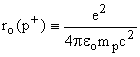
An illustration of the
proton at rest is similar to figure 3, except that the cavity inside
the particle is much smaller. In the same way, as in the
case of the electron, the classical radius of the proton is:
 29
The numerical classical
proton radius is:
ro (p+) = 1.53470 x 10⁻¹⁸
m. 30
29
The numerical classical
proton radius is:
ro (p+) = 1.53470 x 10⁻¹⁸
m. 30
8 –
Vortices in the Electric Field of Moving Electrons.
We understand from the
above, that electrons, positrons and protons are not point
particles, but kinds of hollow clouds of electric fields. In
order to accelerate an electron, we need to have an interaction with
the mass, which causes the acceleration. Let us consider a
simple model of interaction when the electron is accelerated.
When the central part of the electron (around ro), where
most of the energy is concentrated, interacts with another particle,
this is somewhat similar with the interaction of a body (a stone)
falling into a water pool. In physics, we know that all the
momentum as well as the kinetic energy of the projectile must be
transferred to the water pool. For the sake of simplicity, we
mention a falling stone, but a better analogy would require a
penetrable jellylike object. In the case, in which the
internal motion (vortices) inside the fundamental particles is
produced, we do not observe that the kinetic energy is immediately
transformed into heat, contrary to the case of putty projected on a
hard surface. For example, the waves in water do not appear as
thermal energy as long as they remain waves. When the falling
stone reaches the surface of the fluid, the increase of pressure
under the stone pushes water away from under the stone. The pressure
in the fluid pushes water in a radial displacement, and water is
forced out horizontally from under the falling stone. That
water, from under the stone, provokes a horizontal radial motion
forming a wave ring of fluid. These doughnut-shape rings
consist in a whirling fluid rotating around circular axes, which are
called “toroidal vortices”. As soon as the falling stone moves
deeper through water, all the way to the bottom, many more vortices
are formed inside the fluid. The formation of these waves at
the surface, as well as in depth, must satisfy the energy and
momentum conservation.
Circular waves can be
easily seen at the surface, as a function of time, as illustrated on
Figure 4. In this paper, the vortices are illustrated
qualitatively. Mathematical calculation of vortices is already
known mathematically.
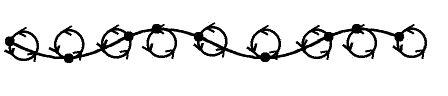 ---
---
Figure 4
Each circle represents one of
the vortices at the same location, at different times. The
black dot on each circle represents an oscillating drop of fluid
rotating around the vortex.
---
Figure 4 is a dynamic
illustration of the toroidal vortices, well known in
hydrodynamics. This is similar to the problem of waves
traveling at the surface of water. Those vortices are visible
at the surface of water, but other similar vortices are also
produced at all depths. At the surface of water, we have the
illusion that the waves move away from the center. However,
hydrodynamics has shown that it is an illusion. In that case, the
center of the wave-system would then become depleted of water, which
does not happen. Figure 4, illustrates two full rotations of a
drop of fluid inside a vortex, during a time interval corresponding
to the passage of two waves. Therefore the kinetic energy of
the stone falling in water is transformed into the kinetic rotation
of the fluid inside these rotating vortices. This is the way
energy is conserved. In water, due to the low coefficient of
viscosity of the fluid, the kinetic energy induced in the fluid is
not readily transformed into heat. In order to be compatible
with the principle of energy and momentum conservation, in the case
of high fluidity, there exists no other physical mechanism, than
forming those toroidal vortices. That is the way the kinetic
energy of the stone is transformed into the kinetic energy of the
fluid, in vortices.
A similar phenomenon also
exists in other fluids as in air, which also has a low
viscosity. In that case, the kinetic energy of the wind is
transformed into vortices called whirlwind, twisters, and tornados,
well before the energy is finally transformed into heat.
However, if we chose a fluid with zero viscosity (like low
temperature superfluid liquid helium), all the kinetic energy and
momentum of the falling mass remains permanently under the form of
vortices in the fluid. In the case of superfluidity, the
motion in the fluid is never transformed into heat. Due to
superfluidity inside electric fluids, there exists no mechanism,
which can transform the vortices of electric fields into heat.
Thermal energy does not exist at the nuclear level, inside
elementary particles. Therefore, the electric field forming an
electron must also be a superfluid. With zero viscosity of the
electric field forming the electron, kinetic energy inside vortices
can be conserved indefinitely, due to these superfluid toroidal
vortices inside each electron. Without storing the
kinetic energy in those vortices, it is impossible to satisfy the
principle of energy and momentum conservation.
We have seen in equation
17, that when an electron is accelerated, that moving electron
possesses kinetic energy, which is equal to the magnetic field
induced by the electron, and which is also equal to the relativistic
mass. Now, from the above considerations, we see that when the
electron is accelerated, some vortices must necessarily be formed in
order to carry the kinetic energy given to the particle.
 A more general overview of these oscillations,
showing the toroidal vortices, is presented on figure 5.
A more general overview of these oscillations,
showing the toroidal vortices, is presented on figure 5.
We see several toroidal vortices created by the absorbed kinetic
energy given to the electric field inside a non-viscous fluid.
As demonstrated above, these vortices possess the kinetic energy,
which appears as magnetic field, and which corresponds to the
relativistic mass.
---
Figure 5.
Figure 5 illustrates a
few internal toroidal vortices inside a moving electron. The
kinetic energy absorbed during the acceleration of that electron
becomes the energy of the toroidal vortices, which is also the
magnetic energy calculated with the Biot-Savart equation. With
decreasing amplitude as a function of r, these electric and magnetic
fields extend up to infinity. The energy of these toroidal
vortices (the magnetic field) is equal to the relativistic mass as
demonstrated above.
---
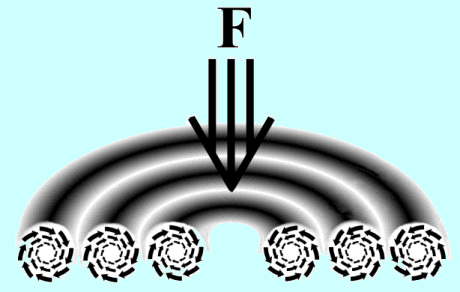
Figure 6 illustrates the
internal structure of the first three vortices drawn on figure
5. Figure 6 illustrates the vortices, assuming a perfect
conservation of energy and momentum, when the electron has been
accelerated by a force “F” applied (downward) on the central part of
the electric field of the electron.
 ---
---
Figure 6
Figure 6 illustrates an electron after acceleration by an external
force F giving velocity v, on the axis of the electron current.
Figure 6 shows the first vortices of an electron. All the
other concentric vortices decreasing as 1/r (for an electric current
as in Biot-Savart equation), are not drawn.
---
Applying the
principle of momentum conservation, we observe, on figure 6,
clockwise vortices of the electric field on the left hand side of
the figure, and anticlockwise motion on the right hand side.
It can be shown that this is also compatible with the fact that a
magnetic field has an opposite direction, on the opposite side of a
flow of electric charges generating a magnetic field. We can
see that the fundamental nature of a magnetic field is nothing else
but an internal velocity of the electric field, forming vortices at
large distances as shown by the Biot-Savart equation. Again,
due to the zero viscosity of the electric fluid, the vortices inside
the electron field are permanent internal rotating electric vortices
forming waves, which store up the kinetic energy induced by the
interacting particle. We will see below in section 10 that
these vortices are also in perfect agreement with the well-known de
Broglie wavelengths.
9 –
Absolute Frame of Reference without Ether.
In section 8 above, we
have seen that, when an electron is accelerated from rest to
velocity v, the principle of energy and momentum conservation
requires that vortices of electric fields be created inside each
charge. As explained in section 8, these vortices are tensors,
which involve rotations related to the direction in which the
electron has been accelerated. If a moving electron receives a
further acceleration in the same direction, the number of vortices
will have a further increase. Also, if that moving electron
moves sideways, the direction and the amplitude of the vortices
rearrange accordingly, in order to always satisfy energy and
momentum conservation. Finally, if that electron is
accelerated backward (slowed down), down to its initial zero
velocity, these internal vortices of electric fields cancel out and
disappear completely. Therefore, we see that moving charges,
always keep inside the particle, all the information about their
speed and their direction as a result of electric vortices.
The full information about their speed and direction exists in the
electric charge at any instant, and remains permanently inside all
moving individual charges. In fact, electric vortices are more
than perfect gyroscopes, since they do not only record perfectly
their direction of motion, but furthermore they record their
velocity with respect to an absolute rest frame, because the energy
in the vortices is an exact measure of their absolute
velocity. Therefore, “all” particles (electrons, protons atoms
and molecules) possess individually and internally all the
information about their speed and their direction, with respect to
an absolute frame of reference. This is the only way to assure
the conservation of energy and momentum and compatibility with the
induced magnetic field following the Biot-Savart equation.
Since the electric charges possess all the information about the
absolute velocity, one must conclude that there exists an absolute
frame of reference corresponding to zero energy of the
vortices. Without an absolute frame, it has been seen (4)
previously, that there cannot exist any physical reality, which
could be independent of the observer. For example, in the
Biot-Savart equation, with respect to what does the velocity “v”
means? Since a magnetic field is not an illusion and possess
its own existence, it cannot possess a different energy as a
function of the velocity of the observer. That would be incoherent,
and therefore totally illogical.
We can read that in many
papers, such a rest frame is attributed to a hypothetical
“ether”. However, there is a difference between an absolute
frame of reference, which possesses only geometrical properties and
a physical “ether”. A “ether” must be understood as a “medium”
which can have a physical interaction with other physical
quantities, as mass and energy. Ether is usually assumed to be
a support for the transmission of light waves, in analogy with the
transmission of sound, which is supported by air (or by solids and
liquids). However, acoustic theory shows that no sound can be
transmitted through a medium, if that medium does not possesses
mass. Therefore some energy and some physical properties
(other than geometrical properties) must exist in such a
hypothesized ether, which can interact with the assumed waves moving
through that ether. To be realistic, ether, if it exists, must
possess mass. Therefore, there is a fundamental difference,
between an “absolute frame of reference”, which is just a
geometrical property, and which corresponds to the average motion of
matter in space, and a “physical medium”, possessing physical
properties like mass and energy, which supports waves. It has
been shown previously (15) that an absolute frame of
reference (not the ether) is required in order to satisfy the
principle of mass-energy conservation. We read:
“ For the moment, the sole property of that
assumed ether is to establish an absolute origin to the
velocity-frame of light and physical matter, because this
frame of reference is absolutely needed to comply with the
principle of energy and momentum conservation.”
However, as mentioned
above, this is the “sole” property, which is needed, because the
principle of mass-energy conservation is fully satisfied without any
energy belonging to that assumed medium. Then again, it is a
geometrical property. Other phenomena have also been observed, which
shows that an absolute frame of reference is required without the
interaction of any physical medium (ether). The GPS (16),
which requires a non-relativist correction (because it requires the
Sagnac effect), provides a proof of a need of an “absolute frame of
reference” for light propagation without involving any interaction
with the media. It is shown that the velocity of light is
actually (c-v) in a frame moving at velocity v, (17, 18)
even if the moving observer always measures c in his own
frame. In fact, the velocity of light is an absolute constant
in an “absolute frame” at rest, but due to the different clock rate
in the moving frame, there is an apparent velocity of light
equal to c in all frames (16).
It is found that although
an absolute frame of reference is required to be compatible with the
principle of mass-energy conservation, there exists no proof that an
ether, which would fill vacuum, exists. Of course, some
undiscovered extremely weakly interacting fields or particles could
exist in space. However, since the principle of mass-energy is
well satisfied in current experiments, these unknown fields do not
appear to be responsible for the transmission of light and particles
in vacuum.
10 –
Coherence between Vortices and the de Broglie Wavelength.
We have seen on figure 5
that the vortices developed inside moving electrons generate
naturally a permanent wave structure inside electrons moving at
constant velocity, exactly like the wave structure required by the
de Broglie equations. Therefore, the internal wave structure
of a moving electron can be interpreted as matter-wave, as predicted
by the de Broglie wavelength equation (13), and well
observed experimentally. Just as in the case of a stone
falling into a water pool, the wave structure of the electron
vortices, which is also compatible with the magnetic field
calculated using the Biot-Savart equation, is the only way to take
into account simultaneously the principle of energy and momentum
conservation inside the electron. Since there is no inelastic
mechanism inside an electron to give up the kinetic energy of these
vortices, these vortices remain permanent as long as the inertial
velocity of the electron is maintained. The electric field
distribution of an electron “at rest” is illustrated on figure 3,
which corresponds exactly with an infinite wavelength, as predicted
theoretically by de Broglie.
We must also note on
figure 5, how an electron becomes compatible with electron
diffraction, which requires that the electron possesses a large
oscillating transverse structure as well as a wavelength in the
axial direction, which are velocity dependent, as observed
experimentally, in agreement with the de Broglie
equation. Consequently, we can say that the de
Broglie wavelength of an electron is due to the magnetic component,
which exists under the form of electric vortices of moving
electrons. This mechanism, generating vortices so frequently
observed in water waves, possesses many similarities with the
toroidal vortices of the electric field inside each moving
electron. Most importantly, we must take into account that the
electric fluid is a super fluid. The de Broglie electron
wavelength as a function of velocity is given by the relationship:
 31
Using equation 31, we see
that we can calculate the density of the de Broglie wavelengths, per
unit length. Just as for toroidal vortices, equation 31 shows
that the number of de Broglie wavelengths per unit length is
proportional to the velocity of the particle. Therefore there
is a striking agreement that the induced vortices in the electric
field of the electron are responsible for the de Broglie wavelengths
of particles.
31
Using equation 31, we see
that we can calculate the density of the de Broglie wavelengths, per
unit length. Just as for toroidal vortices, equation 31 shows
that the number of de Broglie wavelengths per unit length is
proportional to the velocity of the particle. Therefore there
is a striking agreement that the induced vortices in the electric
field of the electron are responsible for the de Broglie wavelengths
of particles.
We have seen that due to
the principle of energy and momentum conservation, the number and
the intensity of vortices increase with electron velocity.
Therefore, when the electron is accelerated to velocity v, it is
observed that that electron becomes different, because it acquires
vortices, which give a proper wavelength to the electron. As
seen above, these vortices are also the magnetic field generated by
a moving charge according to the Biot-Savart equation.
Therefore, the de Broglie electron wavelength is the wavelength of
the vortices, which is responsible for the density of the vortices,
and therefore the magnetic field.
The wavelength of these
vortices in electrons is what produces the electron diffraction in
matter. This is shown in atomic and molecular physics, since
the length of the electron’s orbits inside the atom is an integer
number of the de Broglie electron wavelength. The de Broglie
relationship has been first used in the Bohr model to establish the
basis of quantum mechanics. In the Bohr atom, it is well
established that the length of an electron orbit of a particular
quantum state, is always equal to an integer number of de Broglie
wavelengths. The de Broglie wavelength is equal in size to the
wavelength of the vortices (see figure 5), inside the moving
electron.
It can also be seen that
the internal electric vortices of electrons have a similar structure
as the electron spin. These spins can be coupled with other
interacting spins forming quantum states. The wave nature of the
vortices inside electric charges is also observed in atomic,
molecular physics and nuclear physics. The vortices forming the spin
of the proton are also coupled with the electron vortices (spin) in
the hydrogen atom, to form the 1S and 3S
states (of the ground state), depending in the relative orientation
of the vortices (spins). It is not surprising that the energy
states of atoms and nuclei are quantized, since we can see in
mathematics that the switching from one configuration of vortices to
another one is discontinuous. Therefore, each coupling between
different pair of vortices (of neighboring particles), which
requires a different amount of energy, is the fundamental
explanation for the quantization of energy. This is in perfect
agreement with quantum mechanics.
11 – Application:
Physical Model of the Photon.
Relativistic Mass. -
We have demonstrated here that the magnetic energy generated by the
velocity of electrons, possess a mass, which is identical to the
increase of the so-called relativistic mass in Einstein's
relativity. Also, as demonstrated above, the energy of the magnetic
field is the energy of the vortices of the electric
field. Therefore, the fundamental phenomenon responsible
for the increase of relativistic mass with velocity is the magnetic
vortices of the electric field, as calculated with the Biot-Savart
equation. Consequently, since the magnetic field can be observed at
distances of many meters around wires carrying the current, in
agreement with the Biot-Savart equation, the mass of each electron
is equally distributed in a corresponding huge volume of space.
Super Fluidity of
Electric Field. - We have seen that the electric field forming
an electron is like a drop of a superfluid, (like liquid helium),
which has zero viscosity. Considering the sub-atomic scale,
there exists no physical mechanism, which can transform that
tumultuous motion (vortices) inside the electron into heat.
The electric fluid forming an electron is a superfluid, with a
decreasing density around the central radius. However, we have
also shown above, that almost all the electron mass is located in an
extremely small volume. For example, in section 4 above, we
find that 99.99% of electron energy appears within a radius of 2.8 x
10-11 meter. No doubt, it is this extreme smallness
in the distribution of the energy of that particle, which is
responsible for the belief that it might be a point particle.
An electron is nothing but its electromagnetic field.
However, considering the
infinite distribution of the electric field of an electron in space
(density decreasing as 1/r2), we must realize that each
electron extends out to infinity. Because of its huge size,
the electron can interact, although sometimes imperceptibly, over an
extremely large cross section. This is in agreement with the
vortices of electric field (called "magnetic field") measured many
meters away from the location, where the electric flow is moving, as
calculated using the Biot-Savart equation. Due to the finite
velocity of transmission of electric forces, the mechanism of
acceleration of the electron must be described as taking place
first, as the acceleration of the densest part of the field, where
almost all the energy is located, before that acceleration is
transmitted gradually toward the remote, much less dense parts of
the particle. Therefore electrons, as well as any charged
particle, are not point particles. On the contrary, the size
of all particles extends up to an unlimited volume of space, since
the electric field decreases as 1/r2. Finally, that
electric superfluid is held together by a force called the “Poincaré
stress” (2), which keeps the electric charge from
expanding away, and maintains the decrease of electric field
according to the well-known quadratic law, up to infinity.
Internal Structure of
the Electron. - It is well known experimentally that the
static electric field around an electron “at rest”, decreases as 1/r2.
In
physics, electrons are believed to be pure electromagnetic
field. Unfortunately, it is taken for granted, that the field
around electrons “in motion” also decreases smoothly as 1/r2.
We can see that this is a hypothesis, which is not compatible with
observations and with the vortices required for the application of
the principle of energy conservation explained above. Of
course, measuring the distribution of the electric field around a
fast moving electron can be extremely challenging. However,
many experiments have shown that moving electrons possess a
structure compatible with the vortices explained above. How
can physicists assume that the electron always possess a smooth
(according to 1/r2) structure, while the de Broglie
equation shows that there is an internal wavelength, which
inescapably belongs to the moving particle, as seen in electron
diffraction experiments? Furthermore, the wave structure of
the electron is an experimental fact also observed inside
atoms. For example, when the electron inside the hydrogen atom
is moving at velocity v around a nucleus, the de Broglie electron
wavelength is equal to an integer number of wavelength, as required
in the Bohr model. This means that, “only” at some particular
electron velocities, the electron vortices produce stable electron
configurations in atoms. At all other distances from the
nucleus, the electron orbit is unstable. It is contradictory
to claim that an electron field decreases smoothly as 1/r2,
while we know that moving electrons possess a variable wave
structure, compatible with the de Broglie equation. It is
obvious that something inside the internal structure of the electron
is changing as a function of electron velocity. Since this is
an experimental fact, supported by mass and energy conservation, it
is necessary to consider that the internal structure of the electron
varies with velocity.
A Realistic Model of
the Photon. - The fundamental nature of the photon can
be understood using a mechanical description of the photon, on which
we apply the laws of physics. It is well known that
electromagnetic radiation is always generated during the
acceleration “a” of electric
charges. Using the Larmor equation, the energy emitted by an
accelerated charge is given by the relationship:
 32
Where q is the electric
charge, and W is the power emitted in Watts.
32
Where q is the electric
charge, and W is the power emitted in Watts.
We must avoid any
confusion between the electromagnetic radiation emitted during the
“acceleration” of electric charges (equation 32) and the Biot-Savart
field (vortices) accompanying a moving charge at “constant velocity”
(eq. 1). During the acceleration, the electric charge can be
completely free or bound to another particle. The emission of
electromagnetic radiation from free accelerated electric charges is
called bremsstrahlung. Also, when the electromagnetic
radiation is emitted from an accelerated electron bound to other
particle, a corresponding emission of radiation also takes place. In
that case, this is described as a quantum emission of radiation due
to the transition between two quantum states. Whatever the
degree of freedom of the electric charge is, the emission of
electromagnetic radiation always requires the acceleration of an
electric charge.
The electromagnetic
radiation emitted due to the acceleration of electric charges, bears
many names. It can be called: photon, light, electromagnetic
radiation, cosmic rays, microwaves, radio waves, infrared radiation,
ultra-violet radiation, etc. All these different names refer
to the same thing. The difference in names is generally
related only to the frequency of the radiation. As mentioned
in the book: “Absurdities in Modern Physics: A Solution” (14),
it does not make sense to claim a physical difference between a
photon, observed with a photon detector, (then considered as a
particle,) and electromagnetic radiation, observed with a radiation
detector, (then considered as a wave). This always refers to
the very same package of energy. Under all these different
names, there exists only one single fundamental phenomenon.
The “package of energy” emitted during the acceleration of a charge,
must always be simultaneously compatible with a realistic
description, corresponding to an electromagnetic field emitted by an
accelerated charge, possessing all the characteristics of energy,
amplitude, frequency, phase, length of coherence, time of coherence
and polarization. Therefore here, we use any of these terms
indifferently, to represent electromagnetic radiation. It is
illogical to believe that the nature of light changes as a function
of the detector or observer, as claimed unfortunately in many
papers.
Since light (or photons
or electromagnetic radiation, etc.) is always a consequence of the
acceleration of an electric charge, the structure of light must be
compatible with the morphological structure of the emitter, which is
generally the electron. In view of the fact that “moving”
electrons are made of a large number of extended, concentric
vortices of electric fields, this fact must be reflected on the
morphology of the emitted radiation. Each infinitesimal
element of the accelerated electron emits energy in agreement with
equation 32. Due to the acceleration of a tri-dimensional
volume of electric charges concentrated in vortices, as explained
above, the acceleration of each differential element of the electron
structure, gives rise to a tri-dimensional electromagnetic
wave. Therefore the structure of the emitted light (as
wave-packets) must also possess concentric electric waves.
Since every parts of the three-dimensional electron are accelerated,
similarly, the radiation emitted occupies all space, up to infinity,
in order to be compatible with equation 32. That is simple
logic. Consequently, the so-called “photon” can neither be described
as a point particle nor as an expanding field distribution around
the source. The so-called “photon” can be described as a non-expanding
display of numerous concentric vortices (of unlimited radius) of
electromagnetic fields in a three dimensional space, moving along
the velocity axis. Those arrays can be compared to the
vortices produced, at different depths, when a stone
falls into a water pool, as illustrated above. However, this
comparison is incomplete, unless in addition, we recall that it is
the water pool, (with the vortices), which is moving at velocity
v. Then, the electric vortices of the accelerated electron
generate corresponding vortices in the photon, which then move at
velocity c. The velocity c of the electromagnetic radiation adds
cylindrical parameters to the wave packet. One must also
consider the ends of this cylinder formed by the moving sphere,
which also contains vortices, in compatibility with the morphology
of the accelerated electron generating the “photon”. We can
see that the main length of the moving wave packet is the length of
coherence of the radiation. That length of coherence is
related to the time during which the electric charge is accelerated.
Of course, the radius of
the cylindrical vortices cannot expand in time, since this would
decrease the density of energy in the photon’s field.
Experimentally, it is confirmed that the density of energy of a wave
packet does not decrease in time, since it is an experimental fact
that the quantum levels of target atoms are just as much excited at
any distance from the light source.
We have seen that, just
as in the case of the moving electron, a concentration of
electromagnetic energy is also replicated in the wave-packet, at the
instant it is generated by the electron. Therefore, most of
the energy in the wave-packet is concentrated inside a relatively
small radius (just around the classical electron radius), but some
energy also exists at large distances, up to infinity. The
fact that an individual wave-packet described here occupies a large
volume of space (in both longitudinal and transverse directions) is
such that it can interfere with itself after it has been split by a
local barrier, like a slit. Also, considering the very large
size of the emitting electron, we can see that due to the finite
velocity of transmission of energy at velocity c, the total energy
of a wave-packet cannot be measured instantaneously, in agreement
with the “uncertainly principle” in quantum mechanics. Let us
examine the fact that the so-called “photon” extends in the
longitudinal, as well as in the transverse direction.
Michelson’s
Interferometer. - The Michelson interferometer is
considered here to demonstrate the longitudinal wave structure of
light. The Michelson interferometer produces interference fringes,
by splitting a beam of monochromatic light with a half-silvered
mirror placed at 45 degrees. Therefore, light is sent off in
two perpendicular directions. One beam strikes a fixed mirror
and the other a movable mirror. Each sub-beam reflects off of
another mirror, which returns it to the half-silvered mirror, where
the two sub-beams recombine. At the location where the
reflected beams are brought back together, an interference pattern
results. When we displace the movable mirror, one axial
section of the delayed light beam is superimposed to the other
section of the same beam. By moving the mirror, the delayed
electromagnetic wave of a different section of the same wave-train,
interfering with the wave reflected by the fixed mirror, produces
the well known moving interference fringes. In the Michelson’s
interferometer experiment, most people do not realize that that
experiment generally uses an atypical source of light. If
light from the movable mirror is delayed along a distance larger
that the length of coherence, there exists no interference fringes.
This proves that each
wave-packet of light contains an axial wave structure, of variable
length, which is compatible with the model explained here. It
is also important to recall that these interference fringes exist at
any light intensity, even if light intensity is as low as one photon
per minute or per hour. This has been shown
experimentally. Consequently, these interference patterns
cannot be due to the interference between independent wave–packets.
We must conclude that due to the longitudinal size of the light-wave
emitted by a single electron, we can see how one single wave-packet
of light, sometimes called “photon”, interferes with its own field,
in the longitudinal axis.
Two-Slit
Experiment. - It is also important to recall that
the same wave-packet must also contain simultaneously a transverse
electromagnetic field, in order to be compatible with the morphology
of the moving electron, generating the wave packets. Consequently,
we must show that experimental observations are also compatible with
the interference between two different sections of electromagnetic
field issued from the same photon, in which the transverse
electromagnetic field also varies as a sine function in space.
This transverse electromagnetic field of the wave-packet can be
observed experimentally with the two-slit experiment (or many-slits
experiments). In the two-slit experiment, we see that a
different section of the wavefront of the same wave-packet must go
across different openings on the two-slit-system, which is
perpendicular to the velocity vector of the wave-packet. Due
to the transverse size of the wave-packet emitted by a single
electron, some vortices of the same wave-packet interfere with
others, having a longer or shorter path after passing through the
slits.
This interference between
the transverse fields inside a single wave-packet is well observed
experimentally. Of course, when the distance between the
interfering slits is large, the possibility to produce interference
gets much smaller in agreement with observations. However, in
principle, when we detect an infinitesimal intensity (low rate of
detection), it remains always possible to observe an interference
pattern for any distance between the slits, due to the infinite size
of each wave-packet.
The frequency of the
electromagnetic radiation received on an atom of the detector must
have the resonant frequency, compatible with the quantum transition
of the electron in the atom of the detector.
Furthermore, even at that resonant frequency, the total amount of
energy to be accumulated in the atom of the detector must be equal
to the energy of the quantum state of the atom. This is
necessary to produce a quantum transition in the detector.
Without sufficient energy, (or the correct frequency) the incident
energy of the electromagnetic wave is scattered away from the
atom. Of course, the electron of the atom of the detector,
which absorbs the energy, is extremely appropriate to detect the
energy produced by the fields of interference, since they both
possess the same morphology (vortices). Furthermore, the
absorption of a sufficient amount of energy in the detector to
produce a quantum transition is “only” possible, because there is no
decrease of the electric field density of the wave packet as a
function of the distance from the source. We have seen above
that the radius of the cylindrical vortices of fields do not expand
with time. In physics, it is generally believed that when a
wave-packet is formed, its electromagnetic energy spread out in
space, as an expanding sphere, which gets bigger and bigger in time,
without limits. Then, if the field expands while traveling
through space, the density of energy decreases without limits when
the radius gets larger as a function of the distance from the
emitter. Consequently, when we consider a photon emitted by an
atom located in a remote galaxy, billions of light years away, the
amount of energy that can possibly pass through a narrow slit is so
unreasonably small that obviously, it will never be able to
accumulate a few electron-volts of energy in the short time interval
required to activate the quantum transition required in the atom of
the light detector.
It is well known
experimentally that numerous photons, having a few electron volts,
are commonly detected in photo-detectors, contrary to the logical
expectation of the usual model. Consequently, instead of
having a decreasing amplitude of electromagnetic radiation (as a
function of distance), it is necessary to consider that it is the
number of wave packets (photons), which decreases with the distance
from the source. Then, the same density of energy is detected in
each wave-packet, independently of the distance of the detector from
the source. Consequently, the model explained in all textbooks
claiming that there is a spherical expansion of electromagnetic
waves in space is unacceptable, since the density of the
electromagnetic field would decreases with the distance from the
source. Clearly, such a model cannot provide enough
concentration of energy to the detector to produce quantum
transitions. That model is clearly erroneous, because it is
not compatible with the fact that electromagnetic radiation (light)
provides exactly the same amount of energy to a target,
independently of the distance of the target from the source. It is
not the electromagnetic field, which decreases. Instead, the
expansion of the radiation from a source of light should be
illustrated always using constant wave-packets, with a decreasing
density of the “number” of wave-packets, as a function of the
distance from the source. The usual illustrations are
seriously misleading, since they are incompatible with many physical
observations.
We see now, that only an
appropriate variety of wave packets of electromagnetic radiation can
produce a quantum transition in the atom of the detector. Even
if a variable amount of electromagnetic energy can be found in one
wave-packet of electromagnetic radiation, the amount of energy
extracted from that wave-packet follows the relationship E=hn, characteristic to the detector.
Therefore, after the target has extracted its characteristic amount
of energy (characteristic distribution of wavelengths), the energy
reflected (from the target) becomes modified and show the usual
reflected characteristic spectrum of atoms, as observed
experimentally. We know that the electromagnetic energy is
absorbed by an atom “only” when the frequency of the radiation in
the wave-packet is compatible with the natural frequency of the
quantum state of the atom, so that the atom makes a quantum jump in
energy. Consequently, the quantity of electromagnetic energy
extracted from a wave packet is always equal to one quantum
transition in the detector, independently of the shape of the
wave-packet.
A preliminary description
of the fundamental nature of light has already been described
previously (14), but this was incomplete, because the
fundamental nature of the emitting process of light, explained here,
was then unavailable. The morphology of the electron, emitting
the wave-packet, has to be known before we can understand the
morphology of the wave-packet. We have seen how those
morphologies must be compatible. The fundamental description
given here gives a complete realistic description of light and its
diffraction mechanism, which was initiated in the book "Absurdities
in Modern Physics: A Solution" (14). We have
now a first complete description of a fully realistic model of
light, solving the dilemma of the so-called wave-particle dualistic
nature of light. This realistic model of light works in
conjunction with the realistic description of matter in physics as
described previously (15-18). These descriptions
show that common sense is always applicable in nature, and phenomena
can always be described using classical physical models. More
mathematical calculation related to this realistic model of the
photon will be given later.
12-
Mechanism Responsible for the Relativistic Increase of Mass of
Neutral Particles
We know that a free
neutron is unstable. After a few minutes (885 seconds), a
neutron dissociates into a positive proton and a negative
electron. Therefore, a neutron is a distorted association of a
proton with an electron. However, both particles (proton and
electron) are still in the neutron, as we will see below.
Similarly, atomic hydrogen is formed with an electron and a
proton. Both the electron and the proton exist in a hydrogen
atom. It is the same phenomenon for all atoms in the
universe. All neutral matter is always a combination of
positive and negative charges. We have also seen previously
that the electric field of both a positive or negative electric
charge always possess an electromagnetic mass corresponding to their
energy. We have seen previously, that the mass of all
particles is predominantly located near the center of the particle,
but some of it is also found at great distances, up to infinity.
Let us consider the
simplest well-known neutral particles: The hydrogen atom, the
neutron and the positronium. When a negative charge (an
electron) is associated with a positive charge (a proton), this
forms a neutral particle, which is either hydrogen or a
neutron. We measure that the electric field around those
particles is zero. Therefore, we have to decide whether zero
electric field around neutrons or hydrogen atoms, corresponds to the
“total disappearance of the particles carrying the charges” or if it
is nevertheless the “presence of two charges, whose fields are
directed in opposite directions”, that neutralizes the electric
field. For example, two batteries in series, in opposite
polarity give zero volts, but both batteries still exist
independently, as shown by the fact that the total mass is the sum
of the two batteries.
It is well known in
physics that the electric charge of an electron is generally
detected by its electric field. Furthermore, that electric
field possesses mass and energy. The energy density U of an
electric field E per unit volume is:
U=(1/2)eo E2
Therefore the
corresponding mass density M of the electric field E per unit volume
is c2 times smaller which gives:
M=(1/2c2)eo E2
Since it is observed that
the mass of an electron, combined with the proton, gives the mass of
the hydrogen atom (or the mass of the neutron), we must conclude
that both the electron and the proton exist simultaneously in the
hydrogen atom (and in the neutron). The presence of the total
mass proves the existence of both particles. The very small
difference in the total mass is due to the interaction between the
particles. This total mass not only proves that the electron
and the proton are still there, but that they are positioned so that
their total electric field is neutralized. Therefore the
electric fields of these two fundamental particles (electron and
proton) still exist individually in opposite direction in a neutral
particle.
Positronium.
The same phenomenon also
occurs in the case of positronium, which is made of an electron and
a positron. In positronium, both the electron and the positron
also exist independently, (since the positronium mass is twice the
electron mass), even if the observed electric charge is zero.
Since we have seen that the electrons and the positrons are nothing
but electromagnetic fields, which are responsible for the electron
and positron mass, the fact that positronium possesses the total
mass, proves that the electromagnetic field of both particles is
still there. However, after a short time, when later the two
charges (positron and electron) of positronium annihilate, the
energy (and therefore the mass) of the positronium disappears
completely. The energy is given up into gamma rays,
which are emitted. Therefore, in the case of positronium, we
have an example of a complete disappearance of the electron and
positron, when the annihilation takes place, since there is no mass
left. Then, since there is no mass and no charge left, it is
clear that the electron and the positron are gone. We see
then, that we can always follow the trace of independent
electromagnetic fields inside particles, independently of the
relative polarity of the positive and negative fields, due to the
inherent mass of all electric fields, because it is well known that
electric fields always possess energy (and mass) as seen previously.
Physical Model of
Electric Dipoles Forming Bubbles
Let us now present a
model, showing how logically, both positive and negative fields can
coexist in the same neutral particle. Positive and negative
electric fields can appear in neutral particles as mixed bubbles
forming small electric dipoles. When an electron is trapped in
orbit around the proton, the electric fields forming each particle
produce an average cancellation of the electric fields.
However, we have seen that even if the electric force is cancelled,
the combination of the two particles represents the sum of the
energies (since we have the sum of the masses). Consequently, we
have to conclude that the electric fields which has formed the
particles are still present. The apparent absence of external
electric field around neutral particles, can be explained by the
presence of a very large number of small electric dipoles, formed by
small electric bubbles of positive and negative fields.
Therefore the sum of all these dipolar micro-bubbles produces an
average zero electric field, which explains the fact that these
particles are neutral. However, all the energy and mass
of the particles are still located inside the electric dipolar
bubbles forming the neutral particles. Since the electric
field decreases as 1/r2 around electric charges, the
density of energy and mass, due to in the dipolar bubbles, decreases
as 1/r4. One can foresee that there must exist
parameters for which the dipolar micro-bubbles of electromagnetic
fields are stable.
Generation of the Biot
Savart’s Magnetic Field by Electric Dipoles
However, when the dipolar
electric field inside each bubble, which forms all particles, moves
at high velocity, magnetic fields are naturally generated following
the Biot-Savart’s law. The velocity of these dipolar micro
bubbles (forming the particle) must produce corresponding magnetic
dipoles. Of course, the geometry of the magnetic fields
generated according to the Biot-Savart law must be similar to the
geometry of the bubbles responsible for that induced field.
The total energy of these induced magnetic dipoles cannot be zero,
since the Biot-Savart law must remain valid locally. Therefore
all the energy of the induced magnetic field must still be in the
particle, in conformity with the principle of energy
conservation. Of course, the fields produced in opposite
directions, following the Biot-Savart law, cancel out and are
undetectable, but the total energy must be conserved. The
total energy of the magnetic field generated by moving charges (due
to the Biot-Savart law) must exist at any distance, independently of
the geometry of the generating moving field. Each independent
electric field of each component (positive or negative) of the
dipole produces independent magnetic field dipoles, which have a
zero “average” magnetic field at the macroscopic scale, but which
contains always all the energy (at any scale), as given by the
Biot-Savart law. Therefore this magnetic field, whose geometry
is some sort of facsimile of the bubbles generating it, is the
magnetic energy, whose mass increases with velocity, as given by the
Biot-Savart law and which is responsible for the relativistic
increase of mass (by g) as demonstrated
previously.
Since the fine structure
of the electromagnetic fields average out to zero, the
electromagnetic field cannot be detected, but its existence is
detected due to the relativistic increase of mass of the particle
with velocity. In order to comply with the principle of energy
conservation, the mass of neutral particles, which are all made of
electromagnetic fields, must increase gtimes
as a function of velocity. This model provides the only
realistic physical interpretation of the increase of mass as a
function of velocity. Therefore, even if the magnetic field is
undetectable directly, due to its microstructure, the high velocity
of an electron-proton pair (i.e. either hydrogen or neutron) must
generate magnetic energy, which corresponds to the relativistic
increase of mass g, just as in the case
of independent electrons and protons moving at high velocity.
Fundamental Nature of
Gravity.
Let us go back to the
bubbles of electromagnetic fields in static neutral particles, due
to the addition of positive and negative charges. We can see
that the electromagnetic dipolar bubbles, which exist in neutral
particles forms a basic argument to explain gravity. At large
distances, these electromagnetic bubbles can interact with other
electromagnetic dipoles of other masses, to produce a slight
attractive force toward the higher intensity side of the field, just
as observed with gravity. We know that the gravitational force
is as small as 2.27 x 1039 times weaker that the electric
force. The interaction between two independent sets of
electromagnetic bubbles (i.e. two masses) can produce a force much
similar to the force (although much weaker) usually attributed to
gravity.
It is obvious that
gravity cannot be some kind of field being constantly emitted by the
particle. In such a case, the mass of the particle would
decrease in time. Also, logically, gravitational force, or any other
force, cannot be carried by an action-at-a-distance. No force
can be transmitted between two bodies unless there is something in
between to carry that force. However, if the size of the
bodies is extended, as in the case of these electromagnetic dipolar
bubbles, so that both parts (the internal fields of the neutral
particle) of different particles coexist at the same place, as shown
in the model here, then these internal fields of the particles can
carry a real force, without involving an paranormal
action-at-a-distance. The model of particles presented here is
rational and compatible with the universal force of gravitation.
The author acknowledges
the collaboration of Dennis O'keefe and G. Y. Dufour for commenting
this manuscript.
13
– References.
1 - A. Serway, Électricité et Magnétisme, Les
éditions HRW Ltée Montréal, 1989, page 195 éq. 8.4 (1983).
Also:
http://hyperphysics.phy-astr.gsu.edu/hbase/magnetic/biosav.html
2 - H. Poincaré ”Sur la dynamique de l’électron”
Rend. Circ. Matem. Palermo 21, 129, (1906)],
3 - John David Jackson, “Classical Electrodynamics“, John
Wiley & Sons, New York, (1963).
4 – P. Marmet, “Einstein’s
Theory of Relativity versus Classical Mechanics”,
Newton Physics Books, Ogilvie Road, Ottawa, Ontario, Canada,
K1J 7N4, (1997)
5 - M. Abraham, “Prinzipien der Dynamik des Elektrons”
Ann. Der Phys. 10, 105, (1903).
6 - Classical Electron Radius, Web:
http://scienceworld.wolfram.com/physics/ElectronRadius.html
and
http://www.tcaep.co.uk/science/constant/detail/classicalelectronradius.htm
7 - R. P. Feyman R. B. Leighton and M. sands, ”The Feynman
Lectures on Physics” Vol II, Chap. 28 (Addison-Wesley,
Reading 1964)
8 - H. A. Lorenz, “The Theory of Electrons” (Teubner,
Leipzig 1916, also Dover, New York (1952)
9 - F. Rohlich “Self-Energy and Stability of the
Classical Electron” Am. J. Phys. 28, 639, (1982)
10 - T. H. Boyer, “Classical Model of the Electron and the
Definition of Electromagnetic Field Momentum”, Phys. Rev. D.
25, 3246 (1982).
11 - A. K. Singal, “Energy-Momentum of the Self-Fields of a
Moving Charge in Classical Electromagnetism”, J. Phys.
A 25, 1605, (1992)
12 - J. G. Williamson, M. B. van der Mark, “Is the Electron a
Photon with Toroidal Topology” Annales de la Fondation Louis
de Broglie 22, 133, (1997)
13 - Louis de Broglie, “Ondes et quanta”, Comptes
rendus de l'Académie des Sciences, Vol. 177, pp. 517-519 (1923).
14 - P. Marmet, book: "Absurdities in Modern Physics: A
Solution", ISBN 0-921272-15-4, Les Éditions du Nordir,
(1993). Also on the Web at: http://www.newtonphysics.on.ca/heisenberg/index.html
15 - P. Marmet, "Explaining the Illusion of the Constant
Velocity of Light", Meeting "Physical Interpretations of
Relativity Theory VII", University of Sunderland, London U.K.,
15-18, September 2000. Conference Proceedings "Physical
Interpretations of Relativity Theory VII" p. 250-260 (Ed. M. C.
Duffy, University of Sunderland). Also in "Acta Scientiarum"
(2000) as: "The GPS and the Constant Velocity of Light".
Also: "GPS and the Illusion of Constant Light Speed"
Galilean Electrodynamics", Vol. 14, No:2, p. 23-30.
March/April 2003. Web address: http://www.newtonphysics.on.ca/illusion/index.html
)
16 - P. Marmet, “Natural Length Contraction Mechanism
Due to Kinetic Energy” Web: http://www.newtonphysics.on.ca
/kinetic/index.html).
17 - P. Marmet, “Experimental Tests Invalidating Einstein's
Relativity” Web address: http://www.newtonphysics.on.ca/faq/invalidation.html
18 - P. Marmet, “Simultaneity and Absolute Velocity of
Light”. Ch. 9 of the Book “Einstein’s Theory of Relativity
versus Classical Mechanics”, Newton Physics Books, Ogilvie Rd.
Ottawa, Canada, K1J 7N4, ISBN 0-921272-18-9 (1997). Web
address: http://www.newtonphysics.on.ca
/einstein/chapter9.html)
Ottawa, Canada,
Revised October 14, 2003.
Updated Nov. 4, 2003
---
<><><><><><><><><><><><>
See also a paper by André Michaud, "Field Equations for
Localized Individual Photons and Relativistic Field Equations for
Localized Moving Massive Particles"
International IFNA-ANS Journal, No. 2 (28), Vol. 13, 2007, p.
123-140, Kazan State University, Kazan, Russia.
http://www.gsjournal.net/Science-Journals/Essays/View/2257
Return to: Top of this Paper
Return to: List of Papers on the Web
About the author
