 Einstein's Theory of Relativity
versus
Classical Mechanics
by Paul Marmet
Chapter Nine
Simultaneity and Absolute Velocity of
Light.
9.1 - Simultaneity versus
Identical Clock Displays.
The
problem of simultaneity has been much studied in relativity.
According to Einstein, simultaneous events in one frame cannot be
simultaneous in another. This is known as Einstein's principle of
relativity of simultaneity.
When two
events take place at the same time, we say that they are
simultaneous. We know that Einstein always considered that time is
what clocks show. Therefore when he writes that two events are
simultaneous in two different frames, he means that they occur at
the moment when the clocks of observers in both frames show the
same display. Since we understand that time does not flow more
slowly because clocks run more slowly, Einstein's statement brings
much confusion. Instead of saying that two events simultaneous in
one frame are not simultaneous in another, he should have said
that there is no identity of clock displays between clocks in
different frames. Two clocks moving independently at different
velocities do not maintain identical clock displays after a time
interval. This means that even if both observers see the events at
the same absolute time they will record different clock displays.
Einstein's relativity of simultaneity becomes understandable only
if he means that the clocks can show different displays at one
given time.
9.2 - Thought
Experiment on Clocks Synchronization.
In
order to study this problem in more detail, let us consider
figure 9.1 illustrating Einstein's thought experiment.
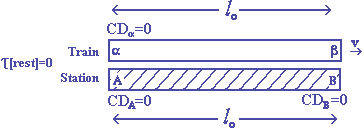
Figure 9.1
Identical clocks labeled A and B are located at rest at each end
of a station A-B having a length lo[rest].
There is no gradient of gravitational potential in this
experiment. In front of the station A-B, a moving train a-b has a
length such that when in motion, the clock labeled a located at one end of the train passes
in front of clock A at the same time as clock b, located at the other end of the train,
passes in front of clock B. Clocks a,
b, A and B were built identically on
the station. Clocks a and b were later put in motion. The
synchronization of the clocks is described below.
9.3 - Synchronization
of Clocks A and B.
9.3.1 - Method #1.
Clocks
A and B on the station are synchronized in the following way. A
pulse of light is emitted from A and reflected on a mirror at B
toward A. The observer in A records on his clock a difference of
clock displays DCDA for
the return trip of the light.
When
the traveling clock a passes near A,
we arbitrarily synchronize clocks a
and A together at zero. At that moment, the absolute time t[rest] on the frames is defined as zero:
| t[rest] = 0 and CDA
= CDa = 0 |
9.1 |
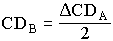
In the
second part of the experiment, a pulse of light emitted by A is
received at B. At that moment, the observer at B synchronizes his
clock at:
 |
9.2 |
Of course
the absolute time is the same everywhere. This synchronization
method gives a clock display on clock B equal to zero when time t[rest] equals zero:
| t[rest] = 0 when CDB
= 0 |
9.3 |
The
synchronization of clock b at time t[rest] = 0 will be determined in section
9.5.
9.3.2 - Method #2.
Nobody
ever
proved
experimentally
that
the
velocity of light is the same when moving from A to B than when
moving from B to A. Michelson's experiment has shown that the
time taken for light to make a return trip between two points
oriented in a different direction in space is the same. However,
there is an error in the
Michelson-Morley demonstration. His experiment has
nothing to do with the measurement of any difference of transit
time during each half of the trip. Some researchers wishing to
investigate more deeply this problem have realized that the
method of synchronization described in section 9.3.1 is not
appropriate if the velocity of light is not identical in both
directions. Consequently, other methods of synchronization have
been suggested in hopes of taking into account the possibility
of a non constant velocity of light in different directions. A
very original method [1]
consists in using a new reference clock labeled m, which carries the display shown by A
at a very small velocity e (of the
order of 10-9 of
the velocity of light) on the station from A to B and later from
B to A. In this way, the stationary clocks A and B can be
synchronized independently in each direction with the traveling
clock m. This method of
synchronization is quite interesting since, as we will now show,
any shift of display on clock m due
to its passage from A to B (or B to A) is negligible at very low
velocity.
The
time taken by clock m to move from A
to B is:
 |
9.4 |
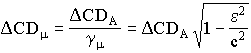
Let us
compare the difference of clock displays DCDm recorded on clock m during its travel time from A to B with
the difference of clock displays DCDA recorded on the stationary clock A during the same time
interval. Using equation 3.10, we have:
 |
9.5 |
The first
two terms of a series expansion give:
 |
9.6 |
From
equations 9.4 and 9.6, we have:
 |
9.7 |
Since e is very small compared with c2 (»
10-18), we can
approximate e/c2 to zero. This gives:
| DCDA-m = DCDA-DCDm
= 0 |
9.8 |
Consequently, clocks A and B can effectively be synchronized using
a third clock m carrying the display
of clock A at very low velocity from A to B. Similarly, we find
that the difference of displays between clocks m and B is not significant when clock m moves from B to A. This is the result
obtained when clock m moves with
respect to a rest frame. In the case of clock m
moving on a moving frame, the calculations will be done in section
9.7.
9.4 - Loss of
Synchronization of Clock a on the
Moving Frame.
Let us
calculate the difference of clock displays on clock a moving across distance lo[rest]
from A to B as shown on figure 9.2.

Figure 9.2
Since
the train moves at velocity v[rest] and the distance traveled by
a is lo[rest], the
time interval Dt1[rest]
for clock a to reach B will be:
 |
9.9 |
Therefore
clock a will be in front of B when:
 |
9.10 |
where t1 is the absolute time (after
the initial synchronization) when a
arrives at B.
However,
the moving clock a runs at a slower
rate than clock A. From equation 3.10 we find that after the time
interval Dt1[rest] taken by
clock a to reach point B, the display
on clock a is:
 |
9.11 |
where gv is the value of g corresponding to velocity v. From
equation 9.11, we see that even if clock a
is initially synchronized with clock A (and with clock B), the
synchronization is lost when a travels
the distance lo[rest] (or any distance). The
display of clock a becomes late with
respect to clocks A and B at rest, as shown by equations 9.10 and
9.11. Let us calculate the difference of clock displays between
clocks a and B when a is at B (see figure 9.2).
 |
9.12 |
The first
two terms of a series expansion give:
 |
9.13 |
Equation 9.13 shows that in order to be compatible
with the different clock rates of a
and A and with the synchronization of a
and A, the moving clock a must show a
clock display which is different from CDB when clock a is just besides B.
9.5 - Synchronization
between Moving Clocks a and b (Method #1).
In
section 9.3.1, we described the synchronization of clock B with
clock A. It consists in setting clock B when light is received
at B, to one half of the interval DCDA
taken by light to go from A to B then back to A. We now
calculate the consequences of applying the same synchronization
method inside a moving frame. Let us consider a pulse of light
emitted from x on figure 9.3 at time t[rest]
= 0. At that moment, we have:
| t[rest] = 0, CDa = CDA = CDB
= 0 |
9.14 |
Let us
calculate at what absolute time t2[rest] light emitted
from a reaches clock b as illustrated on figure 9.3.
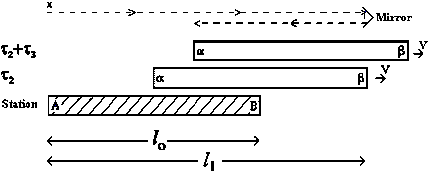
Figure 9.3
We see
that light approaches clock b at a
relative velocity of c-v. For the observer in the moving frame,
the distance to be traveled is lo[rest]. The
absolute time interval Dt2[rest] to reach clock b
is:
 |
9.15 |
When light arrives at clock b, the display on clock a is:
 |
9.16 |
After
being reflected on clock b at time t2[rest],
the light goes back to clock a. Since
clock a and light now travel in
opposite directions, light approaches clock a
at a relative velocity of c+v. The absolute time interval Dt3[rest](b to a) for
light to pass from b to a is:
 |
9.17 |
Therefore
the
total
time
interval
for
light to travel from A to b and back
to a is:
|
Dt[rest](A ®b®a) = Dt2[rest](A
to b)+
Dt3[rest](b
to a)
|
9.18 |
Using
equations
9.15
and
9.17,
we
find:
 |
9.19 |
Neglecting v2
compared to c2 gives:
 |
9.20 |
Since
clocks a and b
are moving, their clock rate is gv
times slower than the clock rate of clocks A and B. Consequently,
from equation 9.20, after the return trip of light (A ®b®a) the display on clock a is:
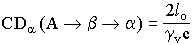 |
9.21 |
Let
us now synchronize clock b with clock
a using method #1. Since light is
emitted from a at CDa = 0, using equation 9.21, at the moment
light arrives at b, clock b must be synchronized to:
 |
9.22 |
However,
we have seen in equation 9.16 that at the same moment, clock a shows a different display. Therefore this
method of synchronization gives different clock displays at the
same instant on clocks a and b. This difference is given by equations
9.16 and 9.22:
 |
9.23 |
Therefore at t[rest] = 0 (when CDa = 0) clock b
must not be synchronized to the same display as clock a. Using equation 9.23, synchronization
method #1 shows that at t[rest] = 0
we must have:
 |
9.24 |
The
phenomenon calculated in equation 9.24 is required for a
complete explanation of the mechanism of the advance of the
perihelion of Mercury as mentioned in section 5.6.
9.6 - Asymmetric
Relative Velocity of Light.
We have
seen that the time interval Dt2[rest]
(equation 9.15) for light to go from a
to b is larger that the time
interval Dt3[rest] (equation 9.17) for the return from b to a.
However, the locations a and b between which light moves, are always
separated by the constant distance lo[rest].
Because
we used the synchronization method #1 on clocks a and b, the
differences of clock displays recorded on those local clocks
when light travels from a to b and from b
to a are identical. Consequently,
Einstein's synchronization method leads to a difference of
synchronization between clocks a and
b such that it prevents the moving
observer from being able to detect that the absolute time for
light to move from a to b is different from the time to move from
b to a.
It is this difference of synchronization between clocks a and b that
prevents the observers in a and b to realize that the light that
approaches them has a relative velocity different from c. The
expression "velocity of light" is too vague. It is much more
significant to describe the velocity at which light approaches
an observer or recedes from him. Using that description, the
velocity of light with respect to an observer can be different
from c.
We see
that this constant number representing the absolute velocity of
light in any frame (in [frame] units) is just a mathematical
illusion. We have shown that it is due to the different clock
rate on the moving frame and to the clock synchronization of the
moving observer. In fact, the velocity of light is an absolute
constant in an absolute frame at rest but due to the different
clock rate on the moving frame and to the synchronization, it appears
constant in any frame.
One
must conclude that inside a moving frame, a difference of clock
displays always exists at one given instant between two clocks (a and b)
located on that frame. Consequently, synchronization method #1
inside a moving frame satisfies the condition of an apparent
constant velocity of light inside that frame but leads to a
different setting of clocks a and b at one instant. In fact everything
appears the same in the moving frame as everywhere else because
the local parameters change in the exact same way to make it
appear so. We will show that this apparent absoluteness of
parameters within individual frames also appears when other
synchronization methods are used. One can say that the observer
is fooled whatever technique he uses to detect his motion.
9.7 - Synchronization
of Clocks a and b (Method #2).
We have
seen in sections 9.5 and 9.6 that inside the moving frame,
synchronization method #1 does not lead (at a given time t[rest]) to the same clock display on
clocks a and b,
even if they are attached to the same frame. A moving observer
might believe that he could detect this difference of clock
displays using synchronization method #2 which consists in
moving a third clock m at low
velocity from a to b. We have seen in section 9.3.2 that
there is no drift of clock display on clock m
when it moves slowly across a frame at rest from A to B. Let us
study now what happens when we move clock m
within the moving frame a-b.

Figure 9.4
Figure
9.4
illustrates
a
train
moving at velocity v with respect to the station. Its length is
lo[rest]. Clock m inside the
train moves at a very small velocity with respect to the train
(using rest units). The observer on the station measures the
velocity of clock m to be e[rest] larger than the velocity v[rest]
of the train. The total velocity u[rest] of clock m with respect to the station is then:
| u[rest] = v[rest]+e[rest] |
9.25 |
Let
us
calculate
the
time
interval
Dt[rest] for clock m
to move from a to b.
Inside the train, clock m must travel
the moving distance lo[rest] at a relative
velocity of e[rest]. The time interval
Dt4[rest]
for
clock m to travel across the moving
distance lo[rest] is:
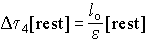 |
9.26 |
The distance l2[rest] traveled by the train during that time interval Dt4[rest]
is:
 |
9.27 |
The
total distance l3[rest]
traveled by clock m is then:
| l3[rest] = l2[rest]
+ lo[rest] |
9.28 |
The
difference
of
clock
displays
on
clock a traveling distance l2[rest] is:
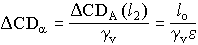 |
9.29 |
where
DCDA(l2) is the difference of clock displays on clock A (or B)
corresponding to Dt4[rest]. The difference of clock displays on clock m travelling lo[rest]
aboard the train is:
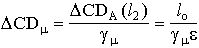 |
9.30 |
where
gm is the value of g
corresponding to the velocity v+e of
clock m. The difference of clock
displays between clock a (or b) and clock m
is, using equations 9.29 and 9.30:
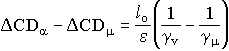 |
9.31 |
Using
the
first
two
terms
of
series expansions we find:
 |
9.32 |
and
 |
9.33 |
Equations
9.32
and
9.33
give,
to
the first order:
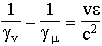 |
9.34 |
Therefore,
the difference between the DCDm on the moving clock inside the
train and DCDa
on the clock moving with the train is:
 |
9.35 |
We
see
that
the
difference
of
clock displays DDCDa-m given by equation 9.35 is directly proportional (first
order) to the velocity v of the train independently of the
velocity e of clock m. Consequently, a slow moving clock m inside a moving train is submitted to a
slowdown of its clock rate so that when reaching clock b, its display is no longer the same as
clock a as shown in equation 9.35. Let
us compare this shift of display (due to velocity e) with the difference of clock displays
between clocks a and b given in equation 9.23 due to the
synchronization of a with b. We have seen in equation 9.23, that the
difference of clock displays (to the first order) between clocks a and b at one
given instant is:
 |
9.36 |
Equation
9.36
(or
9.23)
is
identical
to equation 9.35. Consequently, the drift of clock display on
clock m when moving from a to b is
identical to the initial difference of synchronization between
clocks a and b.
When clock m arrives at b from a,
supposedly carrying the display from a,
its display will be identical to the display on clock b.
To study
the case when clock m moves in the
opposite direction, we just have to substitute v+e in equation 9.33 by v-e
and replace DCDa in equation 9.31 by
DCDb. This is correct because equation 9.29 gives not a
clock display but a difference of clock displays. Equation 9.34
stays the same except for a negative sign and we get for 9.35:
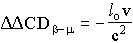 |
9.37 |
We
see
then
that
when
clock
m moves slowly in the opposite
direction from b to a, it will run at a faster rate so that
when it arrives besides clock a, its
display will be the same as the one already existing on clock a. We see that clock m
shows the display of clock a when
located near a and the display of
clock b when located near b. One must conclude that synchronization
method #2 is totally unable to reveal the difference of clock
displays between a and b inside a moving frame generated by
synchronization method #1.
9.8 - References.
[1] This method is often used by F. Selleri, Universita
di Bari, Dipartimento di Fisica, Sezione, INFN, Via Amendola,
173, I70126 Bari, Italy.
9.9 - Symbols and
Variables.
| CDA |
clock display on clock A |
| CDa |
clock display on clock a |
| CDB |
clock display on clock B |
| CDb |
clock display on clock b |
| lo[rest] |
length of the station and the moving
train in rest units |
| t[rest] |
absolute time (in rest units) |
<><><><><><><><><><><><>
Chapter8 ContentsChapter
10
Return To: List of Papers on the Web
Where to get a Hard Copy of this Book