 Einstein's Theory
of Relativity
Einstein's Theory
of Relativity
versus
Classical Mechanics
by Paul Marmet Where to get a Hard Copy of this Book
10.1 - Introduction.
versus
Classical Mechanics
by Paul Marmet
Where to get a Hard Copy of this BookChapter Ten The Principle of Equivalence.
10.2 - Deflection of
Light in an Elevator Moving at Constant Velocity.
Experiments describing a constant relative transverse velocity
between a source and an elevator are generally ignored. Let us
consider a horizontal parallel beam of light (or particles, as
on figure 10.1) projected on an elevator (of negligible mass)
moving upward at a constant velocity v with respect to the
source. The experiment takes place in outer space far away from
any gravitational field.
Because
momentum must be conserved, the beam of light must move in a
straight line. On figure 10.1, the dotted line inside the
elevator shows where the photons can be detected with respect to
the moving elevator at different times. The relative location of
the photons with respect to the elevator moving at a constant
velocity v is:
 |
10.1 |
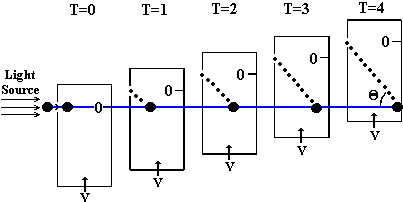
Figure 10.1
10.3 - Inertial versus
Gravitational Acceleration of Masses.
Before
considering the problem of photons moving with respect to an
accelerated frame, let us study a mass m
moving horizontally. The mass enters an elevator which has an
upward acceleration a in outer space
at the moment its vertical velocity with respect to the source
of the mass is zero. The elevator is accelerated by a rocket
placed under it to produce a force F (shown by upward arrows on
figure 10.2A). Due to that force F, the elevator (and the
observer) accelerates following Newton's law:
| F = Ma | 10.2 |
 |
10.3 |
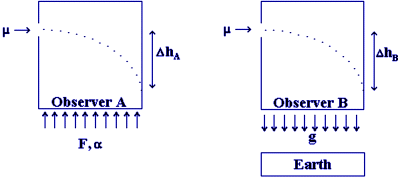
Figure 10.2A Figure 10.2B
Let us
consider a similar elevator located at rest on Earth as
illustrated on figure 10.2B. The Earth's gravitational field
accelerates the mass m toward the
Earth's center. After a time interval Dt,
when the mass hits the opposite wall of the elevator, it will
have traveled an absolute vertical distance DhB.
In the
experiment described on figure 10.2A, the mass m is completely free of any field and any
force and therefore cannot gain any absolute energy when the
floor of the elevator approaches it. An atomic clock bound to
that free mass m will maintain a
constant rate since no acceleration (therefore no energy) is
given to the electrons or particles of the atomic clock.
However, the elevator with the observer will gain kinetic energy
(and therefore mass) due to the momentum transferred by the
rocket. The observer's clock located on the floor of the
elevator will slow down (absolute time) due to its increase of
velocity in free space as given in equation 3.9. Consequently,
the observer using the moving clock will observe a relative blue
shift on light emitted from mass m.
Let us note that the Doppler effect is considered separately and
has not been taken into account.
In the
experiment described on figure 10.2B, the elevator and the
observer cannot gain any energy as a function of time since no
work is produced on them. Neither the potential of the observer
nor its velocity change. Therefore, the atomic clock of the
stationary observer will keep giving a constant rate as a
function of time. However, the clock on the falling mass will
slow down for two reasons (independent of the Doppler effect):
First, because of its increase of velocity (equation 3.10) and
second, because of its decrease of potential energy (equation
1.22). Consequently, the observer standing in the elevator will
observe a red shift on light emitted by the falling mass m.
The
Doppler contribution to the shift of frequency is identical in
figures 10.2A and 10.2B (if a = g).
Its amplitude is much more important than the one due to the
change of internal mass. However it can be subtracted out to
show the difference explained above.
We see
that the principle of mass-energy conservation implies that
there is a fundamental difference between an inertial
acceleration and an acceleration due to gravity since the
consequences of each acceleration are just opposite. In the case
of inertial acceleration (figure 10.2A) the clock located on the
apparently falling mass will run faster than the
observer's clock because of the slowing down of the observer's
clock. On the contrary, in the case of gravitational
acceleration (figure 10.2B), the falling clock will run more
slowly than the observer's clock. One must conclude that the
physical properties of the gravitational acceleration are
different from the ones of inertial acceleration which means
that the gravitational acceleration is not equivalent to the
inertial acceleration.
10.4 - Bremsstrahlung
Due to Inertial and Gravitational Accelerations.
To
illustrate the difference between inertial and gravitational
accelerations, let us consider another thought experiment in
which electric charges are placed in a gravitational field. One
or more electrons are deposited on a stationary insulator in the
Earth's normal gravitational field. This is static electricity.
It is well known that Maxwell's equations predict that any
accelerated electric charge must emit radiation called
bremsstrahlung. According to Einstein's principle of
equivalence, charges at rest in the Earth's gravitational field
should emit bremsstrahlung because of the gravitational
acceleration. However, no experiment has ever detected the
emission of bremsstrahlung due to the gravitational acceleration
of static electricity. The emission of radiation due to
gravitational acceleration has been overlooked.
There
is a way to prove that charges submitted to a gravitational
acceleration do not emit bremsstrahlung. The principle of
mass-energy conservation requires that energy must be given to
an electric charge in order to compensate for the
electromagnetic energy emitted during its acceleration. Let us
try to identify the origin of the energy responsible for the
bremsstrahlung predicted by Maxwell's equations and Einstein's
principle of equivalence.
If
bremsstrahlung is emitted when electric charges are submitted to
gravity, there must be an energetic mechanism available to
compensate for the energy lost by radiation. That continuous
emission of radiation due to gravitational acceleration must
necessarily extract energy from a source. Therefore, after a
long period of time, the accumulated loss of energy in the
source will be more easily detectable than the weak
bremsstrahlung emitted. In the case of individual electrons
stationary in a gravitational field, the only source of energy
available is their mass. Consequently, the electron mass should
decrease as a function of time to compensate for the
electromagnetic energy bound to be emitted. If the electron mass
decreases when standing in a gravitational field, one should
eventually find electrons with different masses depending on the
time they have been submitted to the Earth's gravitational
acceleration.
However, it is observed that electrons maintain their full
integrity and do not lose any mass while standing in a
gravitational field. All electrons have the same mass. Due to
the principle of mass-energy conservation, the absence of any
source of energy shows that no bremsstrahlung can be emitted
from gravitationally accelerated electrically charged particles.
However, in the case of inertial acceleration, the mechanical
energy required is well identified and compensates for the
electromagnetic energy emitted as bremsstrahlung.
These
considerations show again that gravitational acceleration is
different from inertial acceleration. Bremsstrahlung is emitted
only when submitted to inertial acceleration. Since Einstein's
general relativity is based on Maxwell's equations and the
principle of equivalence, we must reexamine Einstein's
predictions.
10.5.1 - Light Path
in an Accelerated Elevator.
Let us
now consider the experiment described in section 10.3 but using
light instead of masses (figure 10.3A). Due to the conservation
of momentum, light keeps moving in a straight line (as on figure
10.1) and takes a time interval Dt
to go across the elevator. Because of the elevator's increasing
upward velocity, during the time interval Dt,
light seems to travel a vertical distance Dh:
 |
10.4 |
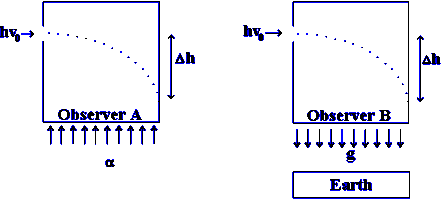
Let us assume that the acceleration due to the rocket produces a change of velocity dv/dt equal to g = 9.8 m/s which is the gravitational acceleration on Earth. Observer A will feel that the upward force of the floor produces the same downward path on the photon as for a massive particle accelerated in the Earth's gravitational field (figures 10.2A and 10.2B).
Figure 10.3A Figure 10.3B
10.5.2 - Light Path
in a Gravitational Field.
Let us
assume momentarily that the equivalence principle is valid.
Therefore, with respect to observer B on figure 10.3B, light
entering the room horizontally would be deflected as
illustrated. This hypothesis implies that light is attracted by
gravity. However, to be valid, we must verify that such an
hypothesis is compatible with mass-energy conservation. If light
is deflected, let us calculate the energy relationship caused by
that deflection.
Let us
call F the hypothetical gravitational force on a photon in the
direction of the gravitational acceleration. During its passage
across the elevator, we assume that the photon is deflected on a
distance Dh in the direction of the
force F, as shown on figure 10.3B. Mass-energy conservation
requires that a displacement Dh in
the same direction of a force F gives an increase of energy DW equal to:
| DW = FDh | 10.5 |
| DW = 0 | 10.6 |
| DW = 0, F = 0 and Dh = 0 | 10.7 |
10.5.3 - The
Equivalence Principle and Light Deflection.
It has
been well recognized that the deflection of light rays is
closely related to the equivalence principle discussed above.
According to the paper "The Equivalence Principle with Light
Rays"[1]:
Since the equivalence between inertial and gravitational acceleration assumed by Einstein is erroneous as shown above in several independent ways, it is not surprising that its consequence (light deflection) is also erroneous.
"This [the equivalence principle] led Einstein to predict that light is bent by a gravitational field around the Sun"
10.6 - Gravitational
Lenses.
There
are several consequences to the fact that light is not deviated
in a gravitational field. The deviation of light by a
gravitational field gave birth to the claim that rings in space
are caused by the focusing of light coming from remote sources
by the gravitational mass of intervening galaxies. This
explanation is certainly erroneous since light is not deviated
by a gravitational field.
These
rings can be explained more logically by the presence of large
quantities of ions moving in the magnetic field of a galaxy. It
is well known that ions spread naturally into rings in a
magnetic field. This is a rational interpretation of a
phenomenon that has been erroneously interpreted as Einstein's
rings.
10.7 - Attracting Force
between Parallel Beams of Charged Particles.
We have
seen in section 10.4 that electrical phenomena can be used to
demonstrate that gravitational acceleration is different from
inertial acceleration. To end this chapter, we will give an
example using electricity disproving the principle of
reciprocity (for another proof, see section 3.9).
In
elementary physics, Ampere's law teaches how to calculate the
force between two parallel straight conductors carrying currents
in the same direction. We learn that a force F between parallel
conductors spaced by a distance Dx
is induced because the current i' in the second conductor passes
in the magnetic field generated by the current i in the first
conductor. The force F by unit of length (in MKS units) is:
 |
10.8 |
[1]
http://altair.syr.edu:2024/lightcone/equivalence.html
[2] F. W. Sears, Principles
of Physics, Addison-Wesley, p. 267, 1946
Return To: List of Papers on the Web
Where to get a Hard Copy of this Book
Author address