
Figure 1
1- Introduction.Return to: List of Papers on the WebGo to: Frequently Asked Questions
2-
Accepted Interpretation of Umbral Enlargment.
We know
that
astronomical data give us accurate values of the radii of the
Sun, the
Earth and the Moon. Furthermore the knowledge of their relative
distances
gives us accurate predictions of the exact instant when the
umbra-penumbra
limit sweeps some specific crater on the moon during lunar
eclipses.
However,
numerous
reports show that the umbra-penumbra limit appears significantly
displaced
on the moon during an eclipse. It is believed that the thickness
of the
Earth atmosphere is responsible for that displacement. The
article of
Roger
W. Sinnott ("Readers Gauge the Umbra Again", in Sky &
Telescope,
April
1983, p. 387) illustrates this interpretation of the shadow's
enlargement
in his statement: "It [the atmosphere] always
increases
slightly
the silhouette of our globe in forming the sharply defined
central
region of the shadow called the umbra."
Similar
conclusions
are also presented by Sinnott in "A Tale of Two Eclipses" (Sky
&
Telescope,
December 1992, p. 678). Therefore, it could be implied that
crater
timings
during full lunar eclipses can be used as a tool to evaluate the
degree
of pollution of our atmosphere.
A
similar
result has also been claimed by Byron W. Soulsby in "Lunar
Eclipse
Crater
Timing Programme" (Journal of the British Astronomical
Association,
Volume
95, Number 1, p.18) where he writes:
In order to study more deeply that phenomenon, it is important to evaluate if the reported increase of 2% of the Earth's shadow at the Moon corresponds to a reasonable value of the height at which the atmosphere is opaque. Calculations give that this amount corresponds to an altitude of 92 km on the Earth."Each eclipse can exhibit oblateness variations due in the main to the conditions prevailing in the Earth's atmosphere at the time of the event, particularly when large volcanic eruptions have occurred before the observations are made."
3-
On the Threshold of Sensitivity of the Eye.
There
is an
important fact that has been overlooked to explain the umbral
enlargement
on the moon. It is linked to the sensitivity of the eyes. It is
commonly
known that under a certain threshold of light intensity, light
cannot
be
detected by the eye. This limiting threshold is quite general
and must
be applied especially when observing a dark limit during a lunar
eclipse.
During
a
lunar
eclipse, we see that the light intensity goes from zero
intensity (at A
on Fig. 1) at the umbra-penumbra limit to an increasing
intensity when
moving across the penumbra. In order to illustrate that increase
of
illumination
we have plotted on Fig. 1 two independent lines corresponding to
two
different
intensities of light. The two intensities plotted correspond to
two
different
coefficients of reflection (albedo) of solar light on the Moon
at
different
locations. Due to the sensitivity of the observer's eyes, we see
on
Fig.
1 that the location of the detection threshold is either
observed in B
or in C depending on the amount of light reflected on the
particular
location
observed on the Moon. On Fig. 1, we see that the location where
the
detection
threshold B or C is observed is at a closer distance to the
umbra-penumbra
limit (in A) for a brighter feature than for a darker one.
Those
considerations
show that the locations B or C determined by the observer as the
detection
threshold are not the umbra-penumbra limit at A. Due to the
inherent
threshold
of sensitivity of the eye the umbra-penumbra limit appears at B
or C.
Therefore,
the observations give an error DxB
or DxC . In the case of a
lunar
eclipse,
the distance (or time) between the umbra-penumbra limit (in A)
and the
point of detection B or C of the umbra corresponds to a
displacement
called
Dx.
On the opposite side of the Earth umbra, this displacement Dx
is symmetrical so that the total width of the umbra on the moon
appears
to be widened by 2Dx.
4-
Apparatus.
The
above
model gives only a qualitative prediction of errors DxB
or DxC from the well
known
phenomenon
of the threshold of sensitivity of the eye. In order to prove
that the
displacements actually observed on the Moon during eclipses are
really
due to the threshold of sensitivity of the eye, one must
actually
perform
the experiment. We have built an apparatus in order to test the
model
above
in conditions that can be measured with the total absence of
atmosphere.
This was realized in a laboratory, using a well calibrated
circular
source
of light for the Sun and an accurately known occulting disk to
simulate
the Earth. The shadows were projected on an exact photograph of
the
Moon.
In the controlled conditions of a lab, after repeated
observations, it
is not too difficult to measure the displacement of the
umbra-penumbra
limit with an accuracy of the order of 0.1 % .
In our experimental set up, light is projected onto a rectangular black piece of cardboard which creates an umbra that is intercepted on the high quality picture of the Moon. Observers locate themselves as close as they wish to the Moon (picture). Placing the observer closer or further to the Moon would just correspond to having a more or less powerful telescope. The piece of cardboard (the Earth) is moved slowly with a micrometer mechanism. The moving umbra is observed crossing the Moon (picture) and the observer is asked to report at what point a certain feature (a crater) of the Moon is being crossed by the umbra. This measured displacement of the Earth between the positions where the shadow is entering and leaving the relevant crater on the Moon enables us to measure the length of the umbra at the Moon.
Difference of illumination between points B and C in the penumbra and the umbra-penumbra limit in A versus the distance between them for two sources of different intensity.
5-
Data and Analysis.
Fig. 2
and
3 show us the ray tracings leading to the limits of the umbra
and the
penumbra.
The relevant corresponding parameters used in the lab are given.
We
have:
R =
radius
of the Sun = (2.8915 ± 0.0005) cm
R =
radius
of the Earth = (7.05 ± 0.01) cm
s =
radius
of the Earth's umbra on the Moon
v =
distance
between the end of the umbra cone and the Sun
r =
distance
between the Sun and the Earth = (92.7 ±
0.1) cm
d =
distance
between the Earth and the Moon = (296.6 ±
0.1) cm
u =
displacement
of the Earth between the points where the crater enters and
exits the
umbra.

Figure 2
Geometry between the different elements used in the
construction
of a shadow.
These
data give a theoretical umbral radius (sthe) of
(20.36 ±
0.04) cm.
In our
experiment
we have measured the required displacement of the cardboard (the
Earth)
(uexp) between the location where the umbra just
enters the
observed crater and the location where the umbra leaves the
crater.
Using
simple geometry, it was then easy to relate that distance to the
experimental
length of the Earth's umbra on the Moon (sexp) as
seen on
Fig.
2 and 3. We also calculated the theoretical length of the umbra
(sthe)
which
then
gave
us
the
umbral
enlargement in percentage.

Figure 3
Relation between the Earth movement and the other
variables.
6-
Results.
The
Earth's
displacements measured experimentally (uexp±0.01)
cm
in
the
laboratory
by
fifteen
independent observers in different
experimental
conditions gave the following diameters in the case of the
crater
Plinius
illuminated with high light intensity (in cm):
10.05, 10.00, 10.12, 10.09, 10.06, 10.01, 9.90,
9.90,
9.95, 10.08, 10.07, 10.04, 9.95, 10.01, 9.99, 9.87, 9.87, 9.85,
9.91,
9.88,
9.87, 9.84, 9.84, 9.85, 9.94, 9.92, 9.89, 9.87, 9.98, 9.91,
9.94, 9.90,
9.86, 9.93, 9.92, 9.90, 9.88, 9.91, 9.89
In the
case
of crater Tycho illuminated at high intensity, the following
data gave
the Earth displacement between the two positions, on each side
of the
Earth,
corresponding to the detection threshold (in cm):
10.01 9.97, 10.01 9.97, 9.90, 9.96, 9.89, 9.89,
9.93,
9.95, 9.97, 9.97, 9.94, 9.86, 9.84, 9.82, 9.82, 9.82, 9.85,
9.82, 9.80,
9.92, 9.88, 9.88, 9.89, 9.87, 9.88, 9.91, 9.89, 9.93, 9.79,
9.82, 9.82,
9.87, 9.84, 9.85, 9.85, 9.88, 9.80
In the
case
of crater Tycho illuminated at low intensity, the observations
led to
the
following results (in cm):
10.10, 10.12, 10.02, 10.07, 10.08, 10.07, 9.95,
9.99,
9.94, 10.12, 10.13, 10.09, 9.90, 9.87, 9.91, 9.89, 9.85, 9.92,
9.90,
9.94,
9.92, 9.93, 9.92, 10.01 9.92, 9.91, 10.03, 10.05, 9.99, 9.88,
9.79,
9.85,
9.89, 9.90, 9.86, 9.91, 9.92, 9.92
Table 1
gives
the mean value of uexp, its corresponding sexp
and
the umbral enlargement percentage for each crater as a function
of
light
intensity. The light intensity (L) in lux was measured on a
photometer.
Table 1:
Umbral
Enlargement.
|
(lux) |
|
(cm) |
(cm) |
Enlargment ± 0.2% |
|
|
|
|
|
|
|
|
|
|
|
|
|
|
|
|
|
|
7-
Discussion.
On Fig.
1
we see that the distance between the theoretical point A (giving
the
exact
umbra-penumbra limit) and the observed thresholds B or C is
inversely
proportional
to the brightness of the source. One then expects that the
umbra-penumbra
limit must show a displacement with respect to the detection
threshold
that is proportional to the inverse of the illumination. Since
our eyes
have a logarithmic response to light intensity, we use the log
scale.
This
is illustrated on Fig. 4 which defines F as the inverse of the
log
intensity
seen by human eyes. The numerator of the function and A are the
calibrating
constants satisfying the characteristics of photometers. The
value of F
is then given by the relation:

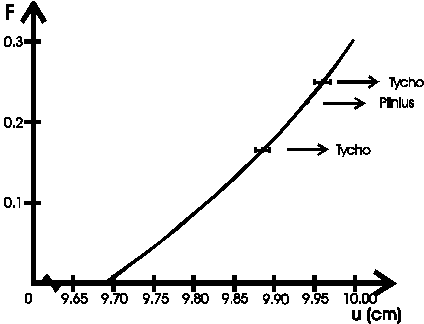
The
theoretical
limit at 9.69 cm can be joined smoothly with the two
experimental
points
for Tycho as expected from the model that the displacement is
caused by
the threshold of sensitivity of the eye. We can then put the
experimental
point for Plinius on the curve. This gives us the intensity of
Plinius
relative to the intensity of Tycho (we have to remember that
Plinius is
in an area of the Moon that reflects less light than Tycho). We
then
deduce
experimentally that Tycho is approximately 2.7 times brighter
than
Plinius
(on the photograph).
In
agreement
with the fact that the contrast of the Moon used in our
experiment is
greater
than in real life and our room darker than what people often
observe in
eclipses (i.e. our conditions of contrast are a lot better than
conditions
in a real lunar eclipse), we observe an umbral enlargement
inversely
proportional
to the intensity of the Sun (as illustrated on figure 4).
There
is
another
factor about the atmosphere that has not been discussed. Light
rays
passing
through the atmosphere are naturally bent because the atmosphere
acts
like
a prism. This is why, during an eclipse, the Moon surface is
never
completely
black but reddish: the red part of the solar spectrum passing
through
the
low atmosphere is the only part scattered on the Moon in the
region of
totality before being reflected back to us on Earth.
An
hypothetical
observer located on the Moon would see those rays being
refracted by
the
Earth atmosphere and the Sun would appear bigger. Consequently,
this
second
effect makes the Sun rays converge due to a lensing effect of
our
atmosphere.
Therefore, due to that lensing effect, the umbra projected on
the Moon
would be smaller. This refraction by the Earth atmosphere gives
an
effect
that is contrary to the observations claiming that the Earth's
shadow
must
be larger due to the thickness of the atmosphere (Antonín
Rükl,
Atlas of the Moon, Aventinum, Prague, 1990, p.214).
8-
Second Experiment.
There
is
another
more elementary way to see the effect of the threshold of
sensitivity
of
the eyes. It can be done by the simple projection of light
through an
aperture.
For example, let us consider that the light emitted by a
projector
reaching
a white screen is limited by a circular aperture between the
source and
the screen. We will observe some fuzziness on the screen around
the
image
of the luminous disk. This fuzziness is the penumbra. Due to the
optical
illusion explained above, our eyes will not perceive completely
the
full
size of the illuminated disk. Its size will appear to vary as a
function
of the light intensity of the source. We will see the bright
disk
apparently
shrinking on the screen as light intensity decreases. This
corresponds
to an increase in the umbra's length.
To
realize
that experiment with an overhead projector, one has to cover it
so no
stray
light can escape. This demonstration was readily shown using our
experimental
setup. The disk projected on the screen seems to grow bigger in
the
region
of fuzziness as the intensity of the projector is increased.
However,
solely
the light intensity and no geometrical data is changed. This
effect is
quite similar to the one taking place during lunar eclipses.
9-
Conclusion.
It is
perfectly
clear that a shadow appears smaller when the amount of light is
increased
as illustrated on Fig. 4. This is exactly the case for the
crater
timing
on the Moon during a lunar eclipse. The occulting diaphragm in
our lab
was certainly not surrounded by any atmosphere. However, it
seemed that
the umbra was about 2 % larger than the real value due to the
optical
illusion
just as in the case of astronomical observations.
We have
seen
that the atmosphere may be opaque for 15 km, but certainly not
90 km.
We
have also proved that the sensitivity of the eyes is a factor
leading
necessarily
to an umbral enlargement. Therefore, the accepted interpretation
of
umbra-penumbra
limit displacement according to which the atmosphere is the
major
factor
is not compatible with the well known phenomenon that
characterizes the
human eye. We therefore believe that almost the totality of the
reported
umbra-penumbra limit displacement is an optical effect that has
nothing
to do with the thickness of the Earth atmosphere.
10-
Acknowledgment.
We
would
like
to thank Élise Milot for the picture of the Moon as well as all
our observers: Isabelle Broussell, Roger Chagnon, Serge
Desgreniers,
Pierre
Gauthier, Saeed Hadjifaradji, Karin Hinzer, Martin Krzywinski,
Yves
Lacoursière,
Ken Lagarec, Pascal Lauzon, Dave Leblanc, Rick Legault, Moussa
Mousselmal,
Grant Nixon, Serge Oliveira. We also wish to acknowledge the
financial
assistance of the Natural Science and Engineering Research
Council of
Canada.
Apparatus.


Micrometric system (with vernier) to move the Earth's shadow

Just before the simulated moon eclipse