 Einstein's Theory of Relativity
versus
Classical Mechanics
by
Paul
Marmet
(
Last checked 2017/01/15 - The estate of Paul Marmet
)
Appendix I
The Dependence of the Size of Matter on
Electron Mass.
INTRODUCTION -
As seen
in chapter one, the size of the hydrogen atom depends directly on
the Bohr radius, which itself varies with the mass of the
electron. Is that the case for all atoms? And what about molecules
and crystals? Before we answer these questions rigorously, let us
try to answer them intuitively.
Consider
for example the hydrogen molecule, H2. It is made of
two hydrogen atoms sharing their electrons. Since the size of the
two hydrogen atoms taken separately varies with the Bohr radius,
it would be reasonable to expect the size of the hydrogen molecule
to do the same. If the radius of all atoms depended on the Bohr
radius, we could apply the same reasoning to all molecules and
crystals. Intuitively, we would arrive to the conclusion that the
dimensions of matter depend on the Bohr radius. If this were to be
the case, then according to chapter one, the size of any object
would be different depending on its location in a gravitational
potential. In this appendix, we will see how the dimensions of
matter are predicted to vary theoretically. We will first look at
all atoms. We will then study molecules which will be followed by
crystals and metals.
THE BOHR RADIUS -
Before
we start our study of the dimensions of matter, a comment needs
to be made about the Bohr radius and its use. Until now, ao
has always been considered a constant because  ,eo,
e and me have been supposed constants. With this in
mind, most experimentalists present their results in units of
bohrs using 1 bohr = ao = 5.29177×10⁻¹¹
m [1] (page 349). For an
experimentalist, by definition, that numerical value is equal to
one bohr unit whether the electron orbit in hydrogen is constant
or not.
,eo,
e and me have been supposed constants. With this in
mind, most experimentalists present their results in units of
bohrs using 1 bohr = ao = 5.29177×10⁻¹¹
m [1] (page 349). For an
experimentalist, by definition, that numerical value is equal to
one bohr unit whether the electron orbit in hydrogen is constant
or not.
For
theoretical results, this is different. Theoreticians could
decide to give the results of their calculations in function of
ao (i.e. in units of ao) to
be able to compare them to the experimentalists' results. For
the theoreticians, ao is defined as a
combination of parameters. Therefore ao is
constant only if all the parameters are constant. One then has
to be careful in reading theoretical results and look at the
method used to see if there really is a dependence of ao
or if it is just a unit. Let us make sure that the physics is
not lost in those calculations.
Most
authors do their calculations in atomic units. In those units, me
= e =  = 1.
This means that the unit of mass is the electron mass. When the
Schrödinger equation (or the Dirac equation) is expressed in
those units, we end up with an equation that seems independent
of me. The authors then go on with numerical
calculations to solve the equations. But if the mass of the
electron is not a constant, then it is not necessarily equal to
one in atomic units (with respect to the initial frame of
reference). This changes the Schrödinger (or Dirac) equation
which changes its solution which changes the value of the
parameter we are looking for (e.g. the bond length or the radius
of an atom in the initial frame of reference). All the results
in this appendix being theoretical, we made sure that their
dependence in ao was real.
= 1.
This means that the unit of mass is the electron mass. When the
Schrödinger equation (or the Dirac equation) is expressed in
those units, we end up with an equation that seems independent
of me. The authors then go on with numerical
calculations to solve the equations. But if the mass of the
electron is not a constant, then it is not necessarily equal to
one in atomic units (with respect to the initial frame of
reference). This changes the Schrödinger (or Dirac) equation
which changes its solution which changes the value of the
parameter we are looking for (e.g. the bond length or the radius
of an atom in the initial frame of reference). All the results
in this appendix being theoretical, we made sure that their
dependence in ao was real.
ATOMS -
It is
easy to derive the radius of all hydrogenlike atoms by supposing
that they are just like a hydrogen atom with an electron
orbiting a nucleus of charge Z. According to Levine [1] (page 525):
"The average radius of a hydrogenlike
atom is proportional to the Bohr radius ao, and ao
is inversely proportional to the electron mass".
The radius of all other atoms has been well
investigated [2, 3] and the results given are proportional to the
Bohr radius. The method used in [2] was
the Hartree-Fock method [4] and in [3], the Dirac-Fock method which is just
the Hartree-Fock method with relativistic corrections due to the
mass of the electron with respect to the nucleus frame of
reference. The Dirac-Fock method gives no relativistic correction
of the electron mass with respect to an external gravitational
potential.
THE HYDROGEN MOLECULE ION -
The
hydrogen molecule is composed of two hydrogen atoms, each made
of one electron and one proton. Its positive ion, H2+
, made of two protons and one electron, is a system that
can easily be solved [1, 5, 6]. Upon finding its wave function
and the potential of the nucleus (in the Born-Oppenheimer
approximation), it is possible to calculate the distance between
the two protons. This gives 2.00ao. (The
variational method is used to solve this problem [5]. It uses wave functions of the
hydrogen atom which depend on the Bohr radius.) The internuclear
distance of a molecule is in direct relationship with the size
of that molecule. We see then that the size of the hydrogen
molecule ion is proportional to ao .
This
means that when we change the mass of the particle moving about
the nucleus, the size of the hydrogen molecule ion also changes.
This has already been realized by Levine [1]
(page 355):
"The negative muon (symbolm-) is a short-lived (half-life 2×10⁻⁶
s) elementary particle whose charge is the same as that of an
electron but whose mass mmis 207
times me. When a beam of negative muons (produced when ions
accelerated to high speed collide with ordinary matter) enters
H2 gas, a series of processes leads to the formation of
muomolecular ions that consist of two protons and one muon.
This species, symbolized by (pmp)+,
is an H2+ ion in which the electron has been replaced by a
muon. Its Re [the distance between the two protons] is 2.00 2/(mme2) = 2.00
 2/(207mee2) = (2.00/207) bohr = 0.0051Å."
It is
about one hundred times smaller than the Bohr radius. If one day
we are able to produce a molecule with a proton and an
anti-proton, the internucleus distance of that molecule will be
amazingly small. It is obvious from this result that the size of
the hydrogen molecule ion depends on the electron mass.
OTHER MOLECULES -
A lot
of calculations have been done to find the size of molecules
(i.e. the length of the bonds in the molecule) [7, 8, 9]. Some
of the molecules studied include F2, Cl2,
LiCl, Ni , HF and HCl. For heavier molecules, the calculations
were done using internal relativistic corrections [10, 11, 12]
because of the higher mass of the electron. Relativistic
corrections due to an external gravitational potential were
never taken into account. Some of the molecules studied in this
way are N2, N2+ , Au2,
AuH, AuCl, Cl2, F2, Xe2, Xe2+
, TlH and Bi2. The table published by Pyykkö [10] is extensive and covers more than
one hundred molecules. All the results cited in the references
are in units of ao or in units that are
related to ao and are proportional to ao.
CRYSTALS AND METALS -
According to Zhdanov [13] (page
201), the equilibrium distance between particles in a crystal is
proportional to the equilibrium spacing in a diatomic molecule
having the same parameters for the potential energy. (The
constant of proportionality depends only on the structure of the
crystal.) This means that the size of crystals is proportional
to the Bohr radius since we have seen in the previous section
that the size of all molecules (and thus the distance between
the nuclei in diatomic molecules) is proportional to the Bohr
radius. Furthermore, the same author [13]
(pages 208-209) develops an ionic model for metals. According to
this model, the atomic radius in a metallic crystal (which is
defined as half the shortest interatomic distance) can be
expressed as:
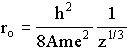
where h is Planck's constant, A is Madelung's
constant, m is the electron mass, e is the charge of the
electron and z is the valency of the atom. We see then that the
size of metals is proportional to the Bohr radius as defined in
chapter one.
CONCLUSION -
It is
obvious that the size of all matter is strongly dependent on the
Bohr radius and therefore the mass of the electron. Even if
relativistic corrections are applied internally using Dirac's
calculations, this correction does not take into account the
relativistic effect caused by an external gravitational
potential. This means that, since every object we know is made
of either atoms, molecules, crystals or metals, the results of
chapter one concerning the dilation and contraction of the Bohr
radius in the hydrogen atom apply to all matter including
humans. Finally, we conclude that this dilation or contraction
is real.
REFERENCES
[1] Levine, Ira N., Quantum
Chemistry, Prentice Hall, Englewood Cliffs, New Jersey,
1991, 629 pages.
[2] Froese Fischer,
Charlotte, Average-Energy-of-Configuration Hartree-Fock
Results for the Atoms Helium to Radon, Atomic Data and
Nuclear Data Tables, volume 12, page 87, 1973.
[3] Desclaux, J. P., Relativistic
Dirac-Fock
Expectation
Values
for
Atoms with Z=1 to Z=120, Atomic Data and Nuclear Data
Tables, volume 12, page 311, 1973.
[4] Froese, Charlotte, Numerical
Solution
of
the
Hartree-Fock
Equations, Canadian Journal of Physics, volume 41,
page 1895, 1963.
[5] Cohen-Tannoudji,
Claude, Bernard Diu et Franck Laloë, Mécanique quantique,
Hermann, Paris, 1986, 1518 pages.
[6] McWeeny, Roy, Coulson's
Valence, Oxford University Press, Oxford, 1979, 435 pages.
[7] Christiansen, Phillip
A., Yoon S. Lee and Kenneth S. Pitzer, Improved Ab Initio
Effective Core Potentials for Molecular Calculations, Journal
of Chemical Physics, volume 71, number 11, page 4445,
1979.
[8] Noell, J. Oakey,
Marshall D. Newton, P. Jeffrey Hay, Richard L. Martin et Frank
W. Bobrowicz, An Ab Initio Study of the Bonding in Diatomic
Nickel, Journal of Chemical Physics, volume 73,
number 5, page 2360, 1980.
[9] Hay, P. Jeffrey,
Willard R. Wadt et Luis R. Kahn, Ab Initio Effective Core
Potentials for Molecular Calculations. II. All-Electron
Comparisons and Modifications of the Procedure, Journal
of Chemical Physics, volume 68, number 7, page 3059, 1978.
[10] Pyykkö, Pekka, Relativistic
Effects in Structural Chemistry, Chemical Reviews,
volume 88, page 563, 1988.
[11] Ziegler, Tom, Calculation
of
Bonding
Energies
by
the Hartree-Fock Slater Transition State Method, Including
Relativistic Effects, in Relativistic Effects in
Atoms, Molecules and Solids, G. L. Malli editor, Plenum
Press, New York, page 421, 1981.
[12] Ermler, Walter C.,
Richard B. Ross et Phillip A. Christiansen, Spin-Orbit
Coupling and Other Relativistic Effects in Atoms and Molecules,
Advances in Quantum Chemistry, volume 19, page 139, 1988.
[13] Zhdanov, G. S., Crystal
Physics, Academic Press, London, 1965, 500 pages.
=========================
Chapter12 Contents Appendix 2
Return To: List of
Papers on the Web
Where to get a Hard
Copy of this Book