 Einstein's
Theory of Relativity
Einstein's
Theory of Relativity
versus
Classical Mechanics
by Paul Marmet
Chapter Three
Demonstration of the Lorentz Equations
without Einstein's Relativity Principles.
3.1 - Fundamental
Physical Principle.
In this
chapter, we will show that the Lorentz equations can be
demonstrated using the principle of mass-energy conservation and
quantum mechanics. The equations obtained are mathematically
identical to the usual Lorentz transformations. There is no need
for Einstein's relativity principles or for the hypothesis of
the constancy of the velocity of light. In fact, no new physical
principle is required and the constancy of the velocity of light
appears as a consequence to mass-energy conservation.
We have
seen in chapter one that the principle of mass-energy
conservation implies that the mass of a particle changes with
the gravitational potential. In this chapter, we will consider
particles with kinetic energy. We will take into account that
masses increase with kinetic energy, using Einstein's
relativistic relationship mv[rest] = gms[rest]. This relationship
shows that a moving particle has a larger mass than the same
particle at rest (using rest mass units). This relationship has been
demonstrated previously (see Web). However, as expected,
when observed within the moving frame (using proper values), the
mass does not appear to change.
In
order to demonstrate the Lorentz equations using physical
considerations instead of a mathematical transformation of
coordinates, we must define accurately the physical meaning of
the quantities used. We have seen that Einstein considered that
time is what clocks display. We know that clocks run more slowly
when they are located in a gravitational potential. However,
time does not flow more slowly because clocks run at a slower
rate.
Consequently, even if the equations that we will find are
mathematically the same as the Lorentz equations, because of
Einstein's interpretation, the parameter representing the time t
in the equation will actually be a clock display CD. Therefore
due to Einstein's confusion between clock display and time, the
units (second) characterizing time t in Lorentz's equations
should not exist because t is actually a clock display (which is
a pure number).
When we
compare Einstein's model of time dilation with the natural
explanation in which the clock rate is simply slower, we are
obliged to compare clock displays, which have no units, with
real time, which needs to be expressed in seconds. In this
chapter, since we wish to establish a comparison between
Einstein's model and mass-energy conservation, it is impossible
to avoid momentarily giving Einstein's units of time to
quantities that represent only clock displays. Furthermore, we
see that the relationship in which length l equals
velocity times a time interval (l = vDt),
leads to an erroneous length because Einstein's definition of
time is not time but a clock display. Therefore the length found
is not a length but a pure number (of local meters). The length
of a rod is a reality independent of the observer and does not
depend on the rate at which a measuring clock is running. There
is no change of length of a rod when the observer uses a clock
running more slowly. Consequently, comparing our calculations
with Einstein’s theory is very subtle because Einstein confused
the slowing down of clocks with time dilation.
3.2 - Change of Energy
and Bohr Radius Due to Kinetic Energy.
We have
explained that the Bohr equation (equation 1.12) gives a
relationship between the parameters that describe the rate at
which an atomic clock runs. The energy levels in the Bohr atom
for each of the n quantum levels are:
 |
3.1 |
where the
subscript o means that the atom is at rest. When the hydrogen atom
is given a velocity, the energy of each of the n levels changes as
seen by an observer remaining at rest and using rest units.
We must
notice that the frame in which the observer is actually located
has no physical relevance. However, a description of the units (of
mass, length and clock rate) used by the observer is necessary. Of
course, one generally assumes that the observer uses the units
that exist in his own frame. However, the description will be
complete only when we specify the frame of origin of the units
instead of assuming every time that the observer uses the units of
his own frame.
The
energy levels of the moving atom (using rest frame units) are
given by putting equations 2.22 and 2.23 in equation 3.1. The Bohr
equation becomes:
 |
3.2 |
Furthermore, since the Bohr radius ao of an
atom at rest is:
 |
3.3 |
using
equations 2.22, 2.23 and 3.3, the Bohr radius of a moving atom
will be:
 |
3.4 |
This
means that the Bohr radius ao increases
linearly with g. This will be
discussed in section 3.4. From equation 3.2, we see that the
energy between atomic transitions of a moving atom (which
determines the clock rate) decreases linearly as g increases (using the units of the rest
frame). We conclude that according to quantum mechanics, the rate
of a moving clock slows down when its velocity increases.
This is
compatible with the slower clock rate of moving atoms as observed
experimentally and interpreted erroneously as time dilation. The
popular phrase "time dilation" should be interpreted as meaning
that the rate of the moving clock has slowed down and not that
time has dilated. Combining the Bohr equation (equation 3.2) with
solely the mass relationship (equation 2.23) and neglecting
equation 2.22 would lead to a rate increase of the moving clock.
This is contrary to observations and to mass-energy conservation,
as seen in chapter two. The correction due to mass-energy must be
applied to the Planck parameter h as given by equation 2.22.
Consequently, the observed slowing down of the clock rate of
moving clocks, which is implied by equation 3.2, is an
experimental confirmation of equation 2.22. This also solves the
apparent contradiction presented in section 2.7.
3.3 - The Lorentz
Equation for Time.
From
the relativistic Bohr equation presented above, let us calculate
the energy of an atom located on a stationary frame. From
equation 3.1 we see that the energy states of a stationary atom
(using rest frame units) are:
 |
3.5 |
where hono[rest]
is the internal energy of excitation in the atom, using rest frame
units. Due to its velocity, the atom located on the moving frame
has a different internal energy. Equation 3.2 gives (using rest
frame units):
 |
3.6 |
where honv[rest]
is the internal energy of excitation of the moving atom (using
rest frame units) that can possibly be received on a frame
at rest in order to be compatible with mass-energy
conservation. Consequently, the radiation emitted from such an
atom has a lower absolute energy and frequency. This can be seen
from equations 3.5 and 3.6:
 |
3.7 |
From
equation 3.7, we see that using rest units, there is less internal
energy Ev[rest] in the moving atom (due to equation
2.22) than in the atom at rest (Eo[rest]).
The
middle term of equation 3.6 represents the internal excitation
energy of the moving atom in rest units while the right hand side
term represents the same internal energy available that can be
received by an observer at rest (also in rest units). Since the
energy states of the moving atom have less energy (always in rest
units), the observer at rest will detect a lower frequency (as
measured using rest frame units) if that energy is emitted. We
must notice that in both cases (equations 3.5 and 3.6), the
constant h refers to a measurement done in the stationary frame
(meaning that the measurement is made from a frame having zero
velocity and using rest units) so that the parameter h must have
the subscript o.
One must
notice a fundamental physical mechanism implied in the decrease of
internal energy in the hydrogen atom as given in equation 3.7
(using rest units). The internal potential energy in a hydrogen
atom is given by equation 1.12. When the hydrogen atom is moving,
equation 1.12 shows that due to the increase of velocity, the
electron mass me and therefore the energy En
increases by a factor g. However, at
the same time, the Planck parameter which is squared and located
at the denominator also increases. The overall effect is that the
internal energy En in the atom decreases when the
velocity increases. One must then realize that when the velocity
increases, the electron mass becomes larger but the decrease of
the Planck parameter corresponds to a decrease of the force
between the electron and the proton.
From
equations 3.5, 3.6 and 3.7 we obtain that the ratio between the
clock rates of the moving clock and the clock at rest is:
 |
3.8 |
The last
term nv[rest]/no[rest] of equation 3.8 gives the ratio between the
frequencies (in rest units) of oscillation of two independent
clocks having different velocities according to the Bohr equation.
This relationship has nothing to do with the relative values of
the frequencies of an electromagnetic wave as given in equation
2.21. In equation 3.8, there are two different frequencies emitted
by two different clocks observed in a single frame. However, in
the case of equation 2.21, we have a single clock emitting a
single frequency observed by two independent observers located in
different frames.
Let us
consider figure 3.1 on which a moving clock M travels in front of
a station (at rest) from A to B. Let us measure the difference of
clock displays DCDo
recorded on a clock located on the station at rest between the
instants the moving clock M passes from A to B. We will also
measure the difference of clock displays DCDv
recorded on the moving clock while it passes from A to B. It is
clear that the absolute time (as defined in section 2.3) is the
same for M to pass from A to be B in both observations.
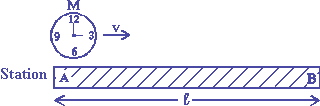
Figure 3.1
However the two clocks will not display the same difference
because they do not run at the same rate. The ratio between
those two differences of clock displays DCDo
and DCDv is proportional
to the ratio of the clock rates no[rest] and nv[rest]. Therefore:
 |
3.9 |
Combining
equation 3.9 with equation 3.8 gives:
 |
3.10 |
which is
mathematically identical to:
 |
3.11 |
From the
usual definition of g, equation 2.2:
 |
3.12 |
we find
that, using equation 3.11:
 |
3.13 |
Einstein
made the hypothesis that "time is what clocks are measuring". This
means that the Dt in Einstein's
relativity and in the Lorentz equations is only a difference of
clock displays on a clock at rest to which the units of time were
given:
In
reality, since Dt is nothing more than
a DCD, the units of DCDo (which is a pure number)
must be given to Dt. Let us give an
example. It is believed that in Einstein's relativity and in the
Lorentz equations, when an excited atomic state of a moving atom
has not become de-excited after a classical time interval, it is
because the time interval was shorter within the moving frame than
in the rest frame. We have seen above that this explanation is
incorrect and that the reason is that the principle of mass-energy
conservation requires a change in the atom parameters and
consequently, a slower internal motion inside atoms. This slower
internal motion makes moving clocks function more slowly.
Therefore, the Dt measured by
Einstein's and Lorentz's clocks is not a time interval at all, but
a difference of clock displays (DCD) of
a clock running more slowly. The correct explanation is that when,
in the Lorentz equation, we find that the Dt'
is
different
from
Dt during the same time interval, we
are fooled by clocks running at different rates in different
frames. It is an error of interpretation to give time units to Dt and Dt' in
the Lorentz equations while they are no more than differences of
clock displays as admitted by Einstein. Since the DCD is a pure number, the Dt in equation 3.14 is also a pure number.
Similarly, the difference of cloc k displays DCDv
is called Dt' in the Lorentz
equations:
A
comparison with the Lorentz equations, as given with equations
3.14 and 3.15, is useful to examine some mathematical properties
common to both interpretations. Equations 3.14 and 3.15 in
equation 3.13 give:
 |
3.16 |
By
definition, the number of units x representing the distance
traveled during Dt (for Einstein
corresponding to the time while a clock shows DCDo)
is:
| x = vDt or x = vDCDo |
3.17 |
Of
course, x is not a real distance, as explained in section 3.1. Let
us substitute Dt from equation 3.17 to
the second term Dt of equation 3.16.
We get:
 |
3.18 |
Equation
3.18 gives the relationship between Dt'
(which
is a difference of clock displays) displayed by a clock located at
a distance x from the origin and moving at a velocity v and Dt displayed by a stationary clock. We
observe that equation 3.18 is exactly the Lorentz equation for
time and that it is compatible with Einstein's hypothesis that
time is what clocks display. This equation is simply an exact
mathematical description of mass-energy conservation in agreement
with equations 2.22 and 2.23 and with the physical mechanism
implied by equation 3.2 We notice finally that the Lorentz
transformation for time has been demonstrated here without using
the hypothesis of the constancy of the velocity of light nor any
new hypothesis. We have used only the mass-energy relationship E =
Km from equation 2.3. In fact, we have obtained the Lorentz
equation for time without the use of any of Einstein's relativity
principles.
One must
conclude that the Lorentz transformation derived above is in
reality a transformation of relative clock displays between
frames. Then Dt and Dt' (when related to this Lorentz equation)
represent differences of clock displays DCD.
3.4 - Length Dilation
Due to Kinetic Energy.
Length
dilation and contraction have been demonstrated in chapter one
for matter placed in a gravitational potential. Using equation
3.4, we will now show that the Bohr equation also gives a change
of length when matter acquires a velocity v. This will be done
without involving the constancy of the velocity of light.
According to equation 3.4, we have:
 |
3.19 |
Therefore, the relative size of the Bohr radius as a function of
velocity is:
 |
3.20 |
Let us
consider a reference meter made of ordinary classical atoms. We
see from equation 3.20 that the size of atoms, which is
proportional to the Bohr radius or to the interatomic distance
(see Appendix I), increases as a function of velocity. This means
that the size of all material matter increases with velocity.
We know
that the number of atoms Na making up the length of a
rod does not change with velocity. Furthermore, it is well
established in modern physics that the interatomic distance jo is proportional to the Bohr
radius ao so that jv[rest]
= gjo[rest]. The length lo
of a rod is:
| lo[rest] = (Na-1)jo[rest] |
3.21 |
At
velocity v, the length lv is:
| lv[rest] = (Na-1)jv[rest] = (Na-1)gjo[rest] |
3.22 |
We note
that the number of atoms Na is much larger than unity.
Therefore, using equations 3.21 and 3.22 we have:
 |
3.23 |
Equation
3.23 shows that there is length dilation of matter when its
velocity increases (in a constant gravitational potential). Length
dilation is a real physical phenomenon involving no stress nor any
pressure, similar to length dilation and length contraction in a
gravitational field, as shown in chapter one. It is just the
natural equilibrium of matter given by quantum mechanics that
makes it dilate at relativistic velocities. Space dilation or
space contraction is meaningless.
The fact
that we are led from our reasoning to length dilation instead of
length contraction does not represent a problem since the assumed
phenomenon of length contraction has never been observed
experimentally in special relativity. On the contrary, we need
length dilation to be compatible with the slowing down of clocks,
which is also required by quantum mechanics and has been observed
experimentally. In order to be coherent with quantum mechanics and
mass-energy conservation, one must understand that there exists no
length (nor space) contraction in special relativity because g is always equal to or larger than one
(equation 3.23). Only length dilation can be produced when there
is an increase of velocity.
3.5 - The Lorentz
Transformation for Lengths.
Let us
consider two identical frames O-X at rest. The axis of those
frames are constructed with many rods in series each having a
length exactly equal to one reference meter (defined in section
2.4). A mass M is located at a distance x[rest] from the origin
O[rest]. For a stationary observer using the reference meters
located on the frame at rest, the coordinate of the mass M is:
| x[rest] = nometer[rest] |
3.24 |
where no
is the number of times the meter rod, when defined at rest
(meter[rest]) must be used to form the length x[rest]. The symbol
no is a pure number measured in the stationary
(subscript o) frame. We must recall that contrary to Newtonian
physics, the simple use of the number no is not
sufficient to represent a length. A length must necessarily be
represented by a pure number multiplied by the length of the
reference meter.
Let us
give the velocity V to one of the frames that we now call O'-X'.
At time t = 0, the origin O' of the moving frame coincides with
the origin O of the rest frame. The axis O'-X' is arbitrarily
displaced on figure 3.2 in order to avoid confusion. Before the
frame O'-X' acquired its velocity, the distance between the origin
O and the mass M was identical in both systems. After the frame
O'-X' has reached velocity V, we have seen that the Bohr radius
and all physical material on the moving frame are dilated as given
by equation 3.23. Therefore the reference meters used to form the
axis are longer. The mass M' on the moving frame is fixed with
respect to that frame and does not move with respect to the
particular segment of meter where it is fixed. Therefore the
number nv of those standard moving rods between M' and
the origin O' is necessarily the same and no = nv.
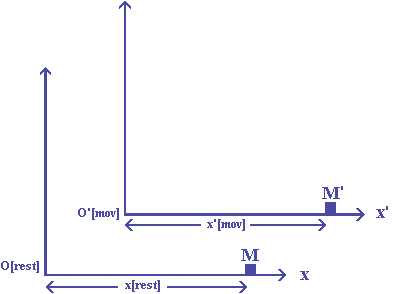
Figure 3.2
However, the absolute distance x'[mov] between M' and O' will
increase because the length of the standard meter has increased
due to the increase of the Bohr radius. The distance x'[mov]
between M'[mov] and the origin O' is given by:
| x'[mov] = nvmeter[mov] = nometer[mov] |
3.25 |
with
Using the
notation x[rest] = lo[rest] and x'[rest] = lv[rest]
equation 3.23 gives:
| x'[rest] = gx[rest]
or Dx'[rest] = gDx[rest] |
3.27 |
Equation
3.27 means that using rest frame units, the distance x' (which is
O'-M') is g times longer than the
distance x (which is O-M) also using rest frame units even if the
numbers of local meters no and nv are the
same. 3.5.1 -
Apparent and Absolute Time.
In order
to predict the consequences of the change of "clock" rate between
systems, we must be able to compare predictions between different
frames. Let us examine the relationship between the "apparent
time" in different frames. In Einstein's relativity, the "time" is
defined as what is perceived by each observer. It is equal to what
a clock measures in its own frame. It is called t in the rest
frame and t' in the moving frame.
Consequently, each frame has its own "time" but we know that it
is only apparent. Real physical time does not flow faster
because the local clock runs faster. For an observer at rest,
Einstein's interpretation assumes that his "time" t is the one
shown by his clock at rest. Similarly, the "time" t' is the
apparent time in the moving frame. Since the moving clock runs
at a different rate than the clock at rest (see equation 3.8),
the time on the moving frame "appears" (as seen by an observer
at rest) to elapse at a different rate giving:
We define
the "absolute second" So[rest] as the time interval t
taken by the atomic clock at rest (located away from any
gravitational potential) to record a constant number Ns
of oscillations. Since that clock at rest runs at a frequency no[rest], the apparent rest
second (called absolute second) will be elapsed when So
equals unity. This gives:
 |
3.29 |
On a
moving frame, the "apparent second" Sv[mov] is equal to
the time taken by the local clock moving at velocity V to record
the same number of oscillations Ns. Therefore during
one "apparent second" (Sv) on the moving frame (at
velocity V), by definition, the clock must record the same number
of oscillations as the clock on the rest frame does during one
"absolute second" (So). This means that during one
"apparent second" inside any frame, the local DCD
is always the same number. Then, since clocks have different
rates, in different frames, the "absolute duration" of the
"apparent second" varies with the velocity of the frame carrying
the clock.
It is
arbitrarily decided that the rest second (in zero gravitational
potential) is called the "absolute second of reference". Since the
number of oscillations is the same for any local second, we have,
for the case of apparent second Sv in a frame moving at
velocity:
| DCD(So)[rest]
= DCD(Sv)[mov] |
3.30 |
From the
definition of apparent seconds in a frame moving at velocity V,
with equations 3.29 and 3.30, we find that the duration of one
moving second is:
 |
3.31 |
In order
to be able to compare "apparent seconds" generated in different
frames, we must be able to express the "apparent time" duration
using common units. We have from equation 3.8:
| no[rest]
= gnv[rest] |
3.32 |
Equation
3.32 in equations 3.31 and 3.29 gives:
 |
3.33 |
Equation
3.33 shows that the unit of time Sv in the moving frame
is g times longer than the unit of
time So in the rest frame.
Let us
consider the "real time intervals" corresponding to the same
numerical value of local apparent "x" seconds elapsed in both the
rest frame and the moving frame. The DCD
shown by either clock is the same in both frames. In Einstein's
relativity, this was erroneously interpreted as the same time
interval in both frames. In the rest frame, the real time t[rest]
is equal to the number of seconds "x" times the duration of the
apparent second So at rest. This gives:
In the
moving frame, the real time (in rest units) is called t'[rest]. It
is equal to the number "x" of seconds times the duration of the
apparent moving second Sv:
| t'[rest] = xSv[rest] |
3.35 |
Combining
equations 3.33, 3.34 and 3.35 gives:
| t'[rest] = gt[rest]
or Dt'[rest] = gDt[rest] |
3.36 |
Equation
3.36 shows that when we consider the same number of local
"apparent seconds" (i.e. the same difference of clock displays) in
two different frames, the real absolute time spent on the moving
frame is g times longer that the
absolute time spent on the rest frame.
Equation
3.36 is equivalent to equation 3.18 when time is measured at the
same location (x = 0). However, one must understand that the
change of time between systems suggested by Einstein is only
apparent because clocks in different frames run at different
rates. This has erroneously been interpreted as time dilation in
the past, but we see now that it is nothing else than clocks
running at different rates in different frames.
3.5.2 - Relationship
between Velocities V and V'.
On
figure 3.2, the right hand side direction of the axes O-X and
O'-X' is positive in both frames. When the moving frame O'-X'
has a velocity toward the right hand side, the coordinate of the
location M' increases (in time) with respect to the rest frame
O-X. Therefore location M' has a positive velocity with respect
to the rest frame O-X. However, figure 3.2 shows that when the
moving frame (with origin O') travels to the right hand side,
location M moves to the left hand side with respect to the frame
O'-X'. The coordinate of location M is getting more and more
negative (in time) with respect to the frame O'-X', while the
coordinate of location M' is getting more positive in time with
respect to the frame O-X. This means that the velocity V' of
point M' (with respect to O-X) has the opposite sign of the
velocity V of point M with respect to O'-X'. This result comes
out of pure geometrical considerations illustrated on figure
3.2. Therefore:
 |
3.37 |
Equation
3.37 signifies that the velocities have opposite directions. We
will show now that the velocities V and V' have the same
magnitude.
3.5.3 - Relative
Velocities within Systems.
Let us
consider a rest frame and a moving frame. Both frames were
identical before the moving frame started to move at velocity
V[rest]. Inside both frames, we consider rods that had the same
length when they were initially in the same frame at rest. This
can be verified later if we count the same number of atoms in
both frames for the length of either rods. The rod at rest
extends from O to M and the moving rod extends from O' to M'.
There
are at least two different ways to compare velocities between
frames. One way consists of measuring directly the velocity in
each frame using proper values and comparing numbers. Another
way, the one we will use here, is to use a definition of
velocity in each frame and to compare the corresponding elements
of the definitions. The velocity u of a moving object across O-M
with respect to the rest frame is defined as:
 |
3.38 |
With
equation 3.38, we start dealing with a series of equations related
to velocities. These velocities can have any direction in space
and might be described by vectors. However, such a description
would lead to a very heavy notation that could be confusing and
would require useless efforts. This is avoided by defining that in
every equation between 3.38 and 3.46, we consider that u and u'
represent the magnitudes |u| and |u'| of these parameters. The
appropriate mathematical sign of the velocities will be considered
starting with equation 3.46.
Inside
the moving frame, a similar slowly moving object moves from O' to
M' (distance Dx'). During the time Dt' the slow moving object crosses the
distance Dx' from O' to M'. The
velocity of the slow moving object with respect to the moving
frame is defined as:
 |
3.39 |
We have
seen that, before the moving rod (O'-M') started to move, it was
similar to the rod in the rest frame (O-M) and that both clock
rates were similar. Consequently, we can use equations 3.27 and
3.36. Let us put the transformation of coordinates given by
equations 3.27 and 3.36 into the equation 3.38. We get:
 |
3.40 |
Let us
use equation 3.23 to calculate the ratio between the units of
length. If the length lo is a unit of length
equal to one meter using rest units, we see that this unit of
length becomes glo
on the moving frame. Therefore the relationship between the units
of length is:
| lo[mov] = glo[rest] or
meter[mov] = gmeter[rest] |
3.41 |
This
means that when we move from the rest frame to the moving frame,
the unit of length becomes g times
longer. Therefore, in order to represent the same physical length
using longer units of length, the number of units Dx'[mov] must be smaller. This gives:
 |
3.42 |
In the
case of time, a corresponding phenomenon takes place. Let us
consider equation 3.36. We see that a time interval Dto equal to one unit of time in
the rest frame becomes g times larger
in the moving frame because it takes more time for the slower
clock to show the same DCD. In that
case, we see from equation 3.36 that the change of local units of
time Dto between frames
gives:
| Dto[mov]
= gDto[rest] or
sec[mov] = gsec[rest] |
3.43 |
This
means that when we move from the rest frame to the moving frame,
the local unit of time becomes g times
larger. Therefore in order to represent the same absolute time
interval using longer units of time, the number of units Dt'[mov] must be smaller. This gives:
 |
3.44 |
Equations
3.39, 3.40, 3.42 and 3.44 give:
 |
3.45 |
Equation
3.45 shows that the velocity u measured using the rest frame units
is the same as the velocity u' using the moving frame units.
Among the
values of velocities which can be given to u, we can choose the
velocity V which is the velocity of the moving frame with respect
to the rest frame (rest frame units). Symmetrically, let us call
V' the velocity u' of the rest frame with respect to the moving
frame (using moving frame units). Using equations 3.37 and 3.45
gives:
or
Equation
3.46 shows that the proper value of the velocity of the moving
frame with respect to the rest frame is the same (negative) as the
proper value of the velocity of the rest frame with respect to the
moving frame.
Let us
add that a velocity appears as a physical concept for a physicist.
However, we have seen above that a comparison of velocities in two
different frames having a relative velocity leads to the same
numbers. We have seen that when we are in a moving frame, the
ratio between the distance traveled and the time taken to travel
it changes with respect to the rest frame. Both the numerator (the
distance) and the denominator (time interval) change by the same
ratio. Consequently, a constant velocity is nothing more that a
constant ratio between two fundamental physical quantities. On can
say that the constant velocity in different frames means the same
thing as three oranges out of six is the same thing as four apples
out of eight. Velocities are just ratios of physical quantities.
3.5.4 - Lorentz's
Second Relationship.
In
order to find the dynamical relationship between the coordinates
x' and x, let us now combine the quantities x, V and t
calculated above. In classical mechanics inside the moving frame
we have:
where xo'
is the coordinate x at t = 0 and V' is the velocity between
frames. In order to be more specific, in complete notation,
equation 3.48 should be:
| xv[mov] = xov[mov]+Vv[mov]tv[mov] |
3.49 |
Let us
consider first in equation 3.49 the expression tv[mov].
The term tv represents the number of units that is
multiplied by the length of the unit [mov]. Let us calculate what
would be the quantity tv[mov] using the [rest] units of
length instead of the [mov] units of length.
From
equation 3.44, we have:
In the
case of the units of distance (xv or xov) we
use again the same method. With the help of equation 3.42 we find:
and
| xov[rest] = gxov[mov] |
3.52 |
From
equation 3.49, transforming xv[mov] with 3.51, xov[mov]
with
3.52,
and
tv[mov] with 3.50, we get after multiplying both sides
by g:
| xv[rest] = xov[rest]+Vv[mov]tv[rest] |
3.53 |
From
equation 3.53, transforming xov[rest] with 3.27, Vv[mov]
with
3.47,
and
tv[rest] with 3.36, we get:
| xv[rest] = g(xoo[rest]-Vo[rest]to[rest]) |
3.54 |
Using a
more conventional notation this is:
Equation
3.55 gives the relationship between the coordinate x' on the
moving frame and the coordinate x, the velocity V and the time t
on the rest frame. This relationship results solely from
mass-energy conservation and quantum mechanics without using any
of Einstein's relativity principles. However, equation 3.55 is
exactly identical to the Lorentz equation related to lengths. The
demonstrations leading to equations 3.18 and 3.55 show the
uselessness of Einstein's special relativity principles. Most
importantly, this demonstration provides a way to give a logical
interpretation to experiments without space or time contraction or
dilation.
3.6 - Constant Velocity
of Light within Any Frame of Reference.
We must
notice that c is also a velocity obtained from the quotient of a
distance by time within any frame. Let us consider that the
internal velocity u is the velocity of light c. In the moving
frame, the velocity u' equals c'. Therefore when the velocities
u and u' considered are applied to light, equation 3.45 gives:
When we
use the complete notation, we get:
This
means that following equations 3.45 and 3.56, one must conclude
that the physical mechanism resulting from mass-energy
conservation and quantum mechanics leads to the conclusion (not
the hypothesis) that any velocity, including the velocity of
light, is constant as measured within any frame (using proper
values). Contrary to Einstein and Lorentz, we do not have to make
the arbitrary hypothesis that the velocity of light is constant
inside all frames. We have found that the constancy of the
velocity of light is a necessary conclusion to mass-energy
conservation and the quantum mechanical equations.
From
another point of view, the value of c, called the velocity of
light, has been defined in section 2.4 as the square root of K
(the quotient between energy and mass) which is the fundamental
basis of mass-energy equivalence. Any theory or experiment not
compatible with the constancy of the velocity of light (using
proper values) is therefore necessarily not compatible with
quantum mechanics and mass-energy conservation. However, since the
velocity of light is given as the quotient of two quantities
(length and DCD) that are different in
different frames, the physical meaning of that constant ratio is
subtle.
3.7 - Non-Reality of
Space Dilation, Contraction or Distortion.
The
distance Dx traveled in a time
interval Dt is defined as:
Let us assume an observer traveling between the ends
of a long stationary rod having a length Dx.
That
length Dx is calculated from the
velocity v times the time interval Dt
necessary to travel between the ends of the rod. We know that the
velocity v is the same on any frame. However, the difference of
clock displays DCDo (which
is interpreted as time Dt by Einstein)
on the rest frame is different from DCDv
(interpreted by Einstein as time interval Dt')
on
the
moving
frame. Consequently, according to Einstein's interpretation, the
length Dx' measured by the moving
observer is different from the length Dx
of the same rod measured by the observer at rest. At the velocity
of light, the DCDc
decreases to zero so that the (apparent Einstein's) length Dx' becomes zero for the moving observer
because his moving clock has stopped running.
It is
irrational to claim that the length of the stationary rod changes
and even becomes zero just because the observer changes his
velocity. How can the length of a rod logically change because a
non interacting observer looks at it? The rod would become longer
or shorter depending on the observer's own velocity. The length
(and other properties) of the rod would not be a property that
would belong to matter. It is the observer that would set the
length of the rod and different observers would simultaneously
find different lengths for the same rod depending on their
observing conditions. Then, what would be the length of the rod if
there were no observer? It is just like the statement that the
moon is not there when nobody is looking at it. We believe that
this is nonsense and that the length of matter is independent of
the observer. This is the same irrationality that appears in
quantum mechanics and which has already been discussed [1].
We have
not yet defined how to measure space. This is because space is not
measurable unless we fill it up at least partially with matter.
Then, it is that matter that we measure, not space. Whether space
is empty or full of matter, we generally refer to it as "space".
We know several methods of measuring lengths of objects but there
does not exist any method of measuring space without using matter
as a reference. In relativity, space is often referred to as being
contracted or dilated. How can it be contracted or dilated when
there is no method of measuring it without assuming some matter in
it? The properties of matter are then inadvertently attributed to
or confused with space. The same comment applies to the belief of
space distortion. How can there be space distortion when we cannot
measure space directly in the absence of matter? The
interpretation of space distortion is nothing more than a change
of the Bohr radius in the measuring instrument or in the matter
filling the space.
This
problem is easily solved logically when we consider that the
internal atomic mechanism of the observer runs at a different rate
since electrons in motion have a different mass. This has nothing
to do with the illusion of space dilation or distortion. One must
conclude that the expressions "space contraction" and "space
distortion" are irrational. They bring confusion and must be
eliminated.
3.8 - Transformation of
Units in Different Frames.
There
are many other consequences to the relativistic changes of
lengths and masses. For example, in chapter one we have seen
that the mass of particles decreases when located at rest in a
lower gravitational potential. In chapter three we have seen
that masses increase with velocity due to the absorption of
kinetic energy. This means that if we take an object of one
kilogram on Earth and move it to a location at rest on the solar
surface, about one millionth of its mass will disappear and be
carried away by the energy generated during the slowing down of
the object falling into the Sun. Even if there is exactly the
same number of atoms in one Earth kilogram after it is carried
on the Sun's surface, we see that the solar kilogram has less
mass than the Earth kilogram using any common frame of
comparison of mass units. Consequently, there is more energy (in
Earth joules) in one Earth kilogram than in one solar kilogram.
This is required by the principle of mass-energy conservation.
Similar
considerations must be applied to most physical constants.
Because of the principle of mass-energy conservation, the units
must always be specified (kg[Earth], meter[Earth], joule[Earth],
second[Earth]). However, the electric charge appears to be
constant in any frame. This means that the ratio of the electron
charge divided by the electron mass (e/m) is different in
different frames. For example, e/m is smaller on Earth (when
using Earth units) than on the solar surface (using Earth
units). In order to be able to compare those quantities with the
ones calculated in different frames, we must take into account
the difference of gravitational potential or the difference of
kinetic energy. To define accurately the reference kilogram, the
reference meter, etc., we must know the exact altitude on Earth
at which these units have been defined.
3.9 - Failure of the
Reciprocity Principle.
We have
studied above some of the differences existing between a frame
in motion and a frame at rest. In a moving frame, clocks run at
a slower rate, the Bohr radius is larger and so are masses
because of their kinetic energy. Let us consider a body on the
rest frame having a mass mo[rest]. Its total energy
is:
| Eo[rest] = mo[rest]c2 |
3.59 |
When mo[rest]
is
accelerated
to
velocity vo[rest] with respect to the rest frame, its
mass becomes mv[rest]. We get:
 |
3.60 |
Equation
3.60 shows that the moving mass mv[rest] is larger than
the rest mass mo[rest]:
Let us
consider now a train moving at velocity vo[rest]
carrying an observer and the mass mentioned above. The mass of the
train, of the observer and of the body described above becomes g times larger than when at rest. However,
since the units in the moving train have been modified by the same
ratio g, the changes of mass, clock
rate and length are undetectable to the moving observer, even if
they are real. Inside the moving train, an observer using
Einstein's reciprocity principle will claim that the object of
mass mv[rest] is at rest with respect to him. He will
thus call it Mo[rest]. Therefore:
| Mo[rest] º
mv[rest] = gmo[rest] |
3.62 |
It is
because we use Einstein's hypothesis of reciprocity that we write
[rest] after Mo in equation 3.62, since Einstein's
hypothesis assumes that the mass that has been transferred to the
train is now at rest for the observer moving with the train.
Furthermore, the symbol º used in
equation 3.62 does not mean that we are defining a new quantity.
The symbol º means that Mo
is the same object in the same physical condition as mv[rest].
Now, the
moving observer takes the object of mass Mo[rest] (that
is stationary with respect to him) and throws it at velocity vo[rest]
with
respect
to
his moving train (considered at rest in his frame) in the
direction opposite to the direction of motion of the train.
According to Einstein's principle of reciprocity, the mass
projected at velocity vo[rest] with respect to the
moving frame acquires velocity and energy with respect to the
moving frame (now considered at rest). Einstein's principle of
reciprocity says that all frames are identical which means that
mass Mo[rest] increases when accelerated with respect
to the train to become Mv[rest]. In fact, the
reciprocity principle implies that the passage of the object of
mass Mo[rest] from zero velocityo[rest] to vo[rest]
(with respect to the train) increases its mass by g times, independently of the
direction of the velocity of the mass with respect to the
train. This gives:
| Mv[rest] = gMo[rest] |
3.63 |
As
expected from the relativity principle, equation 3.63 shows that
mass Mv[rest] is larger than Mo[rest]
giving:
A
physical representation of these changes of velocity shows that
the mass Mv[rest] now has zero velocity with respect to
the rest frame. It is back at rest on the rest frame. Mass Mv[rest]
is then physically undistinguishable from mass mo[rest]
since it is the very same object having the same zero velocity
with respect to the same rest frame. Therefore physically, we must
have:
Combining
equations 3.62, 3.63 and 3.65 gives:
| mo[rest] º
Mv[rest] = g2mo[rest] |
3.66 |
Obviously, equation 3.66 is correct only if g
equals unity so that the velocity must always be zero. This shows
that the principle of reciprocity cannot be valid when we apply
the principle of mass-energy conservation. We must conclude that
Einstein's reciprocity principle is not coherent.
Contrary
to Einstein's claim, the energy given to a mass accelerated with
respect to the train must depend on the direction of its velocity
with respect to the direction of the velocity of the train. When
the directions are opposite, the two velocities (whose magnitudes
are equal) cancel out and the mass of the body must come back to
its original value in the rest frame. Otherwise we would discover
that atoms of matter having traveled to another frame would have a
different mass after their return to the initial frame. We must
conclude that two frames cannot be equivalent when there exists a
relative motion between them.
3.10 - References.
[1] P. Marmet, Absurdities
in Modern Physics: A Solution, ISBN
0-921272-15-4, Les
Éditions du Nordir, c/o R. Yergeau, 165 Waller, Ottawa,
Ontario K1N 6N5, 144p. 1993.
3.11 - Symbols and
Variables.
| ao[rest] |
Bohr radius at rest in rest units |
| av[rest] |
Bohr radius in motion in rest units |
| DCDo |
difference of clock displays on a clock at
rest |
| DCD(So)[frame] |
DCD
corresponding to an apparent second in any frame |
| DCDv |
difference of clock displays on a clock in
motion |
| En,o[rest] = Eo[rest] |
energy of the Bohr atom at rest in state n
in rest units |
| En,v[rest] = Ev[rest] |
energy of the Bohr atom in motion in state
n in rest units |
| ho[rest] |
Planck parameter on the rest frame in rest
units |
| hv[rest] |
Planck parameter on the frame in motion in
rest units |
| lo[rest] |
length of a rod at rest in rest units |
| lv[rest] |
length of a rod in motion in rest units |
| no[rest] |
clock rate of a clock at rest in rest
units |
| Ns |
number of clock oscillations in an
apparent second |
| nv[rest] |
clock rate of a clock in motion in rest
units |
| (So)[rest] |
definition of the absolute second in rest
units |
| (Sv)[rest] |
duration of one moving second in rest
units |
| u[rest] |
definition of the velocity in the rest
frame in rest units |
| u'[rest] |
definition of the velocity in the moving
frame in rest units |
| V = Vo[rest] |
velocity of M with respect to the moving
frame in rest units |
| V'= Vv[mov] |
velocity of M' with
respect to the rest frame in motion units |
| x[rest] |
distance between O and M in rest units |
| x'[mov] |
distance between O'
and M' in motion units |
<><><><><><><><><><><><>
Chapter2 Contents Chapter 4
Return To List of Papers on the
Web
Where to get a Hard Copy of this Book