A New Non-Doppler Redshift
Paul Marmet, Herzberg Institute of Astrophysics
National Research Council, Ottawa, Ontario,
Canada, K1A 0R6
(
Last checked 2018/01/16 - The estate of Paul Marmet )
Updated from: Physics Essays, Vol. 1,
No: 1, p. 24-32, 1988
<><><><><><><><><><><><>
Abstract
It is known that many astronomical
observations cannot be explained by means of the ordinary Doppler
shift interpretation. The mere examination of a recent
catalog of objects having very large redshifts shows that among
109 quasi-stellar objects for which both absorption and emission
lines could be measured, the value of the absorption redshift of a
given object is always different from the one measured in emission
for the same object. It is clear that such results cannot be
explained as being due solely to a Doppler redshift.
A new mechanism must be looked for, in order
to explain those inconsistent redshifts and many other
observations related to the “redshift controversy”.
It is possible to calculate a very slight
inelastic scattering phenomenon compatible with observed redshifts
using electromagnetic theory and quantum mechanics, without the
need to introduce ad hoc physical hypotheses.
A careful study of the mechanism for the
scattering of electromagnetic radiation by gaseous atoms and
molecules shows that an electron is always momentarily accelerated
as a consequence of the momentum transfer imparted by a
photon. Such an acceleration of an electric charge produces
bremsstrahlung.
It is shown in the
present work that this phenomenon has a
very large cross section in the forward direction and that the
energy lost by bremsstrahlung causes a slight redshift. It
is also demonstrated that the relative energy loss of the
electromagnetic wave for blackbody radiation, such as for many
celestial objects, follows the same “Dn/n =
constant” law as if
it were a Doppler law.
This redshift appears indistinguishable from
the Doppler shift except when resonant states are present in the
scattering gas. It is also shown that the lost energy should
be detectable mostly as low frequency radio waves. The
proposed mechanism leads to results consistent with many redshifts
reported in astrophysical data.
1. Introduction
Astrophysical observations show that the
electromagnetic radiation originating from cosmological objects
is often redshifted. Except for some hypothesis such as
assuming that it is a gravitational redshift, this has always
been interpreted as a Doppler shift. To date, the
interaction of light with interstellar gas has not been
seriously considered as a possible mechanism responsible for the
observed redshift because no known forward scattering process
could be demonstrated to lead to an effect compatible with
common astronomical observations. The redshift observed in
astronomy that agrees with a shift of Doppler origin, follows
the relationship:
 |
(1) |
where Dn is the change
in frequency of the radiation and n is
the frequency of the emitted light.
Thomson scattering however does not lead to
Eq. (1). In this case, electrons accelerated by the
transverse electric field of the incident electromagnetic
radiation emit radiation due to their transversal
acceleration. For example, the polarized blue radiation
scattered by the daytime sky results from the transverse
acceleration of bound electrons by visible light. It is well
known that the cross section leading to such scattering increases
very rapidly as a function of frequency n
and therefore cannot lead to a red shift following Eq. (1).
Let us now consider the photon momentum in
the direction of the propagation of the wave. It is this momentum
which produces the Compton effect. In this case, the
momentum transfer from the photon to the electron is taken into
account. However, no one has ever fully taken into account
the bremsstrahlung resulting from the momentum transferred to an
electric charge, when the energy of the electromagnetic radiation
is imparted to electrons or atoms. Although Boekelheide (1) and Cavanaugh (2)
observed energy losses at very high energy due to relativistic
effects on free electrons called "double Compton scattering", no
one (3) has found a full
solution to the S-matrix that could describe electromagnetic wave
interaction on atom at very low energy. It is this low
energy interaction which is interesting here.
Maxwell’s equations predict that radiation is
emitted as a consequence of the change of velocity (acceleration)
of the electron impinged on, due to momentum transfer. That
point has been taken into account in quantum electrodynamics as
explained by Jauch and Rohrlich (3) who show that such a phenomenon always exists, as seen
in their statement:
"This
bremsstrahlung or deceleration radiation with the emission
of a single photon is a well defined process only within
certain limits: The simultaneous emission of very soft
photons – too soft to be observed within the accuracy of the
energy determination of the incident outgoing electron – can never be excluded. In
fact, this radiation is always present even in the
so-called elastic scattering (3) ."
In this paper, we
consider this problem at very low energy (visible light and lower
energy) where classical considerations are still mostly
valid. We further consider the case of photon scattering on
atoms at an extremely low atom density, which is a condition
prevailing in outer space. In the usual treatment of the Compton
effect, bremsstrahlung is neglected. In these circumstances,
it is known that the change Dl in
wavelength is given by:
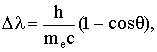 |
(2) |
where h = Planck’s constant, me = mass of the electron, c =
velocity of light in vacuum and q =
scattering angle.
From Eq. (2), we must notice that at any
angle of scattering, bremsstrahlung is completely neglected.
However, the electron is accelerated during the scattering.
In order to illustrate the basic principle leading to an energy
loss due to bremsstrahlung, let us examine the case of 90o
Compton scattering on a free electron which is
initially at rest. The photon momentum transferred to the
electron is such that the collision imparts motion to it.
Since the electron, initially at rest, becomes in motion after the
impact, somehow it must have been accelerated.
According to electromagnetic theory, any
accelerated charge must emit bremsstrahlung. Since the
Compton electron has been accelerated, it must emit
bremsstrahlung. Although the energy emitted due to such
acceleration is extremely small, it is not zero and should not be
neglected as done at low energy. It will be seen that this
energy loss adds a slight correction to Eq. (2). The case of
interaction at q = 0
requires special considerations. It can be considered either
as an extreme case of Compton scattering (q = 0)
or better as the simple transmission of radiation through the
particles of a gas. In the latter case, the scattering angle
is essentially zero degrees, but the physical reality of
interaction with atoms is evident because the observed average
speed of light is reduced in gases.
This reduced speed of light in gases is
frequently calculated with the help of the index of
refraction. In this paper, that parameter will be calculated
as the group velocity and will be considered in more detail
below. The interaction during transmission (or the
scattering angle q = 0) is the only
one that will be treated in this paper, since it leads to
measurable predictions of light traveling through space.
In order to be able to evaluate the energy
loss due to such a phenomenon, one needs to calculate different
parameters such as the time of coherence of the electromagnetic
radiation, the index of refraction of gases, and several other
quantities. These parameters will be calculated in
Appendices A and B.
2. Bremsstrahlung Due to Axial Momentum Transfer.
2.1
Basic Mechanism
In the corpuscular description of light, it
is considered that a particle, called a photon, is emitted from
an excited state after its average lifetime Dt.
This corresponds in electromagnetic theory to an oscillating
dipole continuously emitting coherent electromagnetic radiation
whose amplitude is uniformly damped to a fraction 1/e of
its initial value during the lifetime of the excited
state. This lifetime is equivalent to the time of
coherence of the radiation. During absorption, the
phenomenon is reversed and the time of coherence Dt becomes the time of interaction of the
wave with the atom.
This time of interaction Dt characterizes the wave as its time of
coherence. In the case of the emitter, this characteristic
can be considered as the average time taken by the emitter to
emit a photon. When using a wave description, it is
physically possible to deduce the time of coherence which is the
pulse duration of the wave packet. Therefore Dt appears to belong not only to the
emitter but also to the wave.
One must recognize another property of the
waves: Electromagnetic waves not only have energy but also
momentum. If one considers that the electromagnetic wave
imparts its energy during an effective pulse duration Dt, one must remember that it also
imparts its momentum during that time.
When an atom absorbs a wave train (photon),
the total momentum is conserved and therefore must appear within
the atom. The electron is therefore accelerated due to the
momentum transfer from the photon to the mobile electron.
The much smaller fraction of momentum imparted to the nucleus is
much smaller and can be neglected here. The electron is
then accelerated during a length of time equal to the time of
coherence of the absorbed radiation. After absorption, the
energy stays in the atom for a short interval of time which
explains the apparent reduced speed of light in gases.
Finally, the mechanism is reversed and the energy absorbed of
the wave is re-emitted. This short time interval accounts
for the index of refraction of gases as explained in Appendix
B. This selective forward reemission is obviously
necessary to explain the transparency of gases and the
straight-line propagation of light through them.
2.2 Transmission with Bremsstrahlung.
It is known that, according to
electrodynamics, any accelerated electron must emit
radiation. Let us recall that we consider here an electron
that is accelerated due to the axial momentum transfer of
electromagnetic radiation. Classical electromagnetic
theory used here to treat the acceleration of an electron should
lead to an excellent approximation. This is because the
same classical energy leads to an equally excellent answer when
we calculate, at a similar energy, the electron inside an atom
related to the Thompson scattering or Compton effect.
We must realize that classical
considerations are valid here because of the "Correspondence
Principle" (4). The
Correspondence Principle can be applied here because one deals
with very low energy electromagnetic radiation polarizing a
continuum of atomic hydrogen. A better proof of validity
of these semi classical considerations will be given in Appendix
B using an experimental value with the value deduced from this
theory (at similar energies).
Let us calculate the energy radiated due to
the photon momentum transfer given to the electron. The
total power radiated by an accelerated charge e is:
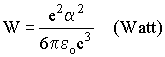 |
(3) |
where the acceleration a=Dv/Dt .
The time of coherence Dt is calculated in Appendix A. The
power radiated is:
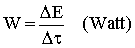 |
(4) |
Equations (3) and (4) yield
 |
(5) |
where DE = energy
radiated (Joule), e = electron charge (Coulomb), Dv change of velocity of electron due to
momentum transfer (m/s), Dt = time
during which the electron is accelerated (s), eo = permittivity of vacuum (F/m) and c = velocity of
light in vacuum (m/s).
The momentum P of the wave train is:
 |
(6) |
where n is the
frequency of the incoming radiation. Since this phenomenon
is transferred to the electron, the change in velocity (Dv=P/m) gives:
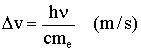 |
(7) |
where me is the
electron mass. Substituting Eq. (7) in Eq. (5), one finds
that the energy radiated due to the absorption and the reemission
of a photon by an electron is:
 |
(8) |
In Appendix A, the Equation (A18)
describes the time of coherence Dt
(pulse duration) of the wave packet issued from blackbody
radiation. We find:
 |
(9) |
where C4= 3.71 ´ 10-23
(s2K2).
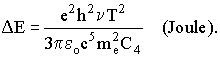
Combining Eqs. (8) and (9) gives:
 |
(10) |
Equation (10) gives the amount of
bremsstrahlung radiated due to momentum transfer of radiation
colliding with electrons. Let us
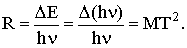
calculate the relative energy loss R in such a case. From
Eq. (10) and the energy of the wave train
 |
(11) |
we obtain:
 |
(12) |
where M=e2h/(3peoc5me2C4).
Numerically, we calculate that M=2.73 ´ 10-21
(K-2).
This energy loss can be applied to either
bound or free electrons, but the cross sections differ greatly
between these two cases, as shown in Appendix B.
2.3 Characteristics of the Energy Loss Equation.
It is
interesting to note that in Equation (12), the relative energy
loss is independent of the frequency n
of the incoming radiation in the case stated (blackbody
radiation). Therefore, the whole spectrum will undergo a
constant relative displacement in energy toward lower
frequencies. This displacement of the spectrum is exactly
similar to the redshift produced when a source of radiation
recedes from the observer (Doppler effect). For example, the fractional redshift (5) for astronomical objects can be described by the fractional redshift constant:
 |
(13) |
where n is the
radial component of the receding velocity of the light source.
Since the relative energy loss is independent
of n in both cases, the new redshift
described by Eq. (12) is undistinguishable from the Doppler
redshift described by Eq. (13) in the energy range studied.
As a consequence, all absorption lines of a
blackbody spectrum will be redshifted with the same dependence as
Z as long as they are away from resonant frequencies.
On the other hand if narrow emission lines, which have a
much longer time of coherence (see Appendix A), are superimposed
on the spectrum, their redshift is smaller than that given by
Equation (12). However, if the emitted light appears at the
same frequency as the resonant absorption line of the interacting
gas, the cross section becomes very much larger. This problem
related to emission lines (instead of absorption lines) is much
more complicated, requires a different treatment and is outside
the scope of this paper.
It may at least be realized that the redshift is emission
should be, in general, different from that in absorption and also influenced
by the energy of the quantum states that characterize the
absorption medium.
One must then conclude that a redshift is
produced due to hydrogen in space according to Eq. (12).
This redshift appears undistinguishable from Doppler redshift for
radiation with a short coherence time. The energy loss of
the initial radiation appears separately as very low frequency
radio waves.
3. Application to Astrophysical Data.
3.1
Interstellar and Intergalactic gases.
Let us
apply this energy loss R to astrophysical data. First, we
calculate the average density D (atom/m3) of gas in space required to produce a redshift
coherent with the Hubble constant Ho. The average number of
collisions N produced on a path one parsec long is:
 |
(14) |
where Ps= 3.092´ 1016
meters/parsec; s
= effective cross section for the atom interacting with the
electromagnetic radiation, and D = gas density in space (atom m-3).
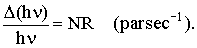
Since the energy loss per collision is very
small compared with unity, let us consider the so-called
thin-target condition. From Eq. (12):
 |
(15) |
Using Eq. (13) for an object at one parsec:
 |
(16) |
where Ho =
0.05m/s/parsec (Hubble constant).
Since Eqs. (15) and (16) give the relative
energy loss per parsec, they lead to:
 |
(17) |
Consequently, Eqs. (17) and (14) yield:
 |
(18) |
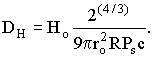
The relevant cross section s is calculated for atomic hydrogen in
Appendix B, Eq. (B8). Assuming that hydrogen is uniformly
distributed in space, the average density DH (atom/m3) required to
produce the same redshift as the one given by the Hubble constant
is obtained from Eq. (18). Combining Eqs. (B8) and (18) yields
 |
19 |
Numerically, let us consider light coming from remote stars at a
temperature of T=50 000 K. That light reaching us will travel
through intergalactic space but also through some intervening
galaxies. Equation 19 shows that if the average density of
hydrogen is DH = 2.5 x 10⁴
atom m-3,
the redshift produced by the interstellar hydrogen considered here
is then equal to the one calculated using the Hubble constant.
This value corresponds to the average density of hydrogen that is
required in space to satisfy the hypothesis. This density cannot
be compared with the density of matter calculated using the Hubble
constant and relativity because, if this density of hydrogen
exists, the expansion does not exist and the determination of the
density using Einstein's relativity becomes irrelevant.
This
value includes the contribution of the very large gaseous nebulae
or galaxies located in the line of sight or concentrated around
the light source itself. Consequently, depending on the
temperature of the source and the nature of the intergalactic gas,
an average density of the order of 0.01 atom per cubic centimeter
is sufficient to produce, on the Planck spectrum, an effect
equivalent to that of a Doppler shift in agreement with the Hubble
constant.
3.2 Angular Spread
We know
experimentally, that light travels in straight line in a medium
as in water or air. Even after traveling one meter in air, we
can calculate that photons have interacted with numerous
molecules since they are delayed, as given by the index of
refraction. However, after millions of collisions in air, most
of the photons still maintain a parallel direction of
propagation. It is easy to evaluate the angular deviation of the
incident radiation due to the axial acceleration of the
electron. It is known that bremsstrahlung radiation is emitted
in the direction perpendicular to the acceleration of the
electron. Since we are dealing with the problem of the momentum
transfer of a wave train to an electron accelerated in the same
direction as the incident wave, the total transverse momentum
component given to the electron is zero (Newton's law). Then the
sum of the transverse momentum component of the two
electromagnetic wave trains re-emitted must be zero. The initial
photon cannot get a large deviation when it is interacting with
the hydrogen because the secondary photon generated during the
interaction has too small energy and momentum to provide a
sufficient recoil to the initial photon. Since the very soft
bremsstrahlung emitted at 90o
has momentum, the initial transmitted wave receives an extremely
slight recoil in order to satisfy the law of conservation of
transverse momentum components. Consequently, the transmitted
radiation will be very slightly deviated from the incident
direction. From geometrical considerations and equation 12, one
can see that:
 |
20 |
In order
to illustrate the smallness of q1, let us calculate it from 12 and 20 for T=20 000
K. One finds:
 |
21 |
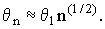
For
photons making a very large number of random collisions (i.e.
n » 1012 collisions), a larger (but still extremely small)
redshift is expected. The broadening of the image must have an RMS
statistical width which, depending on the direction, is given by:
 |
22 |
Consequently,
 |
23 |
Such a
random spread would make a point appear slightly fuzzy with a
large telescope, of the order of magnitude observed in some
quasi-stellar objects.
3.3 Line Broadening
Let us
also briefly discuss how multiple transmission interactions can
make absorption lines wider and fuzzier. It is known that the
redshift is proportional to the number of collisions n,
but not all photons have undergone statistically the same number
of collisions. Thus, the statistical spread in the number of
collisions widens the absorption lines of very redshifted
objects emitting blackbody radiation. Such observations are
reported by Hewitt and Burbridge (6) who reports quasi-stellar objects being discovered
with very broad absorption structures.
3.4 Redshift on the Sun
Let us
consider the surface of our Sun. When observing its photosphere
at the center of the disk, light reaching us on Earth crosses a
much smaller amount of gas above the Sun’s surface than when
light is coming from the limb and travels tangentially above the
surface. Therefore, according to the theory described above, a
larger redshift should appear near the limb.
Such a
redshift near the limb has been known for about 80 years (7-12)
and has been confirmed by at least 50
independent papers. It has never received a clear explanation.
We have calculated that this redshift agrees quantitatively with
the theoretical predictions explained above, taking into account
the Sun’s temperature and the amount of gas above its surface.
More details will be published on that work elsewhere.
3.5 Binary Stars
Since
it is difficult to distinguish a Doppler redshift from the new
redshift described above, one must look for special
circumstances where the Doppler component of the phenomenon can
be clearly identified. An ideal case is seen in binary stars.
Celestial mechanics shows that spectral lines from components of
binary stars must oscillate around the central position since
the average radial velocity of the stars must be the same.
Observations (9),(13) show
that it is not so. Hot stars (O-stars) show a larger redshift
than the cooler (A and B) stars (9),(13). When one applies the theory stated above, one sees
that the extra redshift observed in the high-temperature star
agrees exactly with the value deduced from such a star, taking
into account the temperature and the amount of gas on its
surface. This is another confirmation of the above theory.
3.6 K-Term
It is
known that hot stars in the Sun’s neighborhood are moving away
from us in all directions, while cooler stars do not. This
phenomenon has been called K-effect. (9),(14). The apparent velocity of recession is larger for
hotter stars (14). We have
calculated that this effect agrees with the new redshift theory
described above, knowing the amount of gas on the surface of the
star and the measured temperatures of their surfaces.
3.7 Direct Detection of Bremsstrahlung Radiation
When
visible light travels through gases, the mechanism described
above leads to an energy loss that appears as bremsstrahlung
with wavelengths several hundred meters or even kilometers long.
Grote Reber, (15) with his
hectometer telescope, has observed radiation from the sky in
that wavelength range. He has been able to measure the map of
southern sky (15) at 144
meters wavelength and is now getting data for a map of the
northern sky. This radiation is compatible with the one expected
from the mechanism described above.
3.8 Different Redshift in Absorption and in Emission
It has
been seen [equation 12] that radiation emitted according to
Planck’s law is redshifted when it is transmitted in the forward
direction through an interacting gas. Emission lines, which
necessarily have a much longer time of coherence than that of
blackbody radiation, are also observed in the spectra of some
galaxies or quasars. Their time of coherence Dt is generally much longer than that of
blackbody radiation. Consequently, the emission lines due to the
phenomenon described above will show a different redshift that
that of the blackbody radiation.
This
agrees very well with the fact that the observed absorption
redshift are different from those observed in emission for all
109 quasi-stellar objects for which absorption and emission
lines (of the same object) have been measured (6). It is observed that the redshift in absorption is
always larger than the one in emission.
3.9
Pairs of Quasars and Multiple Absorption Redshift
Walsh,
Carswell, and Weymann (16)
have recently reported the discovery of a close pair of quasars
having the same absorption redshift. They argue that this is
extremely improbable. However, according to the present model, a
double source located inside of behind the same very thick and
dense nebula must show a similar redshift.
Oke (17) has reported
recently that "surprisingly" the number of quasars increases as
the redshift increases. Assuming the redshift mechanism
described above, it is clear that an object surrounded by an
extremely large amount of gas will display an important redshift
and will automatically be interpreted as being at a large
distance. This might explain the apparent lack of quasars at
short distances.
It is
also stated by Oke (17) that
in some cases, different redshifted absorption lines are
observed superimposed on the spectrum of one and the same star.
Quasi-stellar object 0424-131 shows (6) as many as 18 different redshifts in the same
spectra. We cannot ignore that 18 stars at different
temperatures and surrounded by the same amount of gas would
produce such a similar effect. The same phenomenon can also
explain the well-observed forest of spectral Ha lines.
3.10 Implications on the Big Bang Model
In
section 3.1, it is seen that an average concentration of about
10-2 particle cm-3 of gas is enough to produce a redshift that would be
indistinguishable from the effect resulting from the Doppler
shift attributed to the expansion of the universe. Such an
average concentration of intergalactic gas is larger than
usually accepted, although an almost similar concentration (103 cm-3) of gas has
recently been reported (18)
in some intergalactic clouds. However, the density accepted
comes out of the hypothesis of a Doppler interpretation using
Einstein's relativity. Such a calculation of the density of
matter is space is irrelevant here, since it is based on the
Doppler interpretation of the redshift, while the results
obtained here are based on the energy lost due to interstellar
gases which is a Non-Doppler interpretation. Therefore, the
density calculated is erroneous if the universe is not
expanding, as it seems to be.
The
actual density of gases observed lead to higher densities that
predicted. Mean concentrations of the order of one particle per
cm-3 have been
measured in galaxies. Consequently, radiation having a path
across the diameter of a galaxy and traveling through such a
large density of gas would undergo a measurable spectral
redshift. Furthermore, Scoville and Sanders (19) have measured huge molecular clouds with masses up to
106 solar masses and diameters
up to 80 parsecs, giving a density of 200 hydrogen molecules cm-3. The amount of gas
discovered inside and outside galaxies is becoming increasingly
important. Should we expect new discoveries? Is this related to
the missing mass that would stabilize galaxies? From the
increasing rate of discoveries of gas in space, it does not
appear improbable that a particular light path will have its
light interacting a sufficiently large number of times in the
forward direction to produce an important atomic or molecular
redshift.
However, when the redshift obtained from the measurement of
absorption lines is different from the one deduced from emission
lines, as appears to be the results reported by Hewitt and
Burbidge (6) and Arp and
Sulentic (20), it must be
concluded that this is another agreement with this paper. Many
other interesting observations (21) should be considered in order to find new proofs of
the new model that lead to a new interpretation of the redshift.
This is consistent with the observation that large-scale
structures of the universe get larger (22) so that "… theorists know of no way such a
monster could have condensed in the time available since the
Big Bang … "(22).
This new Non-Doppler redshift opens a new field of investigation
related to bremsstrahlung.
4.
Laboratory Verification of Such a Redshift.
Some
laboratory experiments could be considered in order to prove
actual redshifts in gases. Could the necessary conditions to
generate redshifts be produced in a lab in order to demonstrate
this phenomenon? Could this phenomenon be measured when
radiation passes through air at atmospheric pressure? It is well
known that laser light can be tested very efficiently through
great distances in air in order to detect micro-redshifts. We
have seen that a more important redshift is produced when the
length of coherence is short. Therefore, the long time of
coherence, which is a fundamental characteristic of lasers, is
specially inappropriate for the measurement of redshifts in
gases. Therefore, such a test is useless, because the time of
coherence of laser radiation is much too long.
Although narrow absorption lines are more difficult to measure
accurately, they might help to solve this problem. However,
further considerations show that they do not seem to offer much
hope of yielding a positive measurement when transmitted through
long distances in air. Since the average distance between
molecules at atmospheric pressure is much smaller than that of
the length of coherence of the radiation used, the
electromagnetic field is applied in phase on many molecules.
Therefore, the photon momentum is distributed simultaneously on
the total mass of the molecules. A similar phenomenon is
explained by Feynmann, Leighton, and Sands, (23) for Thompson scattering of light in air. This
phenomenon also corresponds to a description of the Mössbauer
effect at low temperature, where the atoms recoil in phase.
Consequently, the bremsstrahlung produced in a gas at high
pressure is extremely small, because the radiation is
simultaneously accelerating many electrons in phase within the
length of coherence of the radiation. Therefore, the combined
mass of all the electrons emits much less bremsstrahlung
radiation. Such an experiment would have to be done at pressures
lower than atmospheric, but the path length would have to be
correspondingly long in order to produce a detectable signal.
<><><><><><><><><><><><>
Appendix A:
Time of Coherence or Pulse Duration of
Blackbody Radiation.
There are
several methods of calculating the time of coherence of
electromagnetic radiation. Whether the electromagnetic radiation
comes from an excited state having a lifetime of 10-8 s. or has a wide Planck distribution, the energy
emitted has a time of coherence that can be calculated from a
Fourier analysis of its emission spectrum (24). The pulse shape of the wave emitted by a black body is
given by the inverse Fourier transform f(t) of Planck’s function.
The Planck spectrum giving the amplitude density dA(n) emitted per unit area as a function of
frequency n is:
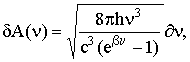 |
A1 |
Where b = h/(kT); k=Boltzmann’s constant;
T=Kelvin temperature.
A pulse
having Planck’s spectrum F(n )=d A(n ) will
have an amplitude f(t) as a function of time t
given by
 |
A2 |
One
considers only the real part of A2 one obtains:
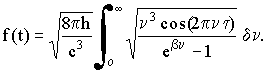 |
A3 |
Only the
real part contains energy. The imaginary part contains the phase
relationship.
It can be shown that the integral
of A3 is approximately equal to:
 |
A4 |
Where J=-24p h/(c3t4) and
P=[8p5h/(c3b4)][csch2(2p2t/b )][2+3csch2(2p2t/p )];
The limit
f(t)for t=0 is:
 |
A5 |
The
inverse Fourier transform A4 can be written in a normalized form
having an amplitude of one at the origin, by taking the ratio R
such that:
 |
A6 |
In order to determine the properties of this
function, let us use the variables :
 and and  |
A7 |
The
normalized
Fourier
transform
R
becomes:
 |
A8 |
Equation
A8)is an analytical function having an excellent approximation. It
gives a description of the phenomenon (25). A very accurate result (which is quite similar) can be
obtained using the numerical Fourier transform. The Planck
function is plotted as curve A in figure 1 and its numerical
inverse Fourier transform is plotted in amplitude as curve B and
in energy as curve C. From this numerical inverse Fourier
transform, one finds that the pulse width (Dt)
at half height (in energy) having the Planck spectra is:
 |
A9 |
where C1=2.183 x 10⁻¹²
The most
probable frequency n max
emitted in Planck’s spectrum is:
 |
A10 |
where C2=5.88 ´ 1010 s-1K-1
The time
Dt described in A9 is characteristic of
the duration of the wave packet emitted by the blackbody at a
given temperature T and therefore, it is mainly influenced mainly
by the most probable frequency component nmax emitted. Consequently, the effective pulse duration of
the most important frequency component nmax is considered to be the effective pulse duration
calculated above for nmax. That pulse duration is inversely proportional to the
temperature of the emitting surface as seen in A10.
We also
wish to show that, within a spectrum at a given temperature,
Planck’s quantum postulate leads to different values of pulse
duration depending on the wavelength considered. According to
Planck, the blackbody spectrum is composed of a finite number of
frequencies (26) resulting from
standing waves emitted from a cavity. These frequencies are given
by the expression:
 |
A11 |
where a=
length of the cavity, and n = 1, 2, 3, 4, . . .
As a
consequence of the finite number of frequencies, Planck’s spectrum
must be represented as a sum of discrete frequencies. All these
frequency components must be coherent, and the signal must be
non-interrupted during the full interval of time of emission,
since it is necessary to reproduce exactly the Planck’s spectrum.
Let us
consider two independent emitters of electromagnetic radiation at
different frequencies n1 and n2. These emitters produce a continuous wave with the same
amplitude (therefore the same energy) during the same period of
time. Each electromagnetic wave crosses atoms of gases, each
having a resonant absorption line located at the same frequency as
that of the wave. The absorption mechanism is such that the
electromagnetic radiation is absorbed when an atom interacts. This
is the consequence of the quantization of atomic states. The time
of interaction of the wave Dt is the
one required to accumulate enough energy to excite the atom. After
all the energy of the beam is absorbed by the gas, one finds that
the product of the time Dt during
which the wave is interrupted (which is the time of interaction)
times the number of atoms excited per second is equal to the unit
time.
 |
A12 |
Where Dt1= time
of interruption of the wave due to absorption by atoms N1; Dt2= time on interruption of the wave due to absorption by
atoms N2; N1= number of atoms of gas N1; N2 = number of atoms
of gas N2.
From the law of
energy conservation:
 |
A13 |
Combining
A12 with A13
 |
A14 |
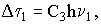
Where C3 = (Dt2)/(hn2) is a constant for a given experimental condition.
Equation
A14 shows that within a given spectrum of blackbody radiation, the
effective wave duration Dt is
proportional to its frequency n .
There
remains to combine A9 and A14. Let us examine A14. For n =nmax we find
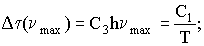 |
A15 |
Therefore,
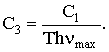 |
A16 |
Equation
A10 in A16 gives,
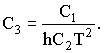 |
A17 |
Substituting in A14 yields,
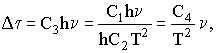 |
A18 |
Where C4= C1/C2= 3.71 ´ 10-23 s2K2.
One must
finally recall that these conclusions depend directly on the fact
that the spectrum is made of discrete values following Planck’s
quantum postulate described in A11. Consequently, A18 gives the
relation between the time of coherence Dt
at any frequency n in the case of
blackbody radiation.
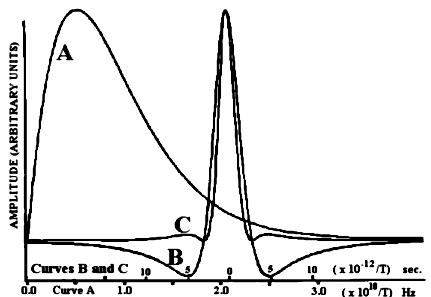
Figure 1
Curve
A is the amplitude of the blackbody radiation (Planck function)
as a function of frequency n at
temperature T. Curve B shows the amplitude of the inverse
Fourier transform of A as a function of time t. The scale can be
ajusted at any temperature T. Curve C is the square of B. It
gives the energy at any temperature T as a function of time t.
<><><><><><><><><><><><>
Appendix B:
Relevant Cross Section of Hydrogen.
Let us
calculate the cross section s, for
which the incident wave gives its energy to the atom through
polarization and deduced from the mechanism of transmission of
radiation through gases. This cross section is obtained using the
same considerations as for calculating the dielectric constant of
gases.
Let us
consider hydrogen at an extremely low pressure, a condition
prevailing in outer space. If the radiation undergoes only one
collision per week, it is then completely inappropriate to
consider that the velocity of propagation is simply slightly
smaller than c. In that case, it is evident that the index of
refraction is exactly one during six of the seven days and also 23
of the 24 hours of the exceptional day, and so on during the last
minute, second, and its fraction, until one has to arrive at a non
zero interval of time of interaction between the absorption of
radiation and its reemission.
Between
absorption and reemission, the atoms must then momentarily retain
the absorbed energy and momentum. This mechanism leads to
identical times of propagation whether one considers a change of
index of refraction or individual collisions with delayed energy
reemission. Therefore, there is certainly a delay during the
interaction of the photon with the particle. The latter model,
however, is closer to the atomic nature of matter.
It is
known that the index of refraction n of a transparent
medium is the ratio:
 |
B1 |
where vp
= phase velocity of the radiation in the medium.
It is
also known that the velocity of propagation of energy corresponds
to the group velocity vg. In order to be able
to point out the parameters involved in the evaluation of the
cross section s, let us calculate the
group velocity of light in atomic hydrogen using a method
analogous to the one suggested by Feynmann, Leighton, and Sands (23) to study the dielectric constants of gases that
similarly depend on their polarizability.
It is
well known (23) that the index
of refraction for visible light in hydrogen is:
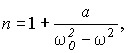 |
B2 |
where a
= Ne2/(2eomo); wo= angular velocity of a
resonant electron in hydrogen; w =
angular velocity of the incoming radiation; N = number of atoms
per m3.
Since we
know that the energy is transmitted with a velocity equal to the
group velocity vg, it can be demonstrated using
Feynmann method (23) that
 |
B3 |
Full
details have been given elsewhere 23, 25. From quantum mechanical considerations, there is a
relatively minor correction for the polarizability of hydrogen. It
is known that the coefficient 8 in equation B3 must be replaced by
9, giving:
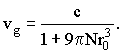 |
B4 |
Since B4
is valid only in the energy range wo2 >>w 2, let us verify that this approximation is valid in the
energy range given by the usual blackbody radiation spectrum. Let
us compare the index of refraction n of hydrogen predicted
by B4 with experimental data. At atmospheric pressure, we have
found that B4 gives n = 1.00012. The best experimental
value available is that of the H2
molecule, which is predicted to be about the same. In H2 the measured value is n = 1.00013 for visible
light. This is in excellent agreement with equation B4 which is
thus valid for visible and longer wavelengths.
Equation
B4 has been derived here in order to point out that the quantity 9pro3 added to the denominator has the dimension of a volume.
The total volume is directly proportional to the density of atoms
N located on the radiation path. Consequently, radiation behaves
as if each atom adds an extra virtual volume 9pro3 in the light path.
Therefore
equation B4 shows that the time taken for the electromagnetic
radiation to cross a given distance inside a volume containing N
atoms per cubic meter is equal to the time the light would take in
a vacuum to cross the same volume, to which one must add a virtual
volume VV per particle, which is
equal to:
 |
B5 |
This last
result may be conveniently used to support the hypothesis of
absorption and reemission of radiation (as suggested previously)
since the total virtual volume is proportional to the number of
atoms times the virtual volume per atom VV.Since the probability of finding an electron around a
hydrogen atom in the ground state being spherically symmetrical,
let us calculate the cross section sH for hydrogen having a virtual radius rv and
virtual volume VV. We have:
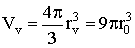 |
B6 |
and since
 |
B7 |
equations
B6 and B7 give the cross section sH for hydrogen. Consequently,
 |
B8 |
Equation
B4, which leads to B8, shows that within the approximation used to
obtain B4, sH is wavelength independent. This result is not unique
and has been obtained previously (23) in comparable cases for the dielectric constant of
gases. The predicted result, leading to a constant virtual volume
different from zero when w® 0, is
verified experimentally, since the dielectric constants of gases
are larger than of the vacuum (k=1) even if w becomes vanishingly small.
It is
known that the virtual volume is a function of the polarizability
of the atom. One must not be surprised that the cross section s found here remains finite and s¹0 when n®0.
This cross section is of course completely different from the
scattering cross section used in Thomson scattering. It is related
to the index of refraction for which light propagates in straight
line.
Finally,
for the case of a single free electron, the Thomson scattering
cross section may be considered. It is s
=6.65 x 10⁻²⁹ m2, which is about
nine orders of magnitude smaller than that obtained above for the
hydrogen atom and consequently has no practical interest in this
paper.
New Verification and Supporting Evidence.
Several
new papers with experimental proofs supporting the energy loss
of photons due to the traces of hydrogen in space have been
published more recently. For example, a paper entitled: The
Cosmological Constant and the Red Shift of Quasars (27), explains the consequences of a redshift due the
traces of hydrogen in outer space. Furthermore, another paper
entitled: Non-Doppler Redshift of Some Galactic Object" (28) shows that
the difference of redshift between the components of binary
stars systems can only be explained by the difference of
temperature responsible for the change of coherence of blackbody
radiation as explained above. Furthermore, that same paper shows
that the K effect and other astronomical observations require
that photons are redshifted when moving through traces of
hydrogen gas. Also, the solar atmosphere shows a redshift which
varies as a function of the radial distance as seen from he
Earth. That is explained in the paper(29): "Redshift of Spectral Lines in the Sun's
Chromosphere". That redshift remained unexplainable until
it was realized that the hydrogen in the solar atmosphere has
exactly the correct concentration to explain its redshift (as
explained above). Finally, various other descriptions of that
phenomena have been presented (30).
<><><><><><><><><><><><>
==================== =====================
Back cover of the Book (Printed in June 1981)
A New Non-Doppler Redshift.
There are
now 109 QSO’s for which the redshift value Z has been determined
independently both in emission as well as in absorption. In
all 109 cases, the emission redshift is different from the
absorption shift (for one and the same object).
This is clearly
contrary to the Doppler hypothesis.
Many more
observations lead to results, which are incompatible with the
interpretation that redshifts are due to relative velocity.
This book
shows that taking into account the change in momentum of the
electrons of gas molecules scattering light in space leads to
bremsstrahlung and a slightly inelastic forward scattering.
This is
the first Non-Doppler redshift theory, which when combined with
the usual Doppler phenomenon, would explain consistently all
spectral shifts observed in astronomy.
------------------------------------
------------------------------------
References.
1 I. F. Boekelheide, Ph. D. Thesis,
State University of Iowa, June 1952.
2 P. E. Cavanaugh, Phys. Rev. 87,
1131, 1952.
3 J. M. Jauch and
F. Rohrlich, The Theory of Photons and Electrons, Addison-Wesley,
Cambridge, Mass, 1955.
4 L. I. Schiff, Quantum Mechanics,
2nd ed. p.417. McGraw-Hill, 1955.
5 G. Field, H. Arp, and J. N. Bahcall,
The Redshift Controversy, W. A. Benjamin, Inc., Reading,
Mass, 1973.
6 A. Hewitt and G. Burbidge,
Astrophys. J., Suppl. Ser. 43, 57, 1980.
7 J. Halm, Astron. Nachr. 173,
273, 1907.
8 W. S. Adams, Ap. J. 31, 30,
1910.
9 E. Finley-Freundlich, Phil. Mag. 7,
303, 1954.
10 L. A. Higgs, Mon. Not. R. Astron. Soc. 121,
167, 1960.
11 F. Cavallini, G. Ceppatelli, and A.
Righini, Astron. Astrophys. 143, 116, 1985.
12 E. Schatzman and C. Magnan, Astron.
Astrophys. 38, 373, 1975.
13 L. V. Kuhi, J. C. Peker, and J. P.
Vigier, Astron. Astrophys. 32, 111, 1974.
14 C. W. Allen, Astrophysical
Quantities, 3rd ed. The
Atlone Press, p.253, 1973.
15 G. Reber, Endless, Boundless, Stable
Universe, University of Tasmania, Australia, Occasional
paper No: 9, 1977.
16 D. Walsh, R. F. Carswell, and R. J.
Weymann, Sky & Telescope 58, 427, 1979.
17 J. B. Oke, Sky & Telescope, 58,
508, 1979.
18 W. L. Sargent, P. J. Young, A.
Boksenberg, and D. Tytler, Abstract of Astrophysics. J., Suppl.
Ser. 42, 41, 1980.
19 N. Z. Scoville and D. B. Sanders, Physics
Today 33, 17, 1980.
20 H. Arp and J. W. Sulentic, Astrophys. J.
229, 496, 1979.
21 H. Arp, Quasars, Redshifts and
Controversies, Interstellar Media, Berkeley, Calif.,
1987.
22 M. M. Waldrop, Science 238, 894,
1987.
23 R. P. Feynmann, R. B. Leighton, and M.
Sands, Lectures on Physics, Addison-Wesley, Reading,
Mass., 1964.
24 M. Françon and S. Slansky, Cohérence
en optique, Centre national de la recherche scientifique,
Paris, 1965.
25 P. Marmet, "A New Non-Doppler
Redshift", (book), Département de Physique, Université
Laval, Québec, Canada, 1981.
26 R. Eisberg and R. Resnik, Quantum
Physics of Atoms, Molecules, Solids, Nuclei and
Particles, Wiley, 1974.
27 P. Marmet, The Cosmological Constant and
the Redshift of Quasars" IEEE Transactions on Plasma
Science, Vol. 20 No. 6, p. 958-964, 1992.
28 P. Marmet, Non-Doppler Redshift of Some
Galactic Objects. IEEE Transactions on Plasma
Science,Vol. 18, No. 1, p. 56-60, 1990.
29 P. Marmet, Redshift of Spectral
Lines in the Sun's Chromosphere, IEEE Transactions
on Plasma Science, Vol. 17. No. 2, p. 238-244, 1989.
30 P. Marmet, Big Bang Cosmology Meets an
Astronomical Death. 21st Century,
Science and Technology, Vol 3, No: 2, 1990.
<><><><><><><><><><><><>
Return to - Top of Page
Return to - List of Papers on the Web
About the Author
<><><><><><><><><><><><>