 Einstein's Theory of Relativity
versus
Classical Mechanics
by Paul Marmet
Chapter Six
Geometrical Illustration of the Advance
of the Perihelion of Mercury.
6.1 - Conditions
Controlling the Geometrical Shape of an Orbit.
The
advance of the perihelion of Mercury given in equation 5.46 was
calculated using perturbations of individual parameters. This
advance can also be illustrated using geometrical considerations.
Newton stated the universal law of gravitation which predicts an
exact quadratic gravitational field around a mass. Newton has
shown that in the gravitational field around a central body, all
masses move in elliptical orbits independently of the mass of the
orbiting body. According to classical mechanics, the necessary
condition to get an exact elliptical orbit is for the mass to move
in a gravitational field whose intensity decreases exactly as the
inverse of the square of the distance R from the central mass:
 |
6.1 |
There are
several measurements showing that this quadratic decrease of the
gravitational field is followed quite accurately in
nature. At a distance RM(o.s.) from M(S)(o.s.),
the field is given by:
 |
6.2 |
where
G(o.s.) is the number of outer space units of the
gravitational constant and M(S)(o.s.) is the number of
outer space units of the solar mass. Equation 6.2 implies that the
Sun generates an exact quadratic gravitational field (in outer
space units) in which Mercury is submerged.
Although
the inverse quadratic law is generally accepted, a very slight
deviation of that law was first suggested by Aseph Hall in 1894 [1]. Since we have seen that
the mass of a body changes when it is moved into a gravitational
potential, we can show that such a slight change of mass leads to
an effect equivalent to the slight change of the quadratic
function suggested by Hall.
Classical
mechanics shows that a massive body travels in an elliptical orbit
when the force F rather than the field between the central mass
and the orbiting mass decreases as the square of the distance. Let
us consider Newton's equation (written in a correct way, contrary
to equation 5.1):
 |
6.3 |
Since the
mass of Mercury changes with its distance from the Sun, it is
incorrect to believe that the force between the Sun and Mercury
still follows an inverse quadratic function of that distance. Even
if the gravitational field around a central mass decreases exactly
as the square of the distance, the total force between Mercury and
the Sun does not decrease at the same rate as the field. The
trajectory of a planet whose mass decreases when it gets deeper in
a gravitational field corresponds exactly to the problem of a non
quadratic force around a central mass. Using classical mechanics
we can calculate the new geometrical shape of the orbit when the
force (not the field) between the Sun and Mercury is non
quadratic.
However,
when we consider the proper parameters of the observer moving to
different distances from the Sun, the gravitational field
(defined as the force divided by the proper mass) calculated from
equation 5.9 is not quadratic for the observer traveling between
different locations from the Sun. Consequently, using the
parameters existing where Mercury interacts with the gravitational
field leads to an apparent non quadratic field (since the proper
mass of Mercury is constant for a Mercury observer).
Using
either the non quadratic force as seen by an outer space observer
that takes into account the change of mass of Mercury or the
apparent non quadratic force given by equation 5.9 (with constant
proper mass) leads to a similar advance of the perihelion of
Mercury. However, these calculations are incomplete because other
fundamental phenomena, like the change of mass as a function of
the velocity of Mercury on its orbit, are not taken into account.
Changes of length and clock rate due to Mercury's velocity and
gravitational potential should also be taken into account.
Since we
have already calculated the total precession in equation 5.46, we
will limit our demonstration here to the change of one parameter
using only the change of mass of Mercury as a function of its
distance from the Sun. We will use only the perturbation of this
parameter and show that it is one of the contributions to the
geometrical precession of the ellipse which can be illustrated in
a classical experiment that can be done in a laboratory using a
simple apparatus.
6.2 - The Change of
Mass of Mercury.
Let us
consider the change of force on Mercury due to its change of
mass as a function of its distance from the Sun. Equation 4.25
shows how the absolute mass of a kilogram decreases when getting
closer to the Sun. Consequently, the total mass of Mercury
decreases by the same ratio. From equations 4.39, 4.40 and 4.41,
the mass of Mercury (in outer space units) follows the
relationship:
 |
6.4 |
Equations
6.4 and 4.25 give:
  |
6.5 |
or:
  |
6.6 |
Using
equation 6.6 in 6.3 gives a force equal to:
  |
6.7 |
which is
equal to:
  |
6.8 |
Let us
define:
 |
6.9 |
Equation
6.8 becomes:
  |
6.10 |
Equation
6.10 shows that the gravitational force is the difference between
a quadratic and a cubic function. It is known that in a quadratic
field, an elliptical orbit with a small eccentricity (first order
expansion) follows the equation r = a(1 + ecosq)
(a is the semi-major axis and e is the eccentricity). This
equation implies two components: a tangential component of
constant radius a and a radial component of amplitude aecosq. Since Kepler's third law predicts the
same period (first order) for orbits having the same average
radius with or without eccentricity, both the tangential and the
radial components lead to the same period in a quadratic field.
However,
in the case of a non quadratic field (cubic term in equation
6.10), the period of oscillation of the radial component becomes
longer than the period of the circular tangential component. Of
course, a circular component does not 'feel' the field gradient.
Because the cubic radial component of oscillation has a longer
period, there is a continual shift of phase between the periods of
the tangential and of the radial components.
Consequently, the cubic term in equation 6.10 which does not
follow Kepler's quadratic gradient of force, is responsible for
the precession of the ellipse because the radial component, having
a longer period, becomes out of phase with the circular component.
It is the difference of period between the tangential and the
radial components of motion that produces the precession of the
ellipse. We also notice that it is the radial component of
oscillation which is most affected by the change of parameters
resulting from mass-energy conservation.
Let us
examine the bracket on the right hand side of equation 6.10. Using
a series expansion, we can show that it is mathematically
equivalent to a simple exponential form given by:
 |
6.11 |
in which
the exact value of e is:
 |
6.12 |
A very
good approximation to the first order (with n = 1) gives:
 |
6.13 |
Combining
equations 6.10 and 6.11 gives:
  |
6.14 |
where e is always positive. Equation 6.14 shows
that, because of the decrease of mass due to mass-energy
conservation, the force F between Mercury and the
Sun no longer decreases exactly as the square of the distance. The
change of mass of Mercury as a function of its distance from the
Sun is responsible for the change of power of RM from 2 to 2+e. Therefore
even if the gravitational field affecting Mercury
decreases exactly as the inverse of the square of the distance as
written in equation 6.2 (as in a perfect Newtonian field), the
gravitational force is not Newtonian as shown in
equation 6.14. Let us reconsider now the trajectory of bodies
submitted to a force decreasing with a function which is slightly
different from 1/R2.
6.3 - Orbital Shapes
and Gravitational Force Gradients.
We have
calculated in equation 6.10 the force on Mercury as a function
of the distance RM. The corresponding gravitational
potential VM(o.s.) is obtained by the integral of
equation 6.10. This gives:
  |
6.15 |
The orbit
followed by a mass submitted to the potential described by
equation 6.15 has already been calculated [2, 3]. Using
temporarily Goldstein's notation [2], the solution of
equation 6.15 is a precessing ellipse with a velocity of
precession equal to:
 |
6.16 |
where W(sec) is in radians per second of time.
Transforming Goldstein's notation into ours, we have m = M(M)o.s.(o.s.)
and h = (G(o.s.)M(S)(o.s.)M(M)o.s.(o.s.)k1)/2.
t is the period of translation of
Mercury around the Sun. The angular momentum l in equation
6.16 is:
  |
6.17 |
where dq/dt is the angular velocity. Therefore,
from equation 6.9 and the definitions above, we have:
 |
6.18 |
From
equations 6.16, 6.17 and 6.18, we have:
 |
6.19 |
Let us
transform the precession W(sec) given
in radians per second for radians per circumference W(circ). We obtain:
 |
6.20 |
By
definition, the period t equals:
 |
6.21 |
Equation
6.21 in 6.20 gives:
 |
6.22 |
Newton's
law shows that the force of gravity FG is equal to the centrifugal force FC in a circular orbit (the eccentricity has not yet been
taken into account). We have the fundamental equations:
  |
6.23 |
Equation
6.23 gives:
 |
6.24 |
Equations
6.24 and 6.22 give:
 |
6.25 |
Equation
6.25 gives the velocity of precession of an ellipse for the case
of a perfect quadratic field in which the orbiting mass changes
with its position in the gravitational potential, due to
mass-energy conservation.
6.4 - Identity of
Mathematical Forms.
We find
that the advance of the perihelion of Mercury obtained with the
perturbation method used by Einstein and by us in equation 5.46,
has the same mathematical form as equation 6.25 which clearly
corresponds to the precession of an elliptical orbit. There are
two obvious differences. Since we have not taken into account
the eccentricity of the orbit, the term 1-e2 is naturally missing in equation 6.25 as explained in
section 5.10. Other similar parameters are ignored here since we
do not take into account the perturbations explained in section
6.1. If we take into account these perturbations, other similar
terms will be added and the full precession will be found as
obtained in chapter five. The aim of the present demonstration
is only to illustrate the reality of the classical precession of
the ellipse in the case of a non quadratic force.
6.5 - Illustration of
Trajectories in Potential Wells.
When
the force on a planet moving around the Sun decreases as the
square of its distance from the Sun, it travels on a perfect
ellipse. However, due to mass-energy conservation, the exact
intensity of the force does not decrease as the square of the
distance. As seen in equation 6.14 the force follows the
relationship:
|
6.26 |
The
trajectory of a particle submitted to equation 6.26 is an ellipse
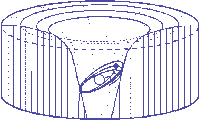
as illustrated on figures 6.1 and 6.2. In figure 6.1, a smooth
conic surface is built (in the Earth gravitational field) in such
a way that the height above the ground increases as the negative
of the inverse of the square of the distance from the central
axis. This corresponds to e = 0 in
equation 6.26. In this case, the potential energy of a ball
sliding (without friction) on the surface increases according to
the inverse quadratic function from the center. If we throw a ball
on the surface, we can get a circular orbit at various distances
from the center. Using a different initial angular momentum, one
can observe a stationary elliptical orbit as drawn
on figure 6.1.

Figure 6.1
Demonstration of a mass moving in an elliptical
orbit in a quadratic potential well changing as 1/r2.
However, if the shape of the cone is different (see figure 6.2)
so that the potential increases more rapidly than the inverse
square of the distance (corresponding to equation 6.26 with e ¹ 0), after
throwing a ball, we see that the axis of the elliptical orbit
precesses just as observed for Mercury in its orbit around the
Sun. The cause of that classical precession on that apparatus is
(in part) the same as the cause of the precession of 43 arcsec
per century of Mercury. Of course, this demonstration assumes
that the friction and the rotation of the ball are negligible.

Figure 6.2
Demonstration of the precessing orbit of a mass
moving in a potential well changing as 1/r(2+e).
This
shows that the advance of the perihelion of Mercury is not
caused by space or time distortion. It is simply a beautiful
demonstration of classical mechanics that predicts precessing
orbits giving the shape of a rosette.
6.6 - Validity of the
Classical Model.
We have
found above that there is a perfect mathematical agreement
between the result calculated in equation 5.46 and the result
predicted using Einstein's mathematics. Moreover, those results
are in perfect agreement with the observations of the advance of
the perihelion of Mercury.
In
order to arrive to his equation, Einstein, needed several new
hypotheses called Einstein's relativity principles. Let us
compare the hypotheses used by Einstein with the ones used in
this book to find the Lorentz transformations and the equation
for the advance of the perihelion of Mercury. This comparison is
important if we wish to apply Occam's razor which gives a
preference to the theory that requires the minimum number of
hypotheses. Einstein's theory requires many new hypotheses, for
example:
1) the
reciprocity principle which is not compatible with mass-energy
conservation as showed in section 3.9;
2) the
hypothesis that the acceleration produced by a change of
velocity is undistinguishable from the acceleration due to
gravity (see chapter ten);
3) the
non conservation of mass-energy in general relativity.
Einstein then arrived at the consequences that space and time
can be distorted, contracted and dilated. In fact, Einstein's
model not only requires new physical hypotheses, it also
requires "new logic" which is not compatible with the natural
understanding of nature. Classical logic can no longer be
applied in relativity. In this book, we use the Bohr model of
the atom which is so familiar everywhere in physics. We also
find that using proper values, the physical relationships are
valid in all frames as in Einstein's relativity. At the same
time, a rational explanation is given. No time nor space
distortion is required and the new interpretation is compatible
with classical logic. There is certainly an extremely strong
preference in favor of this new model when we apply Occam's
razor.
Important Note:
After the writing of that
book, a complete detailed description of the advance of the
perihelion of Mercury entitled:
"A Detailed Classical Description of the
Advance of the Perihelion of Mercury".
This new paper appears: At this location
6.7 - References.
[1] A. Hall, A
Suggestion in the Theory of Mercury, Astr. J. 14,
49-51, 1894.
[2] H. Goldstein, Classical
Physics, Addison-Wesley, Reading, Mass., second
Edition, p. 123, 1980.
[3] E. T. Whittaker, A
Treatise on the Analytical Dynamics of Particles and Rigid
Bodies, Cambridge University Press, Fourth Edition,
Chapter 4, 1937. (also Dover, New York, 1944).
6.8 - Symbols and
Variables.
| FM(o.s.) |
number of outer space newtons for the
gravitational force on Mercury |
| G(o.s.) |
number of outer space units for the
gravitational constant |
| kgframe |
mass of the local kilogram in absolute
units |
| M(M)M(o.s.) |
number of outer space kilograms for
Mercury at Mercury location |
| M(M)o.s.(o.s.) |
number of outer space kilograms for
Mercury in outer space |
| m(M)M[o.s.] |
mass of Mercury in outer space units
at Mercury location |
| m(M)o.s.[o.s.] |
mass of Mercury in outer space units
in outer space |
| M(S)(o.s.) |
number of outer space units for the
mass of the Sun |
| RM(o.s.) |
number of outer space units for the
distance of Mercury from the Sun |
| VM(o.s.) |
number of outer space units for the
gravitational potential on Mercury |
<><><><><><><><><><><><>
Chapter5
Contents
Chapter 7
Return To: List of Papers on the Web
Where to get a Hard Copy of this Book