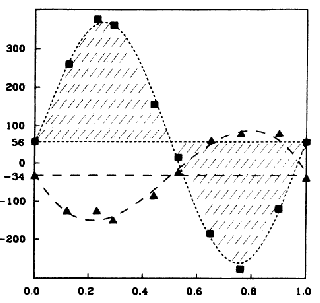
Figure 1
Redshift in Km/s of each component of the Binary HD193567 versus the phase of rotation.
Return to: List of Papers on the WebGo to: Frequently Asked Questions
Abstract
Redshift observations reported in several galactic objects like binary stars, stars clusters, and in the K effect are compared with the predicted non-Doppler redshift caused by the inelastic transmission of photons in gases. It is found that all the observations are compatible with the predicted redshift caused by a gas surrounding the star. The new mechanism explains in a simple way and without the requirement of any of the previous ad hoc hypotheses why so many early-type stars in the solar neighborhood appear to be generally redshifted. This mechanism has important consequences in cosmology.
I. Introduction.
Many
astronomical observations of shifts of spectral lines cannot be
explained
by means of the ordinary Doppler interpretation [1].
As
an
example,
Reboul
[1] reports a
list of 780-refereed
publications on "untrivial redshifts." Relativity
can
explain
some observations, but a large number still remain unexplained.
It
has been known for many years [2],
[3]
that quantum electrodynamics has shown that photon-atom
collisions are
always inelastic. In that case, the exact energy loss
could not
be
calculated because no mathematical solution of the S matrix [2],
[3]
is known. Since the exact amount of energy lost during
photon-atom
collisions was still unknown, a semi-classical solution has been
calculated
[4].
Fundamental
physics teaches that under the passage of electromagnetic
radiation
through gases, the atoms of a gas are polarized. Therefore
some
energy
of polarization is transferred from the electromagnetic wave to
the
atom.
Consequently,
the momentum of the wave is then also transferred from
the
electromagnetic wave to the atom. The direction of that
momentum
is the direction of propagation of the wave. The momentum
transferred
to the atom will then be in the direction of propagation of the
wave.
When a wave is interacting with an atom, the momentum is
transferred to
the electrical charges of that atom and the charges are
therefore
accelerated.
According to electrodynamics, accelerated charges emit radiation
(bremsstrahlung).
The amount of radiation emitted by bremsstrahlung can be
calculated by
Maxwell's equation.
It
has been shown [5] that the
number of photon-atom
collisions is surprisingly large when light is transmitted
through
gases.
It is also an everyday experience [5]
that those collisions
represent a quasi-perfect forward scattering. Calculations
show [4]
that the amount of energy lost per collision depends on the
length of
coherence
of the radiation. In the case of blackbody radiation,
(Planck
spectrum),
the length of coherence is related [4]
to the temperature
of the emitter.
These
calculations have been applied to the case of the redshift on
the
solar limb [5]. It has been
observed continuously
for more than 80 years that an unexplained redshift appears [5]
on the solar limb. On the other hand, the solar disk shows
fairly
constant wavelengths of spectral lines near the center of the
solar
disk.
Since the solar temperature and the amount of hydrogen in the
solar
chromosphere
are well known, one has calculated, according to the new
redshift
theory
[4],
how the redshift should vary across the solar disk. It has
been
found
that the non-Doppler redshift predicted [5]
agrees in
shape and in amplitude with observations and without having to
use any
adjustable parameter.
The
aim of this paper is to consider further examples of unexplained
redshifts
like the ones reported in early-type stars in binary systems, in
stars
clusters, and in the K effect.
II. Case of Binary Stars
The
individual spectrum of each component of many binary stars has
been
observed. A variation of wavelengths of each component of
the
binary
system as a function of time is reported. That
time-dependent
variation
is a Doppler effect due to the velocity of rotation of the two
bodies
around
their center of mass. Typical well-known examples of this
oscillatory
variation of spectral lines due to the radial velocity are shown
in
Fig.
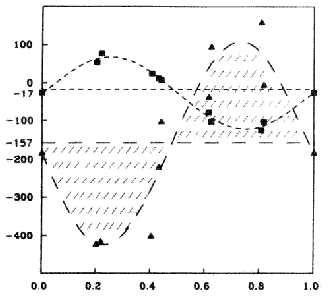
1 and 2. One can see the observed redshift of each star at
different
phases of rotation. The inverted phase observed between
each
spectral
component easily proves the binary-nature of the system.
Many
other
examples are known.
However,
a problem arises because it is observed that the average
radial
velocity (as calculated by the redshift) of the center of mass
of each
component of the system is not the same for each of the two
components.
Celestrial mechanics predicts that when two bodies rotate around
the
center
of mass, the average (velocity of the center of mass) radial
velocity
component
of either star with respect to us must be the same. In
many
cases,
as seen in Table I and Figs. 1 and 2, this is contrary to
observation,
mainly in the case of Wolf-Rayet stars.
|
|
|
|
|
|
|
|
|
|
|
|
|
|
|
|
|
|
|
|
|
|
|
|
|
|
|
|
|
|
|
|
|
|
|
|
|
|
|
|
|
|
|
|
|
|
|
|
|
|
|
|
|
|
|
|
|
|
|
|
III. Discussion of Binary Stars
A
Doppler interpretation of this redshift leads to the suggestion
that
while the two stars rotate around each other, the hot component
moves
away
from us with respect to the other one. This interpretation
is on
course impossible. It has also been recognized that
relativity
does
not solve the problem.
However,
it has been demonstrated [4]
that the electromagnetic
interaction
on atoms is inelastic and leads to a non-Doppler redshift.
In
this
case, the energy loss is a function of the length of coherence
of the
transmitted
radiation. Since the length of coherence of the radiation
is
inversely
proportional to the temperature of the emitter [4,
eq.
(12)],
one can calculate that hotter stars emit radiation having a
shorter
length
of coherence than cooler ones. This leads to a larger
redshift
when
the radiation originates from a hotter surface. It is
quite
remarkable
to notice from observations that all binary stars showing a
measurable
difference of redshift between the two components are Wolf-Rayet
binaries
or hot stars. This agrees with the predicted [4]
non-Doppler redshift and confirms that the difference of
redshift
between
the components is not a Doppler effect.
Several
scientists seem to feel obliged to interpret the larger
redshift
of one component of one binary system in term of a velocity
effect.
In that case, they claim that the redshift is caused by the mass
falling
from one star to the other. Since the system is rotating,
such a
hypothesis should also produce as well a blue shift when the
system is
aligned the other way around, and the mass is flowing in the
opposite
direction.
Although one expects that blue shifts should be observed in
about half
the observations, no blue shift has ever been reported, and
strange
mechanisms
have to be imagined to explain their behavior.
Furthermore, why
do
we observe mass motion between binary components only in the
case of
very
hot components? The non-Doppler interpretation [4]
only, can predict that in binaries, only a redshift (and no blue
shift)
exists, and that redshift appears only on the hottest star
component.
IV. The K-Effect
Radial
velocities of 2148 stars close to the sun have been analyzed by
Cambell and Moore [15] and Smart
and Green [16].
In 1953, Torondjadze [17] observed
that the dynamic
properties of the later-type stars are different from those of
the
young
stars. The early type stars have their own large positive
recessing
velocity (K-term) as if they originated from a location near the
Sun
and
formed an expanding association arranged along the spiral arm of
the
Milky
Way. This K-term has been confirmed by Smart [18].
In
an
analysis
by
Trumpler
and
Weaver
[19],
they write:
"There can be no doubts, at present, that systematic
errors in
the
wavelength of spectral lines used in the measurement of the
radial
velocities
or that any currents in the stellar atmosphere (as suggested
by some
early
investigators) are completely insufficient to explain the
large K-term
of the B stars." Results are summarized by Allen [20].
These tables give, for each type of star, the "apparent
velocity
of recession (redshift) in all directions" for stars
in the
solar
neighborhood. These velocities (Table II) are plotted on
Fig.
3.
Temperatures also come from Allen [20].
|
|
|
|
|
|
|
|
|
|
|
|
|
|
|
|
|
|
|
|
|
|
|
|
|
|
|
|
The apparent recession of early-type stars in the solar neighborhood appears suspicious if one gives them a Doppler interpretation, as we study in the next section. However, the temperature dependence (Fig. 3) shows the compatibility with the non-Doppler interpretation [4]. Other effects like the variation of the amount of gas around various stars and other phenomena will be discussed in more detail in a later paper.
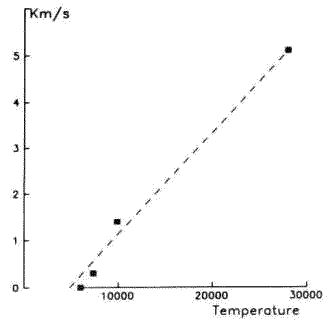
Figure 3
Apparent velocity of recession in all
directions
for stars in the solar
neighborhood as a function of the
temperature of
the star.
V. The Gould Belt
Some
authors have provided evidence that those hot stars are located
on an
apparently
expanding ring of gas around the Sun [21]-[24]
which
forms the Gould belt. The Gould belt is an apparently
expanding
ring
of stars making an angle of 17o
with
the
galactic plane. It was also verified that the observed
redshift
of
these stars is much too large to be compatible with the
calculated
relativistic
redshift.
Olano
[25] and Lindblad et
al. [26]
have considered a model of a local gas ring related to the Gould
belt.
Lindblad [27] believes that not
only stars, but also
the local gas, form an elliptical expanding ring roughly
coincident
with
the Gould belt. He considers that the expanding ring of
gas of
the
Gould belt is decelerated by the dragging action of the
surrounding
galactic
gas. It is assumed that the gaseous galactic disk has a
constant
thickness and density of gas. The gas of the Gould belt is
arbitrarily
assumed to have the shape of an expanding "tube"
of gas
and
that the Sun is located [27] "in
the vacuum enclosed
by the tube." Surprisingly, the height of the
tube is
considered
to remain constant during the expansion (two-dimensional
expansion) and
is always centered and perpendicular to the galactic
plane. It is
assumed that this gas motion acts as a "snowplow model"
and
sweeps the galactic gas in its path.
One
must remember that this model has been obtained by fitting by
computer
the many parameters (initial conditions) of the function
describing the
oval ring, which is looked for, as it was observed
experimentally.
Therefore it is no surprise to find that these stellar
associations (I
Ori, II Per, I Lac) could be fitted on one ring. It is
therefore
less surprising to find that in the Olano [25]
model,
the center of the expansion is in a Per at almost 200 pc from
the Sun,
whereas the center of the expanding system measured and plotted
by
others
[28],
[29]
is very much closer (@50 pc)
to the
Sun.
Consequently, as stated by Stothers and Frogel [29]:
"Unfortunately, the location of the Sun with respect to
the
neutral
hydrogen in the Gould belt seems to be virtually
indeterminate."
The
Olano model [25] brings also
serious difficulties
in the amount of energy needed to produce such a huge expansion
involving
all the Gould-belt mass. The energy required to produce
the
initial
expansion is calculated to be almost 1052
ergs. This is another order of magnitude larger that the energy
of the
most energetic (Type I) supernova [20].
Another
serious
difficulty is that the Olano model requires that the expanding
gas would move along a two-dimensional (and not specifically as
one
would
expect) hollow cylinder having a height of 200 pc. Since
an
expansion
implies a beginning, it implies some sort of explosion.
How can
an
explosion expand as a ring and not as a sphere? Our solar system
is
inside
this ring and we are located near the center where started an
explosion
more powerful that Class I supernova, which apparently left no
trace
behind.
The Olano model does not take into account the inclination of
the Gould
belt with the galactic plane, which has been observed to be
about 17o,
as mentioned by Gould [30].
Tsioumis
and Fricke [31] and Olano
[25], while trying
to fit data with the theoretical model, state that observation:
"could
be
interpreted
as
if
there
were
more
than
one
expanding
subsystem. "
Also,
Olano [25] reports: ".
. . the existence
of two systems of different ages, one young and the other
old, could
explain
this difference." It seems then, that another
expansion;
more or less similar to the last one took place
previously. One
might
then also wonder why the "snowplow" effect did not seem to work
the
first
time, since the second more recent "snowplow"
could find
so much gas left behind. How can so much interstellar gas
be
produced
between the two expansions?
Consequences of this Ring-Expanding Model.
The
reality of the expansion of the Gould belt suffers from at least
four
serious difficulties:
1)
There is no way to explain that an explosion (of neutral gas)
could
expand only in two dimensions as a ring, instead of a sphere.
2)
The energy of the explosion mentioned above has been calculated
to
be
larger that the one due to Class I supernova (1052
ergs) which is an extremely rare event. No trace of such
an
explosion
is found in the solar system neighborhood, where this explosion
took
place.
3)
Although the expanding ring of gas is claimed to react with the
galactic
gas, it does not expand in the same plane. There is an
angle of 17o
between the planes, which has been neglected.
4)
In order to make the observations compatible with the expanding
system,
it is necessary to consider at least two expansions.
Therefore it
is natural to believe that the stars coming from the older
expansion
are
now older and that they should also expand and show a K effect
as
later-type
stars. This is contrary to observations, since the K
effect is
observed
only in the early-type stars (see Fig. 3).
VI. Redshift of Hot Stars in the Orion Nebula
It
has been known for many years [32]-[34]
that O and
B stars in the Orion Nebula show a pronounced redshift relative
to the
lines in the spectrum in the nebula itself.
Findlay-Freundlich [10]
states: "The B stars in the Orion Nebula group show a
systematic
redshift relative to the lines of the nebula, amounting to
at least +
10
Km/s." This can be interpreted as if these stars
were receding
with respect to the Nebula.
Several
hypotheses have been suggested, but the Doppler interpretation
leads to the belief that the stars illuminating the gas are
moving away
with respect to the Orion Nebula. For example, Pankonin et
al. [35] suggested a model
where the ultraviolet
radiation emitted from the star q1Ori
C, located on the boundary and on our side of an assumed neutral
gas,
would
create a "cup-shaped" cavity of ionized gas.
This "cup-shaped"
plasma
would
apparently
be
directed
in
such
a
way
as
to act as a
(parabolic)
reflector with specular properties, reflecting the ions in our
direction.
Therefore the star located at a position near the focus of the
reflector
would have its ions reflected (by the inside of the cup) toward
us in
the
solar system. Then the reflected gas would have a velocity
toward
us, and this would explain how the stars in Orion run away from
us with
respect to the nebula.
The
description of the reflection of the ions inside the cup cavity
is
like the one used to describe the reflection of light on a
parabolic
mirror.
That author does not explain how the ions entering the boundary
of a
plasma,
receive a specular reflection as on a mirror, and produce a
collimated
beam of gas. He does not explain how a plasma can produce
specular
reflection. It seems that the ions should diffuse in all
directions
through the cup-shaped plasma, or even be trapped into the
plasma.
On the other hand, one can calculate that the redshift observed
in the
O and B stars in the Orion Nebula is clearly compatible with the
redshift
produced by the atmosphere of such stars. We believe that
the
redshift
of these O and B stars is caused by this non-Doppler redshift [4].
VII. Redshift of Hot Stars with Respect to
Clusters
More
recently, Olano and Pöppel [25], [36] also recognized that
the
velocity of early-type stars is larger than that of the
surrounding
gas.
It is even larger than the velocity of the surrounding
stars. The
receding velocity of O stars relative to the average star
velocity in
the
same cluster was first observed by Trumpler [37].
Similar
results
were
also
presented
by
Findlay
Freundlich
[10].
Table
III
provides
a
list of some star clusters, and the last column
indicates
the average redshift of the O stars with respect to the cluster
after
correcting
for the redshift of comparison stars.
|
|
|
|
|
|
|
|
|
|
|
|
|
|
|
|
|
|
Trumpler [37] states: "It is rather striking that this (redshift) always comes out positive . . . " He wanted to use this redshift to determine the mass of O stars, but it was discovered later that most of this redshift could not have a relativistic origin. The general redshift of "run-away stars" observed in [38] can only be explained by the non-Doppler interpretation [4], since the redshift increases as a function of the temperature of the star.
VIII. Conclusion
We
saw
that
the
Doppler
interpretation
of
the
redshifts
of
the
hot
stars
belonging to binaries, to star clusters surrounding a nebula, or
to the
hot stars of a cluster, require many ad hoc
hypotheses
in
order to explain only partially some observations. Even
with all
these hypotheses, we have seen that many observations disagree
with the
predictions deduced from the model. Many serious questions
remain
unsolved without our theory. For example, why don't we see
a blue
shift from binary stars, since half the time the mass exchange
between
stars is such that the mass is approaching us? In the case
of the
Gould belt, how can an expansion take place only in two
dimensions?
Why don't we observe the K effect coming from either of the
double
expansions
that would make the Olano model compatible with
observations? Why
is the redshift of early-type stars in clusters always
positive?
How can the solar limb [5] be
redshifted?
Why
do we observe generally, that all hot stars centered on our Sun,
inside
our galaxy, seem to be redshifted, while the Hubble expansion is
not
expected
to be applicable? In that case, observations lead us to
believe
that
we are at the center of the universe, as was believed in ancient
times.
Many questions remain unanswered when we neglect to apply the
non-elastic
interaction of photons with atoms [14].
Current
explanations
rely on a number of ad hoc
hypotheses.
On the other hand, one single electrodynamical theory,
compatible with
quantum electrodynamics, explains all the many observations
described
above,
and furthermore explains the redshift on the solar limb [5].
We
must
conclude
that
the redshift of most of the early-type stars
mentioned
above cannot be a Doppler redshift: It is due to inelastic
photon-atom
interaction [4].
Acknowledgment
The
author acknowledges the collaboration of Dr. R Gosselin for
commenting
on the manuscript, and also E. Cauchon and P. Lavergne for
bibliographical
and drawing works.
References
[1] H. J. Reboul "Untrivial
Redshifts:
A Bibliographical Catalogue" Astron. Astrophys. Suppl., Vol.
45,
pp.
129-144,
1981
[2] J. M. Jauch and F. Rohlich,
The
theory
of
Photons
and
Electrons. Cambridge, MA:Addison-Wesley,
1955, 553 pp.
[3] H. A. Bethe and E. E.
Salpeter,
Quantum
Mechanics of One and Two electron Atoms. New York:
Springer-Verlag,
1957, 368 pp.
[4] P. Marmet, "A
New Non-Doppler Redshift"
Phys. Essays,
Vol.
1, pp, 24-32, 1988. Also Book "A New Non-Doppler
Redshift"
Pub.
Physics
Depart
Department,
Laval
University,
Québec,
Canada.
1979.
[5] P. Marmet, "Redshift
of Spectral Lines in the Sun's Chromosphere" IEEE
Trans.
Plasma
Sci. Vol. 17, pp. 238-244, Apr. 1989.
[6] O. C. Wilson, "Physical
Characteristic
of the Wolf-Rayet Stars" Astrophys. J. Vol., 91,
pp.
394-407,
1940.
[7] O. C. Wilson, "The
Wolf-Rayet
Spectroscopic
Binary HD 190918, Astrophys. J. Vol., 109, pp.
76-80,
1949.
[8] V. S. Niemela, "Observation
of
Wolf-Rayet Binaries, "Proc. IAU Symp., 1980, pp
177-180.
[9] L. V. Kuhi, J. C. Pecker,
and J.
C. Perker, "Anomalous Redshifts in Binary Stars, "Astron.
Astrophys.,
Vol. 32, pp 111-114, 1974.
[10] E. Findlay-Freundlich,
"Red
shift
in the Spectra of Celestial Bodies, "Phil. Mag.
Vol. 7,
pp
303-319, 1954.
[11] W. A. Hiltner, "The
Wolf-Rayet
Spectroscopic Binary BD+36o3991, "Astrophys. J.
Vol. 113,
pp. 317-319, 1951.
[12] K. S. Ganesh and M. K. V.
Bappu,
"The Wolf-Rayet Binary HD 68273, "Kodaikanal Obs. Bull. Ser.
A,
Vol.
183,
1967.
[13] K. S. Ganesh and M. K. V.
Bappu,
"Three Wolf-Rayet Binaries, "Kodaikanal Obs. Bull.
Ser.
A,
Vol. 185, 1968.
[14] A. P. Cawley and J. B.
Hutchings,
"On the 'Anomalous Redshift in Binary Stars, "Astron.
Astrophys.
Vol. 36, pp. 305-306, 1974.
[15] W. W. Cambell and J. H.
Moore,
"Radial Velocities of Stars Brighter than Visual Magnitude 5.51
as
Determined
at Mount Hamilton and Santiago", Publ. Lick Obs. Vol.
16,
pp.
399, 1928.
[16] W. M. Smart and H. E.
Green,
"The Solar Motion and Galactic Rotation from Radial Velocities"
Mon.
Notic.
Roy.
Astron.
Soc. Vol. 96, pp. 471-480, 1936.
[17] A. F. Totondjadze,
"Particularities
in the Movement of Stars with Spectral Classes O and B and the
Expansion
of these Associations of Stars" Bull. Abastumani Obs.
Vol.
15, pp. 115-167, 1953.
[18] W. M. Smart, "Stellar
Kinematics"
319 pp. 1968.
[19] R. J. Trumpler and H. F.
Weaver,
Statistical
Astronomy. Los Angeles and Berkeley: Univ. of
California Press,
p 291, 1953.
[20] C. W. Allen, Astrophysical
Quantities, London: Univ. of London/Athlone, 303 pp.
1973.
[21] V. A. Hughes and D.
Routledge,
"An Expanding Ring of Interstellar Gas with Center Close to the
Sun". Astron.
J. Vol. 77, pp. 210-214, 1972.
[22] K. Grape, Thesis,
Univ.
of Stockholm, Stockholm, Sweden, 1975.
[23] M. L. Franco and W. G. L.
Pöppel,
"Study of the Region 348o£l£12o
, +3o£b£
+17o
in the 21-cm line, Astrophys. Sci., Vol. 53,
pp.91-103,
1978.
[24] F. M. Strauss, W. G. L.
Pöppel,
and E. R. Vieira, "The Structure of Gould's Belt" Astron.
Astrophys.,
Vol. 71, pp. 319-325, 1979.
[25] C. A. Olano, "On a Model
of
Local
Gas Related to Goould's Belt" Astron. Astrophys.,
Vol.
112,
pp. 195-208, 1982.
[26] P. O. Lindblad, K. Grape,
A.
Sandqvist, and Schober, "On the Kinematic of a Local Component
of the
Interstellar
Hydrogen Gas Possibly related to Gould's Belt"
Astron.
Astrophys.,
Vol. 24, pp. 309-312, 1973.
[27] P. O. Lindblad, "21 cm
Observations
in the Region of the Galactic Anti-Center" Bull. Astron.
Inst.
Neth.
Vol. 19. pp. 34-73, 1973.
[28] J. Palouš, "Kinematics of
b and
A Stars" Bull. Astron. Inst. Czech. Vol. 34, pp.
287-291,
1983.
[29] R. Stothers and J. A.
Frogel,
"The Local Complex of O and B Stars, I: Distribution of Stars
and
Interstellar
Dust" Astron. J. Vol. 79, pp 456-471, 1974.
[30] B. A. Gould, "On the
Number and
Distribution of the Bright Fixed Stars" Amer. J. Sci. 3rd
series,
Vol.
III
No:
47,
pp.
325-334,
1874.
[31] A. Tsioumis, and W.
Fricke, "A
Contribution to the Kinematics of the Gould Belt" Astron.
Astrophys.
Vol.
75, pp. 1-6, 1979.
[32] E. F. Freundlich,
"Originalmitteilungen"
Phys.
Z., Vol. 20. pp. 561-570, 1919.
[33] O. Struve and J. Titus,
"Radial
Velocities of the Four Stars of the Trapezium in Orion" Astrophys.
J.
Vol. 99, pp. 84-88, 1944.
[34] O. Struve, "Note on the
Suspected
Gravitational Red Shift of the Orion Stars" Astrophys. J.
Vol.
102,
p.
137,
1945.
[35] V. Pankonin, C. M.
Walmsley,
and M. Harwit, "The Structure of the Orion Nebula: The Ionized
Gas" Astron.
Astrophys. Vol. 75. pp. 34-43, 1979.
Also: C. Goudis, The Orion Complex: A Case of
Interstellar
Matter (Astrophys. and Space Library). Dordrecht,
Holland:Reidel,
1982,
p.
208.
[36] C. A. Olano and W. G. L.
Pöppel,
"Kinematics of Interstellar HI in the Region 320o£l£
341o, +7 £b£
+26,"
Astron. Astrophys., Vol. 94, pp. 151-159, 1981.
[37] R. J. Trumpler,
"Observational
Evidence of a Relativity Redshift in Class O Stars" Proc.
Astron.
Sec.
Pacific, Vol. 47, pp. 249-256, 1935.
[38] A. Blaauw, "The O
association
in the Solar Neighborhood, "Ann. Rev. Astrophys.,
Vol. 2,
pp 213-246, 1964.
<><><><><><><><><><><><>